Top 10 Revenue Intelligence Platforms: The Most Detailed Comparison Guide for 2026

Alex Zlotko
CEO at Forecastio


TL;DR: Best Revenue Intelligence Platforms
The best revenue intelligence platform depends on your main goal. Clari and Forecastio lead on forecasting and pipeline, Gong on conversation intelligence, 6sense on buyer intent, and Gainsight on customer success. Teams that work in Salesforce can also look at Revenue Grid and Weflow.
6sense: Buyer intent intelligence and GTM orchestration
Aviso AI: AI revenue orchestration and agentic workflow execution
BoostUp (Terret): AI forecasting and deal execution
Clari: Enterprise revenue orchestration
Forecastio: Sales forecasting, pipeline intelligence, deal execution, and agentic automation
Gainsight: Customer success, renewal forecasting, and revenue retention
Gong: Conversation intelligence and interaction-driven revenue execution
People.ai: Explainable deal, forecast, and pipeline intelligence
Revenue Grid: Salesforce-native revenue operations and CRM automation
Weflow: Modular Revenue AI for Salesforce
What This Revenue Intelligence Guide Covers
Revenue forecasts, customer conversations, deal activity, and pipeline changes generate large amounts of data. However, having more data does not automatically help companies make better decisions. A revenue intelligence platform turns fragmented sales data into actionable insights that help sales teams understand what is happening, what may happen next, and where action is required.
The revenue intelligence category includes platforms with different strengths. Some focus on sales forecasting and pipeline management, while others specialize in conversation intelligence, deal intelligence, buyer engagement, or customer success. This guide compares the top revenue intelligence platforms in 2026, including Forecastio, Clari, Gong, People.ai, 6sense, Revenue Grid, Aviso AI, Weflow, BoostUp, and Gainsight.
Over the past few years, nearly every major CRM vendor has introduced AI-powered revenue capabilities. HubSpot offers Breeze, while Salesforce combines Revenue Intelligence with Agentforce to help organizations forecast revenue, analyze pipeline health, and automate sales workflows.
Although HubSpot Breeze and Salesforce Revenue Intelligence offer valuable AI-powered capabilities, we excluded them because this guide focuses exclusively on dedicated revenue intelligence platforms, not CRM suites.
The Business Impact of Revenue Intelligence
Organizations generate more customer and revenue data than ever before. However, without the right tools, that information remains scattered across CRM, marketing, customer success, finance, and communication systems. Revenue intelligence helps organizations connect this data and turn it into actionable insights that improve decision-making across the entire revenue lifecycle.
The rapid adoption of artificial intelligence is accelerating this transformation. According to McKinsey's The State of AI report, more than three-quarters of organizations now use AI in at least one business function, while most companies report measurable business value from their AI initiatives. As AI adoption continues to grow, businesses are increasingly investing in AI-powered technologies that automate analysis, identify patterns, and support better revenue decisions.
The market reflects this growing demand. According to Verified Market Research, the revenue intelligence platform market was valued at $2.10 billion in 2025 and is projected to reach $10.80 billion by 2033.
Gartner's introduction of the Magic Quadrant for Revenue Action Orchestration and the merger of Clari and Salesloft, announced in August 2025, also shows that revenue intelligence has become a mature enterprise software category.
Salesforce's State of Sales report found that sales reps spend 60% of their time on non-selling tasks. Revenue intelligence platforms aim to give that time back by capturing activity and surfacing insights automatically.
What Is a Revenue Intelligence Platform?
A revenue intelligence platform is software that helps organizations improve revenue growth by collecting, connecting, and analyzing data across the entire customer lifecycle. Unlike CRM systems that primarily store customer information, revenue intelligence software transforms data into actionable insights that help revenue teams make better decisions, improve sales forecasting, optimize sales pipeline management, increase customer retention, and identify new revenue opportunities.
Modern revenue intelligence platforms combine data from CRM systems, marketing automation platforms, product usage, customer communications, support systems, and financial applications to create a unified view of the revenue process. Many platforms use artificial intelligence, machine learning, and predictive analytics to analyze customer behavior, monitor pipeline health, detect revenue risks, identify expansion opportunities, and deliver AI-powered insights that improve sales performance and revenue operations.
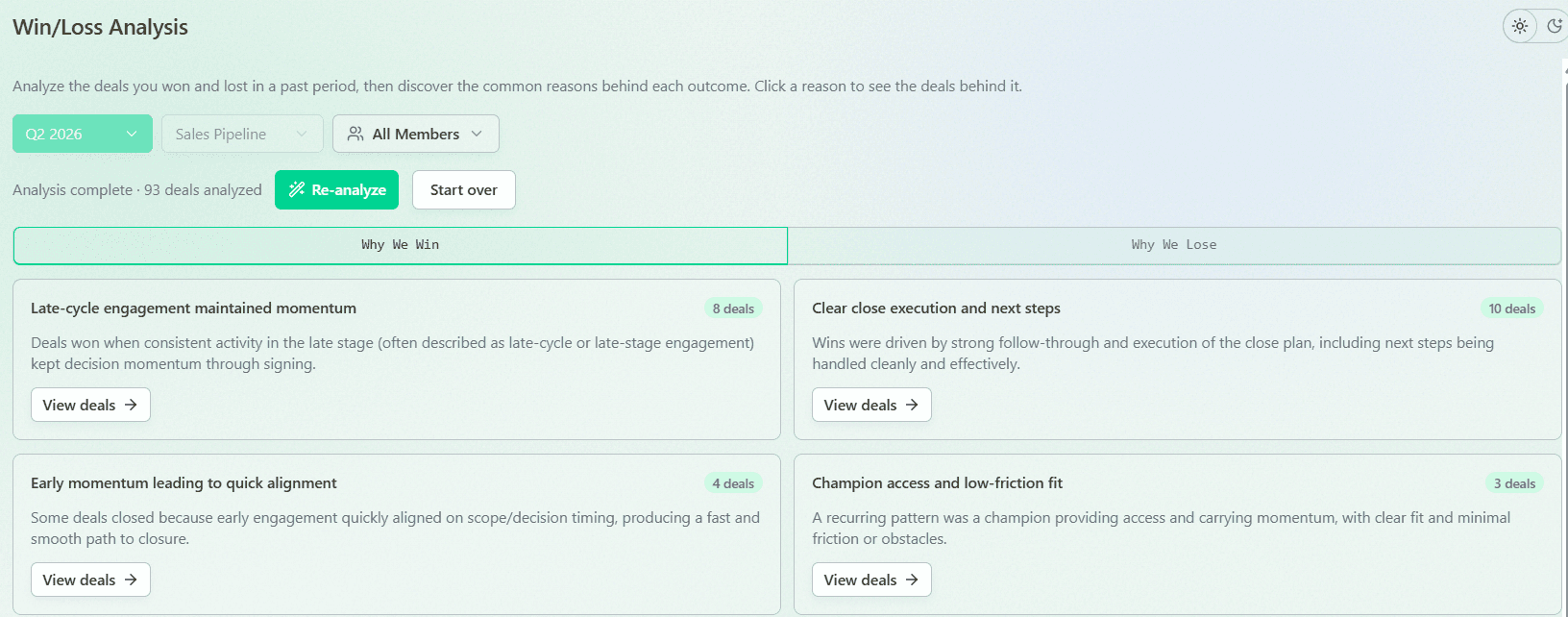
Automated Win/Loss Analysis in Forecastio:
How Revenue Intelligence Platforms Work
Although every revenue intelligence platform has its own approach, most follow the same four-step process.
1. Collect data from multiple sources
The platform automatically gathers information from CRM systems, marketing automation tools, email, calendars, meeting platforms, customer support software, billing systems, product usage, and other business applications. Modern platforms also reduce manual data entry by automatically capturing customer activities and interactions.
2. Connect and enrich the data
The collected information is combined into a unified data model. This creates a single source of truth across Sales, Marketing, Finance, and Customer Success, making it easier to understand customer relationships, pipeline data, and overall business performance.
3. Analyze revenue signals
The platform uses artificial intelligence, machine learning, and predictive analytics to analyze historical and real-time data. Depending on the solution, it may evaluate pipeline health, detect deal risks, monitor buyer engagement, analyze sales conversations, predict churn, identify expansion opportunities, or improve sales forecasting.
4. Deliver actionable insights
Instead of simply displaying dashboards, modern revenue intelligence software provides AI-powered insights and recommendations that help revenue teams prioritize opportunities, improve forecasting accuracy, optimize sales performance, and drive better revenue outcomes. The most advanced platforms also automate workflows or use AI agents for revenue operations to proactively identify risks and recommend actions before problems affect revenue.

Revenue Intelligence vs. CRM, Sales Intelligence, and Conversation Intelligence
Although these terms are often used interchangeably, they serve different purposes. Understanding the differences helps you choose the right technology for your business.
Revenue Intelligence vs. CRM
A CRM stores customer and opportunity data. A revenue intelligence platform analyzes data across multiple business systems and turns it into actionable insights that improve decision-making.
Revenue Intelligence Software | CRM |
|---|---|
Analyzes and enriches data | Stores customer and deal data |
Combines multiple business systems | Primarily manages CRM records |
Delivers AI-powered recommendations | Tracks sales activities |
Improves forecasting and decision-making | Supports relationship management |
Revenue Intelligence vs. Sales Intelligence
Sales intelligence helps sales teams identify and qualify prospects. Revenue intelligence focuses on improving revenue growth by optimizing forecasting, pipeline management, and customer retention across the entire revenue lifecycle.
Revenue Intelligence | Sales Intelligence |
|---|---|
Optimizes revenue performance | Identifies new prospects |
Supports forecasting and sales pipeline analysis | Supports prospecting and lead generation |
Covers the entire customer lifecycle | Primarily focuses on pre-sales activities |
Used by Sales, RevOps, Finance, and Customer Success | Primarily used by sales teams |
Revenue Intelligence vs. Conversation Intelligence
Conversation intelligence analyzes sales calls, meetings, and emails to identify buying signals and coaching opportunities. It is one capability within a broader revenue intelligence platform, which also includes forecasting, deal intelligence, pipeline analysis, customer success, and sales analytics.
Revenue Intelligence | Conversation Intelligence |
|---|---|
Covers the entire revenue process | Focuses on customer conversations |
Combines multiple data sources | Primarily analyzes calls and meetings |
Supports forecasting, pipeline, and customer success | Supports coaching and deal reviews |
Delivers organization-wide insights | Delivers conversation-level insights |
How We Selected the Top Revenue Intelligence Platforms
We looked for platforms that cover the core of revenue intelligence: forecasting, pipeline visibility, and deal intelligence. For each platform, we considered how long it has been on the market, how many customers it has, and what customers say about it on review sites like G2. We also read other independent roundups and checked the websites of vendors that appear often and rank high. Where vendors offered product tours on their official websites, we watched them to get a first-hand look at the features.
Revenue intelligence covers several jobs, so the list includes forecasting platforms, conversation intelligence tools, buyer intent platforms, and customer success platforms. We picked leading options in each group, so you can compare platforms by the job you need done. We excluded CRM suites such as HubSpot Breeze and Salesforce Revenue Intelligence, because this guide focuses on dedicated platforms. Forecastio is our own product, and we include it alongside the others.
Top Revenue Intelligence Platforms Compared
Platform | Best For | Key Capabilities | Time to Value* | Pricing |
|---|---|---|---|---|
Sales forecasting, pipeline intelligence, and agentic automation | AI forecasting, pipeline intelligence,what-if scenarios, deal intelligence,AI Revenue Agents | Days | From $49/user/month | |
Clari | Enterprise revenue orchestration and forecasting | AI forecasting, revenue cadences, pipeline inspection, RevAI | Weeks to months | Custom |
Gong | Conversation-driven revenue intelligence | Conversation intelligence, deal intelligence,forecasting, AI coaching | Weeks | Custom |
People.ai | Enterprise deal and forecast intelligence | AI forecasting, activity capture, stakeholder intelligence, deal analysis | Weeks to months | Custom |
6sense | Buyer intent and GTM intelligence | Buyer intent, predictive analytics, account intelligence | Weeks to months | Custom |
Revenue Grid | Salesforce revenue operations | Activity capture, forecasting, pipeline intelligence, sales engagement | Days | From $30/user/month |
Aviso AI | AI-powered revenue orchestration | Forecasting,conversation intelligence, AI agents | Weeks to months | Custom |
Weflow | Revenue workflow automation | CRM automation, conversation intelligence,forecasting | Days | From $19/user/month |
BoostUp (Terret) | AI forecasting and deal execution | Forecasting,deal intelligence,conversation intelligence,AI agents | Weeks | Custom |
Gainsight | Customer retention and expansion | Renewal forecasting, customer health, churn prediction, AI agents | Weeks to months | Custom |
* Time to Value is our editorial estimate based on publicly available information, implementation requirements, onboarding complexity, and the time typically needed for organizations to realize meaningful business value. Actual results depend on data quality, integrations, customization, and user adoption.
Forecastio
Overview
Forecastio is an AI-powered sales forecasting and revenue intelligence platform that combines sales forecasting, pipeline intelligence, deal intelligence, and AI Revenue Agents in a single solution. It is designed to help organizations improve forecasting accuracy, inspect deals, monitor pipeline health, and automate repetitive revenue operations workflows.
Rather than positioning itself as a broad revenue orchestration platform, Forecastio focuses on forecasting and revenue execution. The platform combines AI forecasting, weighted pipeline forecasting, time-series forecasting, deal intelligence, forecast audit trails, and agentic automation while supporting both HubSpot and Salesforce. Its emphasis on transparent pricing, fast implementation, and explainable forecasts makes it a practical alternative to larger enterprise platforms.

Best For
Sales forecasting, pipeline intelligence, deal execution, and agentic automation.
Core Capabilities
Revenue Forecasting
AI-powered sales forecasting
Weighted pipeline forecasting
Time-series forecasting
Multiple forecasting methods for different sales motions
Multi-revenue stream forecasting
Custom forecasting dimensions
What-if scenario planning
Forecast audit trail
Forecast accuracy tracking by time horizon
Forecast rollups
Pipeline Intelligence
Pipeline health analysis
Pipeline risk detection
Stage bottleneck analysis
Slippage and leakage analysis
Deal velocity
Pipeline trends
Pipeline review dashboards
Deal Intelligence & Execution
AI deal inspection
Deal risk analysis
AI selling recommendations
Win/loss analysis
Deal prioritization
Opportunity review workflows
Revenue execution insights
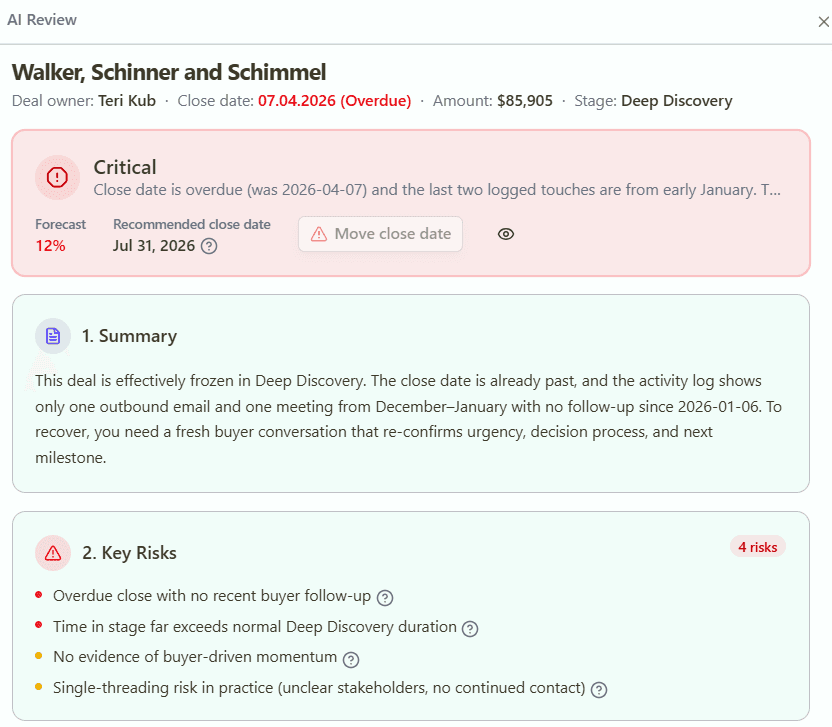
AI and Revenue Agents
AI Deal Review Agent
Win/Loss Analysis Agent
AI Forecast Review Agent
AI Forecast Accuracy Agent
Close date predictions
Complex machine learning models
Forecastio uses artificial intelligence and machine learning to analyze CRM data, identify revenue risks, monitor forecast quality, and automate repetitive forecasting and pipeline review activities.
What Makes It Different
Forecastio combines four capabilities that are often delivered by separate products: advanced sales forecasting, pipeline intelligence, deal intelligence, and AI Revenue Agents. This allows revenue teams to forecast revenue, inspect pipeline health, review deals, and automate repetitive revenue workflows from a single platform.
Another key differentiator is the depth of its forecasting capabilities. Forecastio supports multiple forecasting methods for different sales motions, including AI, weighted pipeline, and time-series forecasting. It also supports multi-revenue stream forecasting, custom forecasting dimensions, one of the most advanced what-if scenario engines in the category, and a comprehensive forecast audit trail. Together, these capabilities help organizations improve forecasting accuracy while understanding exactly why forecasts change over time.
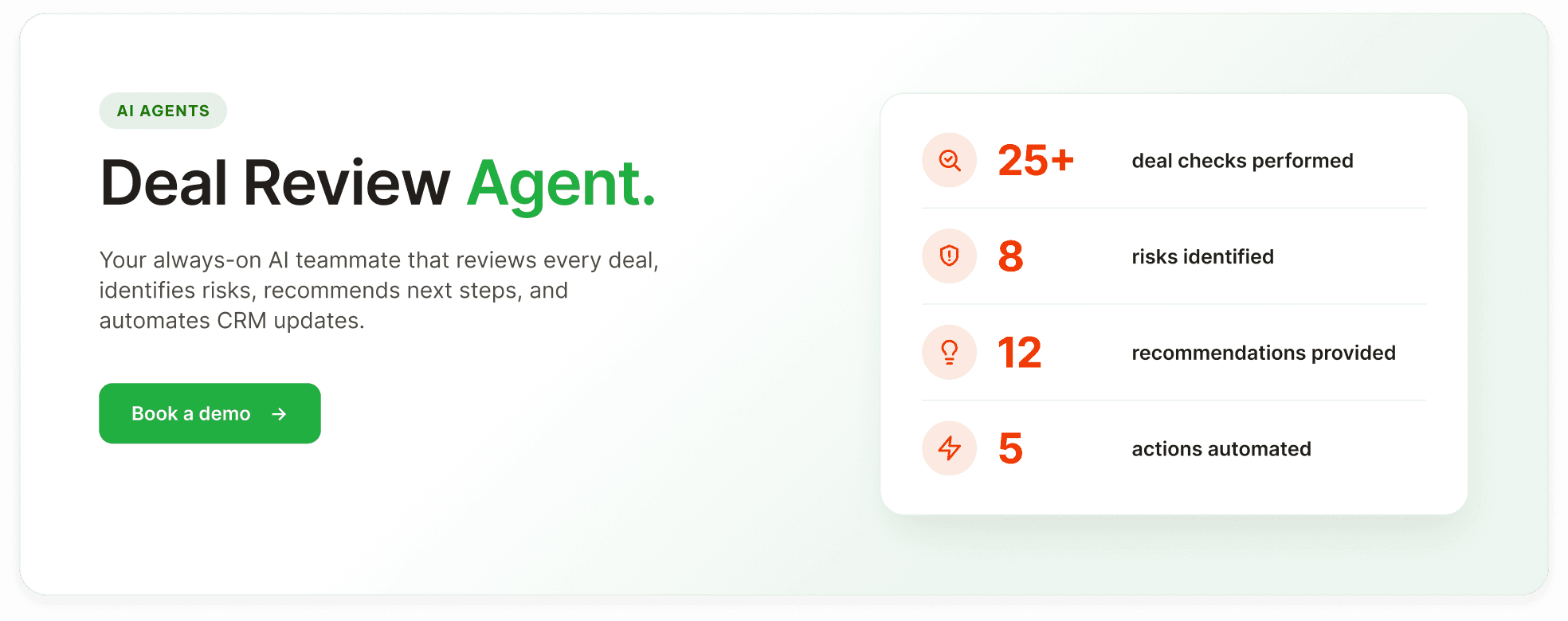
Unlike traditional revenue intelligence platforms that primarily surface insights, Forecastio's AI Revenue Agents actively review pipelines and deals, analyze emails, meetings, CRM notes, and customer interactions, generate selling recommendations, identify risks, and automate routine CRM tasks. This enables organizations not only to predict revenue more accurately but also to improve pipeline execution continuously.
Strengths
Advanced sales forecasting with AI, weighted pipeline, and time-series forecasting in one platform.
Powerful pipeline intelligence, including pipeline health, slippage, leakage, stage analysis, deal velocity, and pipeline review dashboards.
Comprehensive deal intelligence with AI-powered deal reviews, risk detection, selling recommendations, and win/loss analysis.
One of the most advanced what-if scenario engines for revenue planning and scenario modeling.
AI Revenue Agents that analyze deals, emails, meetings, CRM notes, and customer interactions while automating routine CRM updates and revenue workflows.
Multi-revenue stream forecasting, custom forecasting dimensions, transparent pricing, and fast time to value.
Limitations
Primarily focused on Sales. Organizations looking for a single platform that provides the same depth of functionality across Marketing, Sales, and Customer Success may require additional solutions.
Offers a smaller library of out-of-the-box integrations than some established enterprise platforms. However, the platform provides an API and an MCP server, allowing organizations to build custom integrations and connect Forecastio with AI assistants such as Claude.
Pricing
Forecastio offers transparent public pricing.
Sales Forecasting – $49 user/month (billed annually, includes two users)
Forecasting & Revenue Intelligence – $69/month (billed annually, includes two users)
4-week free trial is available
Bottom Line
Forecastio is one of the strongest revenue intelligence platforms for organizations that prioritize sales forecasting, pipeline intelligence, deal intelligence, and AI-powered automation over broad revenue orchestration. Its combination of multiple forecasting methods, explainable forecasts, AI Revenue Agents, transparent pricing, and fast implementation makes it a compelling choice for companies looking to modernize forecasting and revenue operations.
Clari
Overview
Clari is an enterprise revenue intelligence platform and revenue orchestration platform designed to standardize how large organizations forecast, inspect pipeline, and manage revenue execution. Rather than positioning itself as forecasting software alone, Clari combines sales forecasting, pipeline intelligence, AI, and structured operating workflows into a single platform that serves Sales, RevOps, Finance, Marketing, Customer Success, and Sales Engineering.
Forecasting remains Clari's best-known capability, but its broader value lies in bringing together data, workflows, and management processes into a consistent operating model. The platform supports multiple revenue models and emphasizes predictable forecasting through standardized revenue cadences, AI-driven pipeline inspection, and unified revenue data.
Best For
Enterprise revenue orchestration.
Core Capabilities
Clari's capabilities are grouped into six core areas.
Revenue Forecasting
AI-powered forecasting
Multi-model forecasting
Forecast rollups
Forecast projections
Board-ready forecasting workflows
Pipeline Intelligence
Pipeline health monitoring
Slipped and stalled deal detection
Deal inspection
Trend analysis
Deal Execution
AI-guided next-best actions
Revenue inspections
Guided revenue workflows
Opportunity management
Revenue Analytics
RevDB
Revenue Analytics
Enterprise reporting
Unified revenue data foundation
AI & Automation
RevAI
AI deal and trend analysis
AI CRM recommendations
AI forecast projections
Clari Guide
What Makes It Different
Clari's biggest differentiator is its combination of Revenue Context and Revenue Cadences. Instead of treating forecasting as a standalone process, the platform standardizes how revenue teams review pipeline, inspect deals, build forecasts, and run recurring operating rhythms such as forecast calls, pipeline reviews, and QBRs.
Another key differentiator is its support for complex revenue models.
Strengths
Strong enterprise sales forecasting with support for multiple revenue models.
Structured operating model built around Revenue Cadences and revenue inspections.
Broad integration ecosystem spanning CRM, ERP, customer systems, data warehouses, and third-party data sources.
Comprehensive AI capabilities, including forecasting, deal inspection, CRM recommendations, and workflow guidance.
Supports Sales, Finance, Marketing, Customer Success, and other revenue functions within a single platform.
Limitations
No native HubSpot support. Clari is designed primarily for Salesforce and large enterprise CRM environments.
Uses custom quote-based pricing with no publicly available pricing or free trial.
Designed for complex enterprise revenue operations. Smaller organizations may find the platform more complex than they need.
Pricing
Clari uses custom enterprise pricing. The company does not publish public pricing, a starting subscription cost, or a self-service free trial. Buyers must request a customized quote based on their requirements.
Bottom Line
Clari is a strong stong choice for enterprise organizations looking to standardize revenue forecasting, pipeline inspections, and revenue operations across multiple business units and revenue models. Its combination of AI-powered forecasting, structured operating cadences, and enterprise-scale orchestration makes it a benchmark platform for large revenue organizations, although its breadth and implementation approach may exceed the needs of smaller teams.
Gong
Overview
Gong is a revenue intelligence platform built around conversation intelligence. It positions itself as a Revenue AI Operating System that transforms customer interactions into actionable insights for forecasting, coaching, and deal execution. While Gong has expanded into forecasting and AI automation, customer conversations remain at the center of the platform.
The platform captures calls, meetings, emails, and other customer interactions, then uses AI to identify buying signals, deal risks, coaching opportunities, and forecast changes. Unlike traditional forecasting tools that rely primarily on CRM data and historicall patterns, Gong builds its revenue intelligence on what customers actually say.
Best For
Conversation intelligence and interaction-driven revenue execution.
Core Capabilities
Revenue Forecasting
AI-powered sales forecasting
Forecast boards
Forecast projections
Forecast accuracy analysis
Conversation Intelligence
Call recording and transcription
AI conversation analysis
Coaching recommendations
Customer sentiment and buying signals
Email and meeting analysis
Deal Intelligence
Revenue Graph
Deal risk detection
Opportunity inspection
AI next-best actions
AI & Automation
AI follow-up generation
CRM updates
Forecast corrections
Pipeline updates
Guided coaching
Revenue AI Agents
Revenue Analytics
Account boards
Forecast boards
Pipeline analytics
Revenue reporting
What Makes It Different
Gong's biggest differentiator is its Revenue Graph, which enriches traditional CRM and pipeline data with insights from customer conversations, emails, meetings, and other sales interactions. This gives sales teams additional context for deal inspection, forecasting, coaching, and revenue execution.
Another differentiator is Gong's ability to move from conversation analysis to execution. In addition to identifying risks and coaching opportunities, the platform can recommend follow-up actions, update CRM records, correct forecasts, and automate repetitive sales activities using AI.
Strengths
Market-leading conversation intelligence across calls, meetings, and emails.
Strong AI coaching with conversation scorecards and workflow-based recommendations.
Broad AI automation, including follow-ups, CRM updates, and forecast corrections.
Large integration ecosystem with no additional integration fees.
Limitations
Quote-based pricing with both per-user licensing and platform fees. No public pricing or free trial is available.
Designed as a broad Revenue AI platform. Smaller organizations that only need forecasting or conversation recording may find it more than they require.
Organizations that rely less on customer conversations and more on structured CRM processes may benefit less from Gong's conversation-first architecture.
Pricing
Gong uses custom enterprise pricing. The company charges a platform fee together with per-user licensing but does not publish a public starting price or offer a self-service free trial. Buyers must request a custom quote.
Bottom Line
Gong is a strong revenue intelligence platform for organizations that believe customer conversations should drive forecasting, coaching, and deal execution. If conversation intelligence is central to your sales strategy, Gong remains one of the category leaders. If your primary need is forecasting alone or deeper pipeline analysis, more specialized alternatives may provide a better fit — see our full comparison of Gong alternatives and competitors for options built specifically around that.
People.ai
Overview
People.ai, now rebranded as Backstory, is an enterprise revenue intelligence platform focused on explaining why deals, forecasts, and pipelines change. Rather than presenting dashboards or risk scores alone, the platform reconstructs the complete context behind every opportunity using CRM data, emails, meetings, calls, stakeholder relationships, and external signals.
Backstory positions itself as an AI answers platform rather than a traditional analytics tool. Its goal is to provide clear, evidence-backed answers to questions such as why a deal is slipping, which stakeholders have disengaged, and what actions should be taken next.
Best For
Explainable deal, forecast, and pipeline intelligence.
Core Capabilities
Revenue Forecasting
AI-powered sales forecasting
Forecast explanations
Forecast risk analysis
Forecast workflows
Pipeline & Deal Intelligence
Pipeline health monitoring
Deal risk detection
Stakeholder-aware deal inspection
Pipeline drill-down
Account Intelligence
Stakeholder mapping
Relationship intelligence
Organization charts
Opportunity qualification
Account strategy
Activity Capture
Automated capture of emails, meetings, calls, and transcripts
CRM activity synchronization
Reduced manual data entry
What Makes It Different
Backstory's biggest differentiator is explainability. Instead of assigning a risk score, the platform explains why a deal is changing, which stakeholders influenced the outcome, and what actions should be taken next.
Another differentiator is workflow delivery. Rather than requiring users to adopt another interface, Backstory delivers insights through APIs and MCP into existing CRM systems, collaboration tools, and AI assistants.
Strengths
Strong focus on explainable AI instead of simple scoring.
Rich stakeholder and relationship intelligence.
Automated capture of calls, emails, meetings, and CRM activities.
Open API and MCP support for custom workflows and AI assistants.
Well suited for enterprise organizations that need explainable deal intelligence and forecasting.
Limitations
No public pricing or self-service trial.
The recent transition from People.ai to Backstory may create confusion during product evaluations.
Organizations looking for traditional BI dashboards or lightweight reporting may find the platform more focused on AI reasoning than visualization.
Pricing
Backstory uses custom enterprise pricing. The company does not publish public pricing, a starting subscription cost, or a self-service free trial. Buyers must request a demo and receive a custom proposal.
Bottom Line
Backstory is a strong choice for enterprise organizations that need explainable deal intelligence, sales forecasting, and pipeline intelligence backed by rich account context. Its emphasis on AI reasoning, stakeholder intelligence, and workflow integration makes it particularly compelling for companies that want actionable answers.
6sense
Overview
6sense is a revenue intelligence platform focused on buyer intent, account intelligence, and go-to-market orchestration. Unlike traditional forecasting platforms, it helps organizations identify which accounts are actively researching a solution, who is involved in the buying committee, and when sales and marketing should engage.
The platform combines intent data, predictive analytics, AI, and account intelligence to coordinate Marketing and Sales around in-market opportunities. While 6sense includes revenue intelligence capabilities, its primary focus is on identifying and prioritizing buying opportunities rather than managing forecast submissions or sales forecast rollups.
Best For
Buyer intent intelligence and GTM orchestration.
Core Capabilities
Buyer Intent Intelligence
Signalverse buying signals
Intent data
Buying-stage prediction
Buying-group identification
Predictive account scoring
Keyword-level intent analysis
Sales Intelligence
AI Sales Copilot
Account summaries
Company and people search
AI-recommended actions
Smart alerts
Opportunity prioritization
Marketing & GTM Orchestration
Audience segmentation
AI advertising
Email agents
Account-based marketing
Campaign orchestration
Smart forms
Data Intelligence
CRM enrichment
Company and contact data
Visitor identification
Technographics and firmographics
Bi-directional CRM integrations
AI & Automation
RevvyAI assistant
Natural language search
Predictive AI models
AI workflow recommendations
What Makes It Different
6sense differentiates itself by focusing on the earliest stages of the buying journey. it identifies anonymous buying behavior, predicts purchase intent, and helps revenue teams engage accounts before opportunities are created.
Another key differentiator is its shared GTM intelligence model. Rather than serving Sales or Marketing independently, 6sense provides a common layer of buyer intelligence that helps both teams identify high-value accounts, coordinate outreach, and prioritize opportunities throughout the buying journey.
Strengths
Market-leading buyer intent and account intelligence.
Strong predictive analytics and AI-powered account prioritization.
Connects Marketing and Sales around a shared view of buying activity.
Broad data enrichment capabilities with company, contact, and visitor intelligence.
Includes RevvyAI for AI-powered search and recommendations.
Limitations
Not designed as a traditional sales forecasting platform with forecast submissions, manager rollups, or commit forecasting.
Public pricing is not available, despite publicly listed product packages.
Organizations looking for deep deal intelligence, conversation analysis, or frontline forecast management may require complementary tools.
Pricing
6sense publicly lists several Sales Intelligence packages and offers a "Get Started for Free" entry point. However, the company does not publish public pricing for its commercial plans, and buyers must contact sales for a customized quote.
Bottom Line
6sense is one of the strongest platforms for organizations that want to identify buying intent earlier, prioritize the right accounts, and align Sales and Marketing around high-value opportunities. Companies looking for enterprise sales forecasting or forecast governance should consider it as a complementary platform rather than a direct replacement for forecasting-focused solutions.
Revenue Grid
Overview
Revenue Grid is a revenue intelligence platform with a strong Salesforce-native architecture. The platform combines automated activity capture, sales forecasting, pipeline intelligence, sales engagement, and AI guidance while keeping captured data inside Salesforce. Rather than starting with forecasting, Revenue Grid starts by improving CRM data quality and activity capture, then builds forecasting, analytics, and guided selling on top of that foundation.
Its positioning is built around four core workflows: Capture, Inspect, Engage, and Direct. This approach emphasizes complete, reportable CRM data before applying AI, forecasting, and pipeline analytics.
Best For
Salesforce-native revenue operations and CRM automation.
Core Capabilities
CRM Data Capture
Automated activity capture
Native Salesforce data ownership
Email and calendar synchronization
Historical activity synchronization
Custom synchronization rules
Inbox and calendar sidebars
Revenue Forecasting & Pipeline Intelligence
AI-powered sales forecasting
Pipeline health analysis
Pipeline risk detection
Team analytics
Forecast dashboards
Deal Intelligence
Deal guidance
Meeting assistance
Mentor AI
Guided selling
Revenue insights
Sales Engagement
Sales cadences
Multi-channel sequence workflows
Workflow automation
AI & Analytics
AI-powered search
Revenue data lake
CRM recommendations
Record assistance
What Makes It Different
Revenue Grid differentiates itself through its Salesforce-first architecture. Unlike platforms that store captured activities outside the CRM, Revenue Grid writes emails, meetings, and other sales activities directly into native Salesforce records.
Another differentiator is its product strategy. Revenue Grid treats reliable CRM data as the foundation of revenue intelligence. Instead of positioning AI as the starting point, it combines activity capture, CRM integrity, forecasting, pipeline intelligence, and guided selling into a single operational workflow.
Strengths
Excellent automated activity capture with native Salesforce data ownership.
Strong focus on CRM data quality and operational accuracy.
Combines forecasting, pipeline intelligence, sales engagement, and guided selling in one platform.
Flexible deployment options, including private cloud.
Transparent pricing starting from approximately $30 per user/month.
Limitations
Primarily designed for Salesforce organizations. It is not the best fit for companies using HubSpot or other CRM systems.
Conversation intelligence is less comprehensive than platforms such as Gong.
Forecasting and AI capabilities are built on Salesforce data quality, making CRM adoption and data consistency particularly important.
Pricing
Revenue Grid offers transparent pricing starting at approximately $30 per user/month. Enterprise plans with additional AI and deployment options are available through custom pricing.
Bottom Line
Revenue Grid is an excellent choice for Salesforce organizations that want to improve CRM data quality while adding sales forecasting, pipeline intelligence, guided selling, and AI capabilities. Its native Salesforce architecture and transparent pricing make it a compelling alternative to larger enterprise platforms for teams that prioritize operational efficiency and reliable CRM data.
Aviso AI
Overview
Aviso AI is an end-to-end AI revenue intelligence platform built around sales forecasting, pipeline intelligence, conversation intelligence, and agentic AI. Aviso aims to unify forecasting, revenue execution, sales engagement, and customer success in a single platform.
In recent years, Aviso has shifted its positioning toward AI agents and autonomous execution. While forecasting remains a core capability, the platform increasingly emphasizes AI avatars, agent orchestration, no-code agent building, and workflow automation. It has one of the strongest "AI agents for revenue teams" narratives in this category.
Best For
AI revenue orchestration and agentic workflow execution.
Core Capabilities
Revenue Forecasting
AI-powered sales forecasting
Custom forecasting hierarchies
Consumption forecasting
Pipeline inspection
Opportunity scoring
Deal risk analysis
Conversation Intelligence
AI conversation analysis
Buyer intent analysis
Sales coaching
Sales performance tracking
Sales enablement
"Ask Anything" AI assistant
Agentic AI
MIKI AI assistant
AI avatars
AI agent orchestration
Role-based workflows
50+ AI agents
No-code Agent Studio
Customer Success Intelligence
Virtual Customer Success Manager
Customer health scoring
Renewal intelligence
Retention workflows
Customer success AI agents
Sales Engagement & Automation
AI SDR support
Workflow automation
Playbooks
Messaging
CRM writeback
Real-time synchronization
What Makes It Different
Aviso AI differentiates itself by combining sales forecasting, conversation intelligence, customer success, and AI agents in a single platform. Instead of stopping at insights and recommendations, the platform is designed to orchestrate multi-step workflows that help revenue teams execute actions automatically across the revenue lifecycle.
Another differentiator is its broad agentic AI vision. Aviso provides AI avatars, no-code agent building, workflow orchestration, and AI-powered assistants that support Sales, RevOps, and Customer Success.
Strengths
Broad platform spanning forecasting, pipeline intelligence, conversation intelligence, sales engagement, and customer success.
One of the strongest public positions around agentic AI and workflow automation.
Real-time CRM synchronization with CRM writeback.
White-glove onboarding and free migration for new customers.
Limitations
No public pricing or free trial. Buyers must request a custom proposal.
The platform covers a wide range of capabilities, which may be more than organizations looking for a dedicated forecasting or conversation intelligence solution require.
Many AI capabilities are described using vendor-specific "agentic AI" terminology. Buyers should validate which workflows are production-ready for their specific use case.
Pricing
Aviso AI uses custom enterprise pricing. The company offers personalized onboarding, implementation services, and free migration but does not publish a public starting price or self-service pricing.
Bottom Line
Aviso AI is a strong choice for organizations looking for a single platform that combines sales forecasting, pipeline intelligence, conversation intelligence, customer success, and AI-powered execution. Companies investing heavily in AI agents and workflow automation will find one of the most comprehensive platforms in this comparison, while organizations looking for a simpler forecasting solution may find its breadth unnecessary.
Weflow
Overview
Weflow is a revenue intelligence platform built around Salesforce automation, conversation intelligence, deal intelligence, and sales forecasting. The platform positions itself as a modular Revenue AI platform that helps organizations improve CRM data quality, automate CRM updates, inspect pipeline health, and increase forecast visibility.
Unlike many enterprise competitors, Weflow follows a modular product strategy. Organizations can adopt individual products for activity capture, conversation intelligence, or forecasting, or deploy the complete Revenue AI platform. Combined with transparent pricing, no platform fee, and a public free trial, this makes Weflow an attractive alternative for organizations that want enterprise capabilities without enterprise-style packaging.
Best For
Modular Revenue AI for Salesforce.
Core Capabilities
CRM Data Capture
Automated email, meeting, and contact synchronization
CRM activity capture
Automatic Salesforce field updates
MEDDIC field population
Bidirectional Salesforce synchronization
Conversation Intelligence
Call recording and transcription
AI conversation summaries
Scorecards
Multilingual support
Meeting templates
Deal Intelligence & Forecasting
AI-powered sales forecasting
Forecast rollups
Deal health analysis
Deal risk monitoring
AI & Automation
Ask Weflow AI
Agent Builder
AI workflow automation
Mobile Productivity
Mobile Copilot
Salesforce mobile workflows
Rep productivity tools
What Makes It Different
Weflow differentiates itself through its modular architecture. Organizations can deploy activity capture, conversation intelligence, forecasting, or the complete Revenue AI platform independently, allowing them to expand gradually instead of committing to a large enterprise implementation from day one.
Another key differentiator is its commercial model. Weflow publishes transparent pricing, offers a 14-day free trial, charges no platform fee, and includes Agent Builder within its products instead of selling it as a separate add-on.
Strengths
Transparent modular pricing with no platform fee.
Strong Salesforce automation and CRM data quality capabilities.
Public 14-day free trial.
Agent Builder included without additional licensing.
Combines conversation intelligence, deal intelligence, and forecasting in one platform.
Limitations
Primarily designed for Salesforce organizations. Companies using HubSpot or other CRM systems should verify compatibility before evaluating the platform.
Better suited for mid-market and growing companies than highly complex global enterprise environments.
Pilot programs require a minimum of ten users according to the vendor's public documentation.
Pricing
Weflow publishes transparent modular pricing.
Activity & Contact Capture: from $19/user/month
Conversation Intelligence: from $39/user/month
Deal Intelligence & Forecasting: from $39/user/month
Revenue AI Platform: approximately $79/user/month
14-day free trial
No platform fee
Bottom Line
Weflow is a strong choice for Salesforce organizations looking for a modular and commercially transparent revenue intelligence platform. It combines CRM automation, conversation intelligence, deal intelligence, and sales forecasting while allowing companies to adopt only the capabilities they need. For organizations that value pricing transparency, fast implementation, and Salesforce automation, Weflow is one of the strongest alternatives to larger enterprise platforms.
BoostUp (Terret)
Overview
BoostUp, now rebranded as Terret, has evolved from a forecasting platform into a broader AI-powered revenue intelligence platform. The company positions Terret as a "virtual revenue fleet" that combines sales forecasting, pipeline intelligence, conversation intelligence, and AI-powered revenue execution in a single platform. Its core products include Terret Forecast, Terret Nexus, and Terret Conversation Intelligence.
Although the branding has changed, the platform's core strengths remain familiar. Forecast precision, pipeline health, deal inspection, conversation analysis, and RevOps configurability continue to be central to the product. The biggest shift is Terret's stronger focus on AI-powered execution, moving beyond revenue analytics toward automated recommendations and workflows.
Best For
AI forecasting and deal execution.
Core Capabilities
Revenue Forecasting
AI-powered sales forecasting
Machine-learning forecasting
Real-time forecast updates
Board-ready forecast summaries
Multi-dimensional forecasting
Pipeline & Deal Intelligence
Pipeline health monitoring
Deal inspection
Risk assessment
Deal strategy recommendations
Win/loss analysis
Sales velocity analysis
Conversation Intelligence
AI conversation analysis
Revenue context generation
Call intelligence
Conversation-driven deal insights
Revenue Analytics
Revenue Graph analytics
Root-cause analysis
Self-service dashboards
Forecast risk analysis
Revenue metrics
AI & Automation
Terret Nexus
AI agents
Answer-to-action workflows
AI playbooks
Board narrative generation
What Makes It Different
BoostUp differentiates itself through its answer-to-action approach. Rather than stopping at analytics, Terret Nexus is designed to identify the root causes behind forecast changes, deal losses, and pipeline risks, then recommend concrete actions through AI-generated playbooks and workflows.
Another differentiator is the combination of advanced forecasting with extensive RevOps configurability. The platform supports complex revenue models, flexible forecasting hierarchies, and highly configurable metrics.
Strengths
Strong sales forecasting with AI predictions and board-ready narratives.
Good balance between forecasting, pipeline intelligence, conversation intelligence, and AI-powered execution.
Highly configurable platform for complex revenue models.
Flexible administration with support for multiple CRMs, currencies, and custom objects.
Limitations
Primarily designed for enterprise revenue organizations. Smaller sales teams may find the platform more complex than their forecasting and revenue operations require.
No transparent public pricing or self-service trial. Buyers need to contact sales for evaluation and pricing.
Organizations looking only for sales forecasting may find the platform broader than necessary, as it combines forecasting, conversation intelligence, revenue analytics, and AI execution in a single solution.
Pricing
Terret does not publish official pricing. The company follows a demo-led sales process and promotes a 48-hour proof of concept. Third-party sources estimate pricing at approximately $79/user/month, but this figure is not confirmed by the vendor and should be treated as indicative only.
Bottom Line
BoostUp (Terret) is a strong choice for organizations looking to combine advanced sales forecasting, pipeline intelligence, conversation intelligence, and AI-powered deal execution in a single platform. Its answer-to-action approach and extensive RevOps configurability make it particularly attractive for enterprise revenue teams with complex forecasting processes, although the recent rebranding and lack of transparent pricing may require additional evaluation.
Gainsight
Overview
Gainsight is the only platform in this list primarily focused on customer success, renewals, and expansion revenue rather than net-new sales. Its Revenue Optimization solution combines AI-powered renewal forecasting, customer health scoring, churn prediction, expansion planning, and customer success workflows to help organizations grow recurring revenue.
Unlike traditional sales forecasting platforms, Gainsight treats revenue risk as a post-sales challenge. The platform analyzes customer health, product usage, support history, stakeholder engagement, and renewal signals to predict retention outcomes and identify expansion opportunities. For organizations where renewals represent a significant portion of revenue, this approach provides much deeper visibility than pipeline-focused forecasting alone.
Best For
Customer success, renewal forecasting, and revenue retention.
Core Capabilities
Revenue Optimization & Forecasting
AI-powered renewal forecasting
Expansion forecasting
Customer Success Qualified Leads (CSQLs)
Renewal probability analysis
Revenue optimization workflows
Customer Risk Intelligence
Customer health scoring
Churn prediction
Renewal risk analysis
Automated risk programs
Expansion opportunity detection
Customer Intelligence
Staircase AI conversation analysis
Customer sentiment analysis
Stakeholder engagement tracking
Sponsor change detection
Product usage intelligence
AI & Automation
Atlas AI Agents
Renewal automation
Customer success workflows
Slack intelligence
Adoption monitoring
Customer Success Analytics
Net Revenue Retention (NRR)
Gross Revenue Retention (GRR)
ARR dashboards
Renewal waterfalls
Customer 360
CRM & Data Foundation
Customer 360
People Maps
Product usage integration
Renewal Center
Bi-directional Salesforce synchronization
What Makes It Different
Gainsight differentiates itself by treating revenue intelligence as a customer lifecycle challenge rather than a pipeline challenge. Instead of concentrating on net-new opportunities, it helps organizations forecast renewals, identify churn risks, and uncover expansion opportunities using customer health, product adoption, support history, stakeholder engagement, and conversation signals.
Another differentiator is the depth of its renewal forecasting. Rather than relying only on historical renewals or health scores, Gainsight combines multiple customer signals to build a much richer view of renewal probability and long-term customer value. This makes it particularly well suited for subscription and recurring revenue businesses.
Strengths
One of the strongest platforms for customer success and revenue retention.
AI-powered renewal and expansion forecasting.
Comprehensive customer health scoring and churn prediction.
Strong conversation intelligence through Staircase AI.
Atlas AI Agents automate customer success and renewal workflows.
Deep Salesforce integration through Renewal Center.
Limitations
Not designed for traditional sales forecasting, pipeline reviews, or frontline sales forecast management.
Enterprise-focused implementation typically requires dedicated administration and longer deployment times.
Quote-based pricing with no publicly available pricing for Customer Success or Revenue Optimization modules.
Pricing
Gainsight uses custom enterprise pricing for its Customer Success and Revenue Optimization products. The company offers a free trial for Product Experience (PX), but it does not publish pricing or a free trial for its full Customer Success platform or Renewal Center.
Bottom Line
Gainsight is the strongest choice for organizations where renewals, retention, and customer expansion drive revenue growth. It is not a direct replacement for sales forecasting or pipeline intelligence platforms such as Forecastio or Clari, but it excels at helping Customer Success teams reduce churn, improve renewal forecasting, and maximize customer lifetime value.
How to Choose the Best Revenue Intelligence Platform
Choosing the best revenue intelligence platform starts with understanding your primary business objective. Some platforms specialize in sales forecasting, while others focus on conversation intelligence, buyer intent, or customer success. Before comparing vendors, define the business problem you want to solve.
The checklist below can help match your goals with the capabilities you should look for.

Revenue Intelligence Platform Selection Checklist
Primary Goal | Required Platform Capabilities |
|---|---|
Improve sales forecasting | AI forecasting, multiple forecasting methods, forecast accuracy tracking, what-if scenarios, forecast audit trail, multiple-revenue stream support |
Improve pipeline health | Pipeline health dashboards, deal aging, stage analysis, slippage, leakage, pipeline review automation |
Improve deal execution | Deal intelligence, AI recommendations, win/loss analysis, next-best actions, deal review workflows |
Reduce manual data entry | Automated activity capture, CRM synchronization, AI-powered CRM updates, workflow automation |
Improve sales coaching | Conversation intelligence, call analysis, coaching scorecards, objection detection, AI coaching recommendations |
Shorten the sales cycle | Buyer engagement analysis, deal risk detection, stakeholder intelligence, opportunity prioritization |
Improve CRM data quality | CRM hygiene, duplicate detection, automated field updates, activity capture |
Align Marketing and Sales | Buyer intent data, marketing automation, account intelligence, predictive analytics |
Improve renewals and expansion | Customer health scoring, churn prediction, customer success workflows, renewal forecasting |
Support multiple revenue models | Multi-revenue stream forecasting, custom forecasting dimensions, flexible forecasting hierarchies |
Automate revenue operations | AI agents, workflow automation, CRM updates, forecasting automation, pipeline review automation |
When evaluating vendors, avoid comparing feature lists alone. Instead, focus on whether the platform supports your sales process, CRM, reporting requirements, and implementation timeline. A solution with fewer features may deliver greater business value if it closely matches the way your organization operates.
AI Agents: The Next Evolution of Revenue Intelligence
The first generation of revenue intelligence platforms focused on collecting and visualizing sales data. The second generation introduced AI-powered insights, helping organizations identify deal risks, forecast revenue, and monitor pipeline health. Today, the category is entering a new phase where AI not only analyzes information but also recommends actions and performs routine work automatically.
Instead of spending hours reviewing dashboards, modern revenue teams can rely on AI agents that continuously monitor pipelines, inspect deals, analyze customer interactions, and surface opportunities that require immediate attention. This shift allows sales managers to spend less time searching for problems and more time coaching their teams and closing deals.
AI Agents Are Becoming Specialized
Unlike traditional AI assistants that answer general questions, revenue intelligence agents are designed to solve specific business problems. As the market evolves, platforms are introducing specialized agents that work alongside sales reps, managers, and RevOps teams.
Examples include:
Forecast Review Agents that analyze forecast changes, identify the main drivers, and explain why revenue projections increase or decrease.
Pipeline Review Agents that automatically detect stalled opportunities, pipeline leakage, declining buyer engagement, and stage bottlenecks before weekly pipeline reviews.
Deal Review Agents that inspect opportunities, analyze emails, meetings, CRM notes, and sales conversations, then generate selling recommendations and highlight potential risks.
Forecast Accuracy Agents that compare forecasting methods, identify forecasting bias, and recommend adjustments to improve forecasting accuracy over time.
CRM Hygiene Agents that detect missing fields, outdated close dates, duplicate records, and incomplete sales activities, while automatically updating CRM records to reduce manual data entry.

From Dashboards to Autonomous Revenue Operations
Perhaps the biggest change is that AI agents are beginning to move beyond analytics. Instead of simply generating reports, they can execute routine operational tasks such as updating CRM records, assigning follow-up actions, generating opportunity summaries, or preparing pipeline review reports.
This transition transforms revenue intelligence software from a reporting tool into an operational layer that continuously improves data quality, supports sales operations, and keeps pipelines up to date without requiring constant manual effort.
What to Look for in AI-Powered Revenue Intelligence
Not every platform offering AI provides the same level of automation. When evaluating a solution, consider whether its AI capabilities can:
Analyze customer interactions, emails, meetings, and CRM records.
Generate actionable insights instead of simply highlighting problems.
Automate routine CRM and reporting tasks.
Support forecasting, pipeline management, and deal execution.
Integrate naturally into existing workflows instead of creating another dashboard to monitor.
Over the next few years, AI agents are expected to become a standard component of revenue intelligence platforms. Organizations that adopt them early will spend less time maintaining CRM data and reviewing reports, and more time improving forecast quality, pipeline execution, and overall sales performance.
Frequently Asked Questions
What Is the Best Revenue Intelligence Platform?
The best revenue intelligence platform depends on your primary business objective.
If your priority is sales forecasting, pipeline intelligence, and AI-powered deal execution, Forecastio is one of the strongest options.
Organizations looking for enterprise revenue orchestration should consider Clari.
Gong is a market leader in conversation intelligence.
6sense specializes in buyer intent and go-to-market intelligence.
Gainsight is designed for customer success, renewals, and expansion revenue.
Rather than looking for the platform with the most features, choose the one that best matches your sales process, CRM, revenue model, and implementation requirements.
How Do I Choose a Revenue Intelligence Platform?
Start by identifying the business problem you want to solve.
If improving forecasting accuracy is your priority, focus on platforms with multiple forecasting methods, AI forecasting, and scenario planning. If your goal is improving pipeline health, look for strong pipeline analytics and deal intelligence. Organizations that struggle with CRM adoption or manual data entry should prioritize automation and activity capture.
You should also evaluate implementation time, pricing transparency, CRM compatibility, AI capabilities, and the platform's ability to scale with your business.
What Are the Advantages of a Revenue Intelligence Platform?
A modern revenue intelligence platform helps organizations improve visibility across the revenue process by combining CRM data, customer interactions, AI, and analytics.
Typical benefits include:
More accurate sales forecasting
Better pipeline health visibility
Earlier identification of deal risks
Improved sales coaching through AI and conversation intelligence
Reduced manual data entry through automation
Higher CRM data quality
Faster pipeline reviews
Better alignment between Sales, Marketing, and Customer Success
AI-powered recommendations that improve sales performance
Instead of relying on intuition, revenue teams can make decisions based on real-time data and predictive analytics.
What Types of Revenue Intelligence Platforms Are Available?
Although all platforms belong to the same revenue intelligence category, they often specialize in different areas.
The most common categories include:
Sales forecasting platforms, focused on forecasting accuracy and revenue planning.
Conversation intelligence platforms, which analyze sales calls, meetings, and emails.
Buyer intent platforms, which identify in-market accounts and buying signals.
Revenue orchestration platforms, which combine forecasting, pipeline management, workflows, and AI.
Customer success platforms, focused on renewals, customer health, and expansion revenue.
Many modern vendors combine several of these capabilities into a single platform, but most still have a primary area of specialization.
What's the Difference Between a CRM and a Revenue Intelligence Platform?
A Customer Relationship Management (CRM) system and a revenue intelligence platform serve different purposes.
A CRM such as Salesforce Sales Cloud, HubSpot, or Microsoft Dynamics is designed to store customer information, manage opportunities, track sales activities, and support day-to-day sales processes. It acts as the system of record for customer and pipeline data.
A revenue intelligence platform sits on top of the CRM and analyzes that data using artificial intelligence, predictive analytics, and automation. Depending on the platform, it can improve sales forecasting, monitor pipeline health, analyze customer interactions, identify deal risks, generate actionable insights, automate CRM updates, and support sales coaching through AI-powered recommendations.
Many organizations use both systems together. The CRM captures and stores information, while the revenue intelligence platform transforms that information into insights, forecasts, and automated actions that help improve sales performance and revenue outcomes.
Share:


![15 Best Sales Engagement Software [2025 Rankings]](https://framerusercontent.com/images/iWZEowZXTxrgAmGADqkvuGtOxjg.jpg?width=1224&height=816)