RevOps vs Sales Ops: Key Differences, Who Owns What, and Which You Need

Alex Zlotko
CEO at Forecastio

TL;DR
Sales Ops makes the sales team more efficient. RevOps aligns marketing, sales, and customer success around one revenue process.
The biggest differences are authority, not tasks. RevOps reports to the CRO, COO, or CEO and owns the total revenue forecast: new business, renewals, and expansion. Sales Ops reports to sales leadership and owns the sales forecast.
Many “RevOps” teams are Sales Ops with a new title. If the team reports to the VP of Sales and forecasts new business only, the mandate hasn’t changed.
Most companies build Sales Ops first. The trigger for RevOps is not an ARR number but problems between teams: lead handoffs, renewals, and conflicting revenue numbers.
When moving from Sales Ops to RevOps, fix shared definitions and data before changing the org chart.
At scale, companies run both, with Sales Ops as a team inside RevOps.
RevOps roles pay more: a median of $120,000 vs $97,090 for sales operations, based on 2026 US job postings.
Introduction
The difference between revenue operations (RevOps) and sales operations (Sales Ops) is scope. Sales Ops makes the sales team more efficient: CRM, pipeline, territories, quotas, and the new-business forecast. RevOps aligns marketing, sales, and customer success around shared data, processes, and one revenue number, from first touch to renewal and expansion. In many companies, Sales Ops sits inside RevOps as one of its teams.
Still, many teams treat RevOps vs Sales Ops as a naming question. There is a reason for that: the two functions are converging. In a Gartner survey of 318 sales leaders, sales operations teams spent 73% of their time supporting non-sales functions in 2022, up from 39% in 2019. Gartner says many companies made this shift on purpose, as they moved to a revenue operations model.
But a Sales Ops team doing more work is not the same as RevOps. The two have different metrics, reporting lines, and forecast responsibilities. Picking the wrong one at the wrong stage leads to messy handoffs, conflicting numbers, and forecasts nobody trusts.
Below, we break down revenue operations vs sales operations: what each function does, how they differ, who owns what, and which one your company needs right now.
RevOps vs Sales Ops at a glance
The table below compares sales ops vs RevOps across nine dimensions. The differences that matter most are not tasks but authority: who each function reports to and which forecast it owns. Both come up again in the sections below.
Criteria | Sales Ops | RevOps |
|---|---|---|
Main goal | Make the sales team more productive | Make total revenue predictable and efficient |
Scope | Sales team only | Marketing, sales, and customer success |
Revenue covered | New business | New business, renewals, and expansion |
Customer journey | From lead handoff to closed-won | From first touch to renewal |
Key metrics | Win rate, quota attainment, pipeline coverage, sales cycle length, sales velocity | Net revenue retention, CAC, customer lifetime value, forecast accuracy, lead-to-customer conversion rate |
Forecast ownership | Sales forecast (new business) | Total revenue forecast: new business, renewals, and expansion |
Data and systems | Sales objects in the CRM and sales tools | Shared data model and the full GTM tech stack |
Typically reports to | VP of Sales or Chief Sales Officer | CRO, COO, or CEO |
When companies build it | Early, once there is a repeatable sales motion | When several teams share one pipeline and retention matters |
What is sales operations?
Sales operations (Sales Ops) is the function that helps the sales team sell more efficiently. It builds and runs the systems, processes, and data that reps and managers use every day. The goal is more selling time and more predictable sales results.
So what does sales operations do?
CRM administration for sales: deal stages, required fields, and data quality
Sales process design, from lead assignment to closed-won
Territory, quota, and capacity planning
Sales compensation plans and commission tracking
Pipeline reviews and the sales forecast
Sales reporting and dashboards for managers
Sales tools such as sales engagement, conversation intelligence, and CPQ
How sales ops is measured and where it reports
Sales Ops is measured on sales outcomes: win rate, quota attainment, pipeline coverage, sales cycle length, and sales velocity
It usually reports to the VP of Sales or the Chief Sales Officer, and its authority stops at the edge of the sales team. Sales Ops can fix how reps update deals. It can’t change how marketing qualifies leads or how customer success runs renewals. That is the gap RevOps is built to close.
What is revenue operations (RevOps)?
Revenue operations (RevOps) is the function that aligns marketing, sales, and customer success around one revenue process. It owns the shared data, systems, and rules that connect these teams, from the first marketing touch to renewal and expansion. The goal is predictable revenue growth for the whole company, not better output from one team.
What does RevOps do?
Lifecycle and funnel definitions, such as what counts as an MQL, SQL, and opportunity
Handoff rules between marketing, sales, and customer success
The shared data model and data governance across the CRM and other GTM tools
The GTM tech stack and how the tools integrate
The total revenue forecast, including renewals and expansion
Cross-team reporting and annual GTM planning with finance and leadership
The four pillars of RevOps
People: clear ownership and shared goals across revenue teams
Process: documented workflows and handoffs from lead to renewal
Technology: an integrated stack of RevOps tools with one system of record
Data: shared definitions and a single source of truth for reporting
How RevOps is measured and where it reports
RevOps is measured on company-level outcomes: forecast accuracy, net revenue retention, LTV:CAC ratio, and lead-to-customer conversion rate.
It typically reports to the CRO, COO, or CEO. That position gives RevOps the authority to set rules for every revenue team, including Sales Ops.
Key differences between revenue operations and sales operations
RevOps and Sales Ops use similar skills: process design, CRM work, and analytics. The difference is how far their authority reaches. It shows most clearly in five areas: scope, metrics, data ownership, forecasting, and reporting line.
Scope and revenue streams
Sales Ops covers one team and one revenue stream: new business. Its work starts when a lead reaches sales and ends at closed-won.
RevOps covers the full customer lifecycle: lead generation, sales, onboarding, renewals, and expansion. In subscription businesses, renewals and expansion are a large part of revenue, and Sales Ops has no say over them.
A simple test: if a problem sits inside the sales team, Sales Ops can fix it. If it sits between teams, such as marketing and sales disagreeing on lead quality, it needs RevOps.

Metrics
Sales Ops tracks how well the sales team executes. Win rate, quota attainment, pipeline coverage, and sales cycle length all describe sales performance.
RevOps tracks how well the whole revenue engine works. Net revenue retention depends on customer success. LTV:CAC depends on marketing spend, sales cost, and how long customers stay. Lead-to-customer conversion runs across the marketing-to-sales handoff. No single team can move these numbers alone, so they need a cross-team owner. For the full list with formulas, see our guide to RevOps metrics.
Data and systems ownership
Both functions work in the CRM, but they own different layers. Sales Ops configures the sales side: deal stages, required fields, and sales dashboards. RevOps owns the shared data model: lifecycle stage definitions, how records sync between tools, and who can change what.
This split matters in practice. If Sales Ops adds a deal stage on its own, marketing’s funnel reports and customer success’s handoff rules can break. In a RevOps model, Sales Ops still runs the sales pipeline, but within the definitions RevOps sets.
Forecasting
Both functions forecast, but they forecast different numbers.
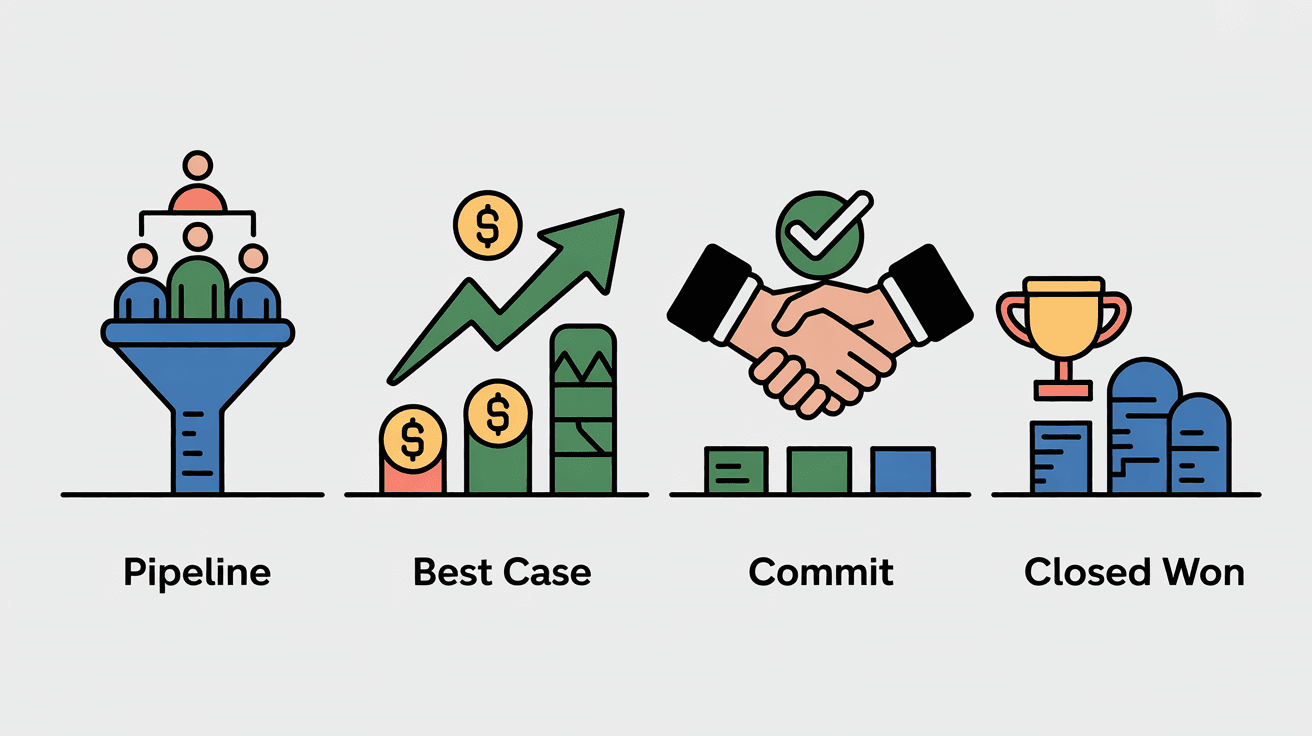
Sales Ops owns the sales forecast. It runs pipeline reviews, inspects deals, and rolls up rep and manager calls using forecast categories such as commit, best case, and pipeline. The question it answers: how much new business will we close this quarter or month?
RevOps owns the total revenue forecast. It combines the sales forecast with expected renewals, expansion, and churn. It also owns the method behind the number: data sources, category definitions, and how accuracy is measured. The question it answers: how much revenue will the company actually bring in?
Problems start when the two forecasts use different data. Sales reports one number, finance another, and customer success a third. According to HubSpot’s 2026 State of B2B Revenue report, only 32% of finance and sales teams close the month from the same numbers. RevOps fixes this by setting one methodology and one data source, then letting Sales Ops run the sales part inside it.
We also recommend tracking forecast category discipline: the share of deals in each category that actually closed or slipped, by team and by rep. It shows whether the sales forecast can be trusted before it rolls into the company number.
Reporting line
Sales Ops reports to sales leadership. RevOps reports to the CRO, COO, or CEO. This is the most important difference, because it decides whether RevOps can set rules for marketing and customer success or only advise them.
Many companies rename Sales Ops to RevOps and change nothing else. Your team is still Sales Ops if:
It reports to the VP of Sales
It has no say over marketing ops or customer success processes
It forecasts new business only
Marketing and customer success keep their own definitions and reports
If two or more of these apply, the team has a new title but the old mandate.
Who owns what: RevOps vs Sales Ops responsibility matrix
Most friction between RevOps and Sales Ops comes from unclear ownership. The matrix below shows who owns each activity in a company that has both functions. “Owns” means the function makes the decision. “Sets the rules” means it defines the standards the other team works within.
Activity | Sales Ops | RevOps |
|---|---|---|
CRM setup for sales (fields, views, automation) | Owns | Sets the rules |
Deal stages and sales pipeline | Owns | Sets the rules |
Lifecycle stage definitions (MQL, SQL, opportunity) | Input | Owns |
Lead routing | Assigns leads to reps | Owns handoff rules between teams |
Territory and quota planning | Owns | Input |
Sales compensation plans | Owns | Input |
Pipeline reviews and deal inspection | Owns | No role |
Win/loss analysis | Owns | Input |
Sales forecast | Owns | Sets the rules |
Total revenue forecast | Input | Owns |
Renewal and expansion processes | No role | Owns |
GTM tech stack and integrations | Input | Owns |
Full-funnel reporting and attribution | No role | Owns |
Annual GTM planning | Input | Owns |

In this setup, Sales Ops sits inside RevOps as one of its teams. A common RevOps team structure has a RevOps leader reporting to the CRO or CEO, with sales ops, marketing ops, customer success ops, and revenue analytics under them. Sales Ops often keeps a dotted line to sales leadership, so it stays close to reps and managers.
When do you need Sales Ops, RevOps, or both?
Most companies should build Sales Ops first and add RevOps when the go-to-market gets more complex. Sales Ops fixes problems inside the sales team. RevOps becomes necessary when the problems sit between teams: lead handoffs, renewals, and conflicting numbers. At scale, most companies run both, with Sales Ops inside RevOps.
The payoff is measurable. In a Deloitte Digital survey of 650 US B2B sales executives, organizations with RevOps were 1.4 times as likely to exceed their 2023 revenue goals by 10% or more.
Signs you need Sales Ops first
Reps spend hours updating the CRM instead of selling
Deal stages and required fields are inconsistent, so pipeline management relies on guesswork
Forecast calls are based on rep gut feel
Territories, quotas, and commissions live in spreadsheets
New reps take too long to ramp because the sales process isn’t documented
If these problems sit inside the sales team, a strong Sales Ops hire will fix them faster than a RevOps leader would.
Signs you’ve outgrown Sales Ops
Marketing and sales argue about lead quality and what counts as an MQL
Customer success learns what was promised only after the deal closes
Sales, marketing, and finance report different revenue numbers
Renewals and expansion are a growing share of revenue, but nobody forecasts them together with new business
Each team buys its own tools, and data doesn’t sync between them
When two or more of these show up, adding more Sales Ops capacity won’t help. The problem is ownership across teams, and that is the job of RevOps.
Sales Ops or RevOps by company stage
The right model depends less on revenue and more on how many teams and handoffs touch revenue. The table maps four common growth stages to the ops model that usually fits. Find the row that matches how you sell today.
Stage | What it looks like | Ops model |
|---|---|---|
Founder-led sales | Founders and a few reps sell, one product | No dedicated ops. A sales leader covers the CRM |
Repeatable sales motion | First sales team, one product, one motion | First Sales Ops hire, usually a generalist |
Scaling | SDRs, AEs, and account managers, a marketing pipeline target, a customer success team, growing renewals | First RevOps leader, with Sales Ops reporting into RevOps |
Multiple motions | Several products, segments, or regions, or self-serve plus sales-led | Full RevOps team: sales ops, marketing ops, customer success ops, and revenue analytics |
How to move from Sales Ops to RevOps
Moving from Sales Ops to RevOps is a change in scope, not a change in title. These five steps expand the function from the sales team to the full revenue engine without disrupting how sales runs today.
Map the customer journey. Document every step from first touch to renewal, and every handoff between teams.
Agree on shared definitions. Marketing, sales, and customer success need one definition of a qualified lead, an opportunity, closed-won, and churn.
Pick one system of record. Clean the data in it and stop teams from keeping separate versions of the truth.
Change the reporting line and ownership. The RevOps leader should report to the CRO, COO, or CEO, not to the VP of Sales. Use the responsibility matrix above to settle who owns what.
Build one forecast and one review rhythm. Combine the sales forecast with renewals and expansion using one method, then review it in a regular cross-team meeting. This is also the fastest way to improve forecast accuracy at the company level.
The order matters. Definitions and data come before the reorg. Changing titles and reporting lines first only moves the same conflicts to a new org chart.
How Forecastio supports Sales Ops and RevOps in HubSpot
Forecastio is a HubSpot-native sales forecasting and revenue intelligence platform. It gives Sales Ops and RevOps the same data and the same forecast, so they stop reconciling numbers in spreadsheets.
For Sales Ops, Forecastio:
Builds AI forecasts from historical patterns and active deal signals, with multi-level roll-ups that match your org structure
Reviews deals with the Deal Review Agent and flags risks before pipeline reviews
Shows why each rep loses deals with win/loss analysis
Recommends next best actions, such as updating close dates and deal amounts

For RevOps, Forecastio:
Forecasts new business, renewals, and expansion in one place, for both subscription and transactional revenue
Takes daily, weekly, and monthly snapshots of every pipeline change
Explains pipeline movement and health with waterfall, deal slippage, sales cycle, and pipeline stage analysis
Tracks forecast category discipline by team and rep

Forecastio works best for teams with at least 5–10 AEs and hundreds of open deals. Teams go live in days, and full setup runs during a free one-month pilot. A Salesforce integration is coming in January 2027.
FAQ
Should RevOps replace Sales Ops?
No. RevOps sets the rules across revenue teams, and Sales Ops runs the sales motion within them. When companies remove Sales Ops entirely, pipeline reviews, territories, and compensation plans usually lose their owner. In most mature setups, Sales Ops becomes a team inside RevOps instead of disappearing.
Who should RevOps report to?
RevOps should report to the CRO, COO, or CEO. The key rule is that it should not report to any of the teams it is meant to align. When RevOps reports to the VP of Sales, it tends to put sales workflows ahead of marketing and customer success needs.
Does RevOps pay more than Sales Ops?
Usually, yes. In a 2026 analysis of 2,211 US job postings, Glozo found a median salary of $120,000 for revenue operations roles and $97,090 for sales operations roles. Glozo notes that role-level medians are directional. The gap reflects RevOps’ broader scope and its heavier focus on data and systems skills.
What does a revenue operations manager do?
A revenue operations manager owns the processes, data, and tools that connect marketing, sales, and customer success. Day to day, that means maintaining lifecycle definitions, managing the CRM and GTM stack, building cross-team reports, and supporting the revenue forecast. For HubSpot users, the HubSpot revenue operations certification covers many of these skills.
What is the difference between RevOps, marketing ops, and sales enablement?
Marketing ops runs the marketing engine: campaigns, marketing automation, attribution, and lead scoring. Sales enablement prepares reps to sell through training, content, and coaching. Neither is RevOps. In a RevOps structure, marketing ops sits next to sales ops as one of its teams. Sales enablement reports either to sales leadership or to RevOps, depending on the company.
Share: