
Best Gong Alternatives & Competitors in 2026 (10 Tools Compared)

Alex Zlotko
CEO at Forecastio
Last updated
Reading time
11 min
Improve Deal Execution. Forecast Accurately
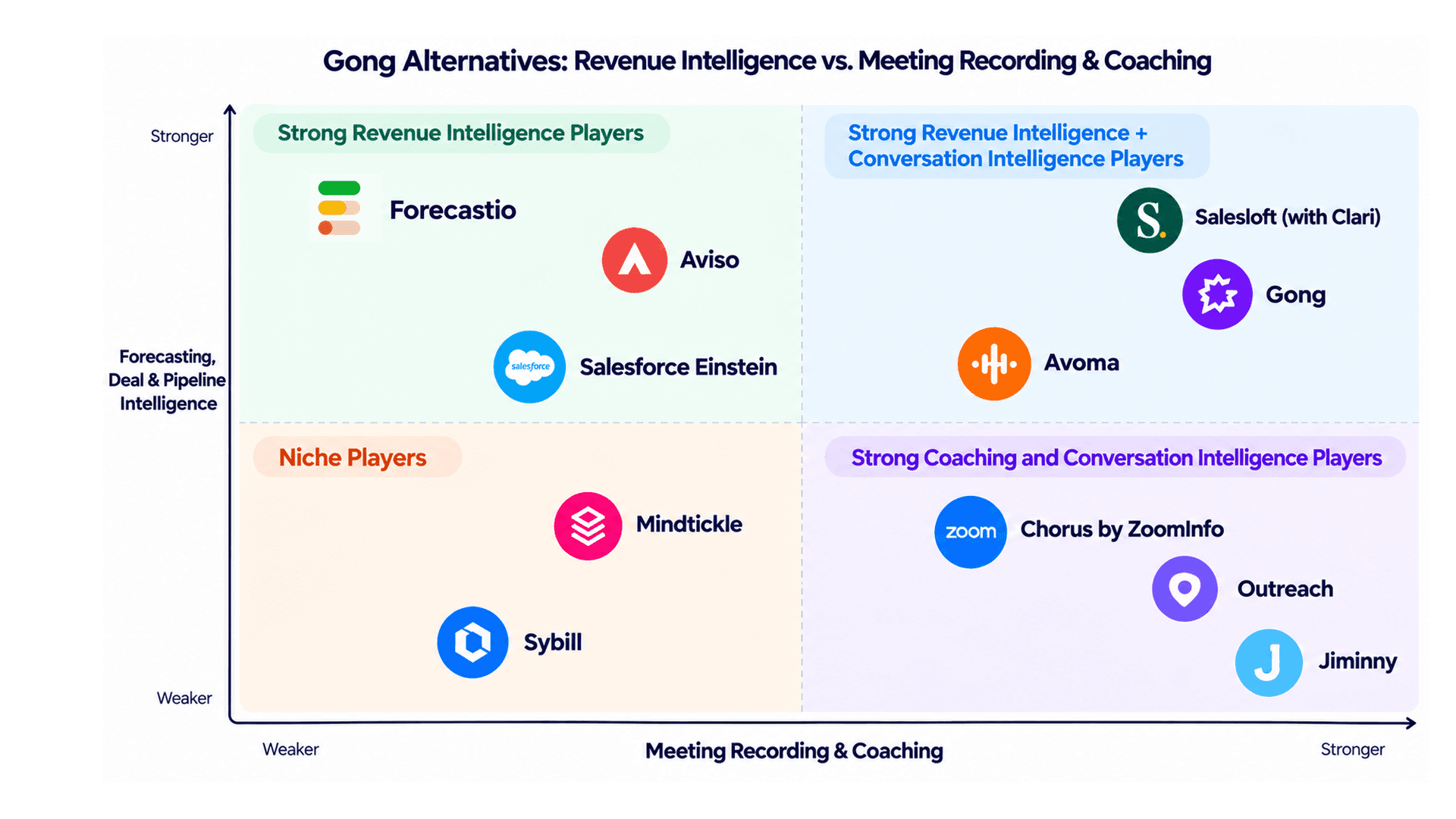
TL;DR: Best Gong Alternatives
Gong alternatives and Gong competitors span different specialties, no single tool matches Gong's exact mix of coaching and deal intelligence. Forecastio and Aviso lead on forecasting depth, Jiminny and Salesloft lead on live in-call coaching, and Chorus by ZoomInfo, Avoma, Outreach, Mindtickle, Salesforce Einstein, and Sybill each fit narrower needs, compared in full below.
Best for forecasting accuracy: Forecastio, Aviso, or Clari inside Salesloft
Best for live coaching: Jiminny or Salesloft
Best for revenue intelligence (deal and pipeline together): Forecastio or Aviso
Best for rep enablement and training: Mindtickle
Best if you're already running Salesforce: Salesforce Einstein/Agentforce
Best for lean, budget-conscious teams: Sybill or Forecastio
Why Are Sales Teams Looking for Gong Alternatives?
Most teams start evaluating Gong alternatives around renewal time. Gong doesn't publish pricing anywhere on its site. Forecasting isn't included in the core platform either; it's sold as a separate add-on. Reviewers also flag a steep learning curve, real AI accuracy issues, and integration gaps that show up in everyday customer interactions, not just on a dashboard, for teams running HubSpot instead of Salesforce.
No public pricing. Gong's pricing page doesn't list a single number. Teams contact sales, fill out a form by team size, and get a custom quote plus a separate platform fee, pricing that lands closer to enterprise prices than most lean teams budget for.
Forecasting costs extra. Sales forecasting can't be purchased as a standalone product. Customers have to license the core Gong platform first, then add Forecast or Forecast Essentials on top, according to Gong's own pricing page.
A real learning curve. It's one of G2's most common complaints, a standalone theme across 51 reviews, alongside AI accuracy issues (69 reviews) and missing features like real-time coaching (60 reviews).
HubSpot support has real gaps. Gong's own HubSpot integration FAQ confirms reps can't edit deal fields from inside Gong when HubSpot is the CRM, and only newly processed calls sync going forward. In Gong's own community forum, one admin called HubSpot support "incremental but still not sufficient," and said reps preferred staying in HubSpot's deal board over switching to Gong.
One contract, all or nothing. There's no way to trial a single module before buying the full platform, which raises the switching cost before a team even sees if it fits.
How We Compared These Tools
We compared these 10 platforms on seven criteria: forecasting depth, deal intelligence, pipeline intelligence, HubSpot and CRM sync, coaching capability, pricing transparency, and implementation speed. Together, these cover the two layers that matter most in a revenue intelligence platform, deal-level insight and pipeline-level insight, not just conversation intelligence at the call level.
Forecasting depth. Can it forecast on its own using AI, weighted pipeline, or statistical models, or does it just record calls for someone else to build the forecast?
Deal intelligence. Does it surface deal health and risk signals on its own, or does a rep have to dig through a dashboard to find where a deal actually stands?
Pipeline intelligence. Does it run waterfall analysis, sales cycle analysis, and pipeline stage analysis, giving real pipeline visibility across the whole book of business, or does reporting stop at a single deal?
HubSpot and CRM sync. Does it write back into HubSpot the way it does into Salesforce, or is HubSpot support an afterthought?
Coaching capability. Can a manager give real time coaching directly from a live call, tied to the team's own sales methodology, not just review a scorecard after the fact?
Pricing transparency. Is pricing public, or does a team have to contact sales just to get a number?
Implementation speed. Does the tool go live in days, or does it need a longer rollout with added professional services?
Deal intelligence earns its own criterion because the payoff is measurable: Gartner's May 2026 survey of 227 chief sales officers found that sales organizations providing AI-enabled next-best-action recommendations are 2.6 times more likely to achieve commercial growth.
For pricing, integration behavior, and forecasting models, we pulled from each vendor's own pricing and product pages, plus G2 and Capterra reviews, linked throughout the article. For Gong specifically, we also drew on our own side-by-side comparison of Forecastio's and Gong's forecasting capabilities.
Gong Competitors at a Glance
Ten Gong alternatives compared on forecast depth, deal intelligence, coaching, CRM sync, and starting price. Forecastio, Avoma, Salesforce, and Sybill are the only ones with public pricing, the rest require a custom quote. Salesforce Einstein is the only option with zero HubSpot support, and Outreach and Salesloft both advertise real-time HubSpot sync but carry documented reliability complaints from their own HubSpot marketplace reviews
Tool | Forecast Depth | Deal Intelligence | Coaching | Starting Price |
|---|---|---|---|---|
AI/ML models, 98% claimed | Pipeline inspection, at-risk tracking | Post-call only | Custom quote | |
AI forecasting + scenarios | AI risk alerts, deal health score | Real-time, live guidance | From $19/user/mo | |
Predictive forecasting | Relationship & momentum tracking | Post-call only | Custom quote | |
AI/ML models, time series, scenarios | Deal health & risk tracking, selling advice | Post-call only | From $49/user/mo | |
None | Deal summaries, risk signals | Real-time, live in-call | No public price (~$85 reported) | |
None | Limited, via call intelligence | Post-call + role-play | Custom quote | |
AI Forecast Projection | Deal Health Scores, auto fields | Real-time, live coaching | Custom quote | |
Hybrid AI/weighted rollups | Via Sales Cloud/Agentforce | Post-call only | $50–$125/user/mo add-on | |
AI Sales Forecasting | Deal Summary Agent, MEDDPICC autofill | Real-time, live coaching | Custom quote | |
None | Deal inspection, win/loss patterns | Post-call only | Free–$90/user/mo |
The Best Gong Alternatives, Reviewed
Ten Gong competitors compared in detail below, alphabetical, covering what each one actually does, where it's strong, what it costs, and how it stacks up against Gong specifically.
Aviso
Aviso is an AI revenue platform built around forecasting, using machine learning models to back a claimed 98% accuracy figure. It's the strongest fit for teams outside HubSpot and Salesforce, since it's the only tool on this list supporting Dynamics 365, Oracle, SAP, and Siebel too. Coaching stays post-call only.
Forecast depth
Aviso is an AI revenue platform built around forecasting, using a stack of machine learning models (LSTMs, gradient-boosted methods, NLP, Bayesian modeling) to back a claimed 98% forecast accuracy. Aviso doesn't publish the methodology behind that number, so it's worth treating as a vendor claim rather than a verified benchmark.
Deal intelligence
Aviso surfaces risk signals on stalling deals through an "Opportunity Map," a 2x2 matrix separating upside deals from at-risk ones, and its "Deal Acceleration" feature suggests next steps to keep stalled deals moving.
Pipeline intelligence
A real strength, not a bolt-on. Aviso's pipeline inspection tools track deal slippage directly, flag likely causes behind pipeline flux, and show historical pipe created against conversion rates and win distribution by category, effectively stage-by-stage pipeline analysis. One published case study on that same page cites a 23% cut in sales cycle time, from 168.6 to 129.5 days, after adoption. Aviso doesn't use the term "waterfall analysis" anywhere on its own site, but its quarter-over-quarter pipeline comparisons cover similar ground.
Coaching
Post-call only: reviewing buyer engagement and methodology adherence after the call ends, not during it.
CRM sync/support
CRM integration here is the broadest of any tool on this list: HubSpot, Salesforce, Microsoft Dynamics 365, Oracle, SAP, and Siebel. HubSpot's own marketplace listing confirms real-time, bi-directional sync with writeback, Aviso can auto-update deal details and log activity directly, not just record what already happened.
Pricing
Custom quote only, no published number.
Implementation speed
Mixed. Most G2 reviewers describe initial setup as quick and easy, but one enterprise reviewer reported a multi-module rollout that ran months past a promised six-week timeline, with the Salesforce integration specifically called out as slow.
Against Gong
broader CRM reach and deeper pipeline analytics are the clear edges, Gong doesn't support HubSpot as anything more than a secondary integration, and stage-level pipeline reporting isn't part of its core product. Coaching is a wash, both are post-call only. The forecasting accuracy claim is the one to verify against your own pipeline before trusting it.
Avoma
Avoma is an AI meeting assistant and conversation intelligence platform where real-time coaching, not forecasting, is the strongest feature: answer cards trigger mid-call around specific topics. Pricing is public and tiered starting at $19/seat/month, a rarer trait in this list, and it fits teams already on Salesforce more than HubSpot.
Forecast depth
Avoma is an AI meeting assistant and conversation intelligence platform that treats forecasting as a separate, paid add-on rather than a core feature. Avoma's own page claims its Revenue Intelligence module improves standard forecast accuracy by 15-25% by pulling in objective conversation data instead of relying only on rep-entered updates, but no named customer case study backs that range.
Deal intelligence.
Avoma's dashboards flag at-risk deals based on inactivity, ghosting patterns, or missing next steps, and its "Smart Trackers" pick up deals and churn risk signals from call phrasing. Reps get auto-generated follow-up emails to close activity gaps before a deal goes cold.
Pipeline intelligence
Lighter than Aviso's. Avoma's pipeline management centers on deal-health visualization and engagement-based risk flags, plus stage-progression rules tied to activity triggers, but doesn't publish slippage-rate tracking, sales-cycle-length analysis, or stage-by-stage conversion reporting the way Aviso does.
Coaching
This is where Avoma pulls ahead of Aviso: coaching here is genuinely real time, not just post-call. Avoma's coaching page describes "answer cards" that trigger mid-call around specific topics or keywords, on top of post-call scorecards for MEDDIC, BANT, SPICED, and SPIN, talk-to-listen ratio, filler-word counts, and sentiment per rep.
CRM sync/support
On Salesforce, Avoma's own integration page describes pushing structured data back to both standard and custom objects, including risk scores, deal-health alerts, and churn-risk signals mapped directly to Salesforce fields, notably richer than what crosses over elsewhere. On HubSpot, the sync stays one-way and more basic: notes, meeting participants, and deal records only. HubSpot's own marketplace listing puts Avoma at 4.3 out of 5 stars across 14 reviews, but one reviewer specifically flagged "can't get notes from Avoma to HubSpot" as a limitation despite praising the note quality itself.
Pricing
Public and tiered, according to Avoma's pricing page: Startup at $19/seat/month annually, Organization at $24, Enterprise at $39, all billed per seat, with Conversation Intelligence, Revenue Intelligence, and Lead Router add-ons priced separately at $29 each. A 14-day free trial covers the Organization plan with every add-on enabled, no credit card required, and viewer and collaborator seats stay free permanently.
Implementation speed
Fast to start, slower to master. G2 reviewers repeatedly call initial setup "easy" and "smooth," including one mid-market team that migrated cleanly off Gong. The learning curve shows up later: several reviewers describe the interface as overwhelming until they learn the shortcuts, since there's a lot to configure across all those modules.
Against Gong
pricing transparency and real-time coaching are Avoma's edges. Pipeline intelligence and CRM sync depth go the other way, Gong's native integrations run deeper and Avoma's one-way HubSpot connection can't write back. See our full Avoma vs. Gong comparison for the deeper breakdown.
Chorus by ZoomInfo
Chorus by ZoomInfo is a conversation intelligence platform backed by 14 machine-learning patents, now folded into ZoomInfo's broader GTM Studio suite. Its deal recommendation engine flags risk directly from call transcripts, and Salesforce sync runs deep and native. HubSpot support is the clear weak point, with a 1-star real-world rating.
Forecast depth
Chorus positions itself as a conversation intelligence platform, "the fastest growing Conversation Intelligence product in existence" per ZoomInfo's own product page, backed by 14 machine-learning patents. Its Revenue Intelligence System leans on relationship and deal visibility rather than a published forecast-accuracy number, there's no equivalent to Aviso's 98% or Avoma's 15-25% claim anywhere on ZoomInfo's site.
Deal intelligence
A patented "Deal Recommendation Engine" proactively detects and surfaces deal risk, and pipeline reviews blend CRM fields (stage, close date, deal size) with conversation insights like budget risk, competitor mentions, and legal roadblocks flagged directly from call transcripts.
Pipeline intelligence
Present but blended into deal intelligence rather than broken out on its own. The same recommendation engine flags stale or at-risk opportunities and tracks which interactions move a deal forward, but ZoomInfo doesn't publish dedicated slippage-rate or sales-cycle-length reporting the way Aviso does.
Coaching
Post-call only. Chorus curates a library of top calls for virtual call shadowing, lets managers rate performance and leave feedback through scorecards, and surfaces average talk time and filler-word counts automatically. Nothing on ZoomInfo's own sales coaching page describes live, in-call guidance.
CRM sync/support
On Salesforce, ZoomInfo's own integrations guide describes a native, bi-directional sync: call recordings, transcripts, and Trackers push automatically to the matching Account or Opportunity, activity logs from scheduled meetings, and custom Salesforce fields. On HubSpot, the picture is worse. HubSpot's own marketplace listing describes bi-directional sync on paper, but the real-world rating is 1 out of 5 stars from 2 reviews, one reporting that weeks into being a customer they "haven't been able to see HubSpot data in Chorus" at all, with no documentation on how to get Chorus calls and transcripts into HubSpot either.
Pricing
Custom quote only. ZoomInfo's own pricing page offers no published numbers and no advertised free trial, just a form to contact sales for a demo and quote.
Implementation speed
Mixed, and worth the naming note again here: the current G2 rating sits under "GTM Studio – Powered by ZoomInfo" (4.5 out of 5, 3,512 reviews) rather than "Chorus" alone, since ZoomInfo folded that review base in after its 2025 GTM Studio launch, with several reviewers naming Chorus specifically as the call-recording and transcription piece. Within those reviews, initial setup gets called "easy" and "plug and play" repeatedly, but one reviewer reported an integration that "took months" with "non-existent" CSM support
Against Gong
pricing is a wash, neither publishes a number. Deal risk detection and competitor-mention tracking are close calls too. The real gap is CRM depth, Gong's native integrations don't carry the same real-world complaints Chorus's HubSpot connection does right now. For more, see our Gong vs. Chorus comparison.
Forecastio
Forecastio is a HubSpot-native revenue intelligence platform built forecasting-first: five methodologies, an audit trail, and flexible what-if scenarios, with customers reporting up to 90-95% accuracy. We publish pricing outright, starting at $49/user/month. The honest tradeoffs: Salesforce isn't supported yet, and we don't have a live coaching or recording tool of our own.
Forecast depth
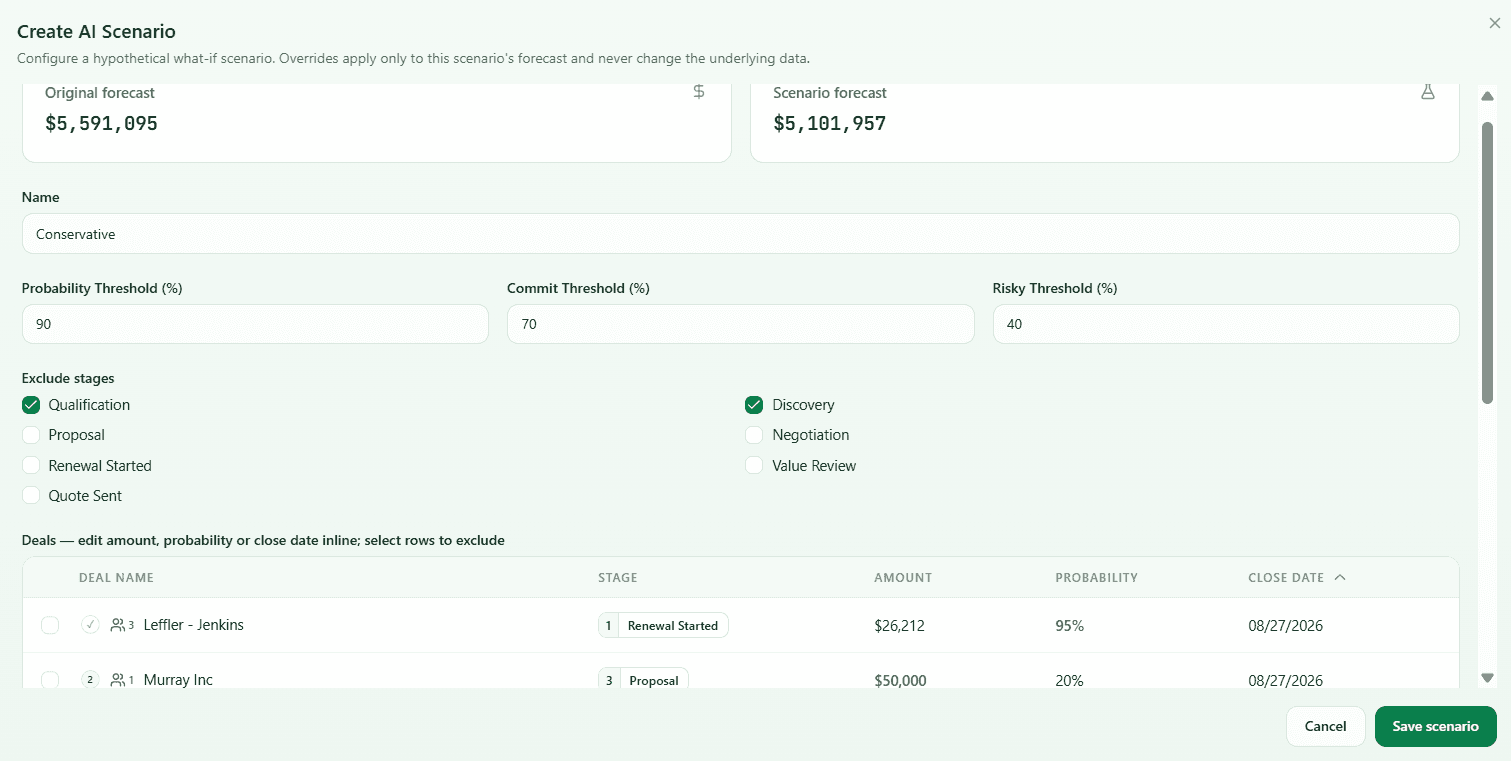
Forecasting is our core discipline, not an add-on: Forecastio runs time-series forecasting, automated stage probabilities, and what-if modeling, with customers reporting up to 90-95% accuracy. For how this compares across the market, see our guide to sales forecasting software. The Forecast Accuracy Agent audits data quality and process discipline to find what's lowering accuracy and recommends fixes. The Forecast Review Agent flags volatility and unsupported forecast growth for board-ready review; one published example surfaced 18 risks worth $3.1M in a single pass.
Deal intelligence
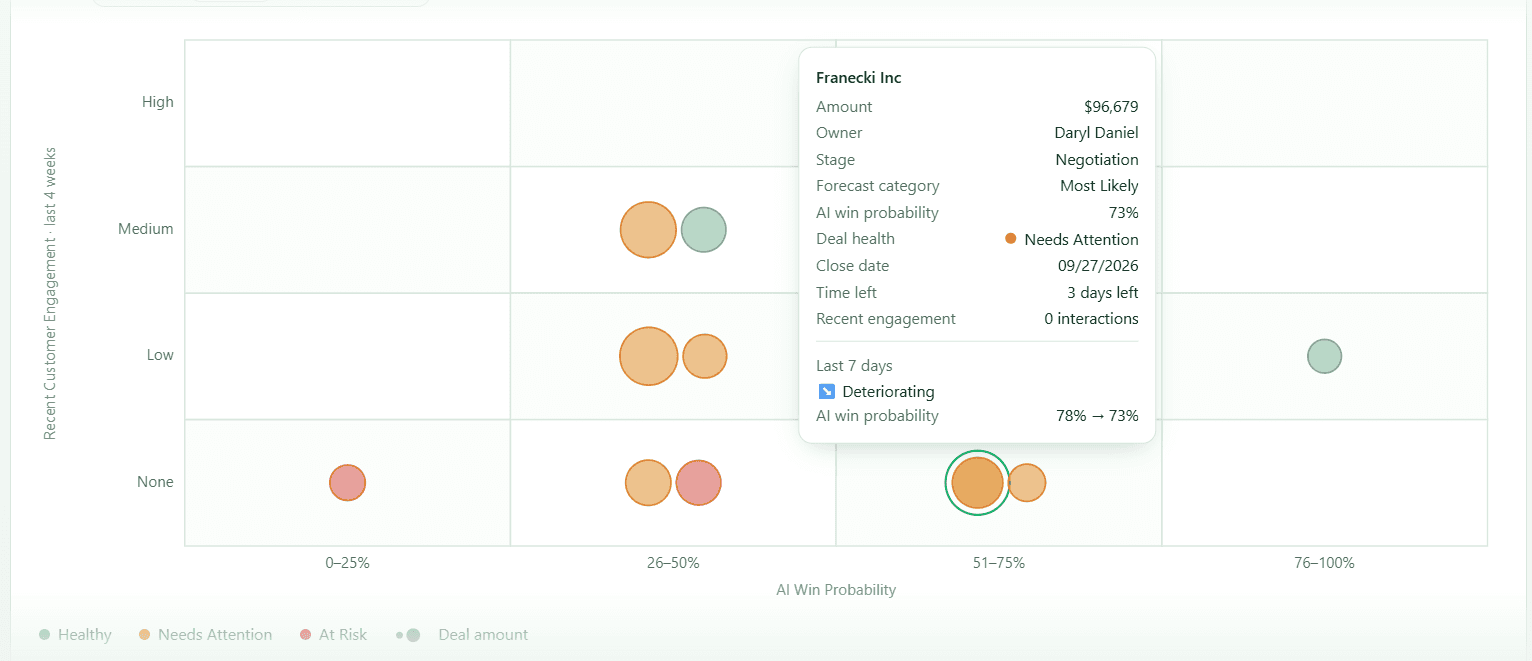
The Deal Review Agent flags risk signals, stalled deals, missing next steps, weak multithreading, slipping close dates, and recommends the next action. Call analysis feeds in here too: stakeholder engagement, sentiment, and selling recommendations pulled from sales calls and other information available in the CRM. Deal Maps tracks the handful of deals that matter most, showing execution trend, engagement change, and win probability trend in one view.
Pipeline intelligence
We treat this as its own discipline, not an extension of deal intelligence: waterfall analysis of where pipeline was created, pushed, or lost each quarter, deal slippage tracking, sales cycle analysis, stage-by-stage performance, and pipeline health overview.
Coaching
No live or post-call scorecards, and no recording or meeting tool of our own, a real gap next to Gong, Avoma, and Chorus. Call signals feed deal intelligence instead of a separate coaching layer. The Win/Loss Analysis Agent explains what to improve to increase win rates, pulled from a rep's or team's actual deal history.
CRM sync/support
HubSpot native, and that's it for now. Salesforce isn't supported yet; we're targeting a functional, bi-directional integration by the end of 2026, a roadmap item, not a current capability.
Pricing
Public and transparent, unlike Gong: $49 per user per month for Sales Forecasting, $69 per user per month for Forecasting & Revenue Intelligence, both billed annually. No custom quotes, no sales call required just to see a number.
Implementation speed
Fast by design: HubSpot-native means connecting the CRM is most of the setup. Initial implementation usually takes up to one week, while full implementation, including customizations and adjustments, never lasts more than 3-4 weeks. .
Against Gong
Forecasting method depth is the clearest gap. We support five forecasting methodologies, an advanced audit trail, and flexible what-if scenarios. Gong's forecasting, sold as an add-on to begin with, doesn't match any of the three. Pricing transparency and pipeline intelligence depth are wins too, Gong doesn't publish numbers and gates forecasting behind its base platform. Coaching format goes the other way: Gong centers on live and post-call scorecards from its own recording tool, we don't have one and fold call signals into deal intelligence and win-loss analysis instead.
Jiminny
Jiminny is a revenue and conversation intelligence platform built around live coaching: managers can join a call incognito and send real-time guidance mid-conversation, a rarer feature on this list. That strength doesn't carry into CRM sync, though, where both HubSpot and Salesforce run narrower than the marketplace listings suggest.
Forecast depth
Jiminny is a revenue intelligence and conversation intelligence platform, not a dedicated forecasting tool the way Forecastio is. Jiminny's own revenue intelligence page frames forecasting as grounded in "real-time data and insight-rich, AI-led analysis" rather than gut feel, but publishes no forecast-accuracy number and no distinct forecasting-methodology count the way Forecastio and Aviso do.
Deal intelligence
Deal summaries, stage progression, and forecast categories sit in one view, and Jiminny surfaces risk signals automatically: a new competitor mentioned, no next step scheduled, communication gone cold. Full pipeline visibility shows which deals are healthy and which are at risk at a glance.
Pipeline intelligence
Blended into deal intelligence rather than broken out, the same pattern as most Gong competitors on this list. Stage-progression tracking exists, but Jiminny doesn't publish dedicated waterfall, slippage-rate, or sales-cycle-length reporting.
Coaching
This is Jiminny's strongest parameter and a real point of separation from other Gong alternatives here. Live Coaching lets a manager join a call incognito and send real-time messages to the rep mid-conversation, genuine in-call guidance, not just a post-call scorecard. Those coaching notes stay attached to the recording for playback afterward, on top of standard call scoring and talk-time analysis.
CRM sync/support
Weaker than the marketing suggests on both CRMs. HubSpot's own marketplace listing advertises bi-directional sync, but Jiminny's own integration docs describe something narrower: Jiminny pulls HubSpot data only to match call participants, then pushes activity logs and optional deal-stage updates back, not a true two-way field sync. Salesforce runs the same way: Jiminny's Salesforce FAQ confirms it works through the REST API and a Chrome extension rather than a native package, creating tasks, events, or notes and optionally updating lead status or opportunity stage, one-way out, not native.
Pricing
Custom quote only. G2's pricing page lists a single Enterprise edition with pricing available on request, though a free trial is offered.
Implementation speed
Fast. G2 reviewers repeatedly call setup "straightforward" and "uncomplicated," including integrating with HubSpot and Zoom. One reviewer on HubSpot's own marketplace listing put the HubSpot install itself at five minutes.
Against Gong
Coaching is the clear edge, live in-call guidance is something most Gong competitors on this list don't offer, and Gong itself is post-call only. CRM depth is the weak spot on both major platforms, HubSpot and Salesforce alike run narrower than their marketing pages suggest.As a Gong competitor built around coaching, Jiminny fits teams whose priority is live rep guidance, not CRM depth or pipeline forecasting.
Mindtickle
Mindtickle is a revenue enablement platform first, a different category from most tools here: forecasting blends four methods, and coaching centers on AI-powered role-plays against an adaptive buyer rather than live call guidance. It's the strongest pick for teams ramping new reps at scale, not chasing pipeline accuracy.
Forecast depth
Mindtickle is a revenue enablement platform first, a different category from most other Gong alternatives on this list, and forecasting reflects that: its forecasting page blends four methods, historical, opportunity-stage, length-of-sales-cycle, and lead-driven. No accuracy percentage is published.
Deal intelligence
Deal risk gets flagged from what's actually said on calls and in emails, plus whether the right number and level of contacts accepted meeting invites, multithreading as a risk signal in practice. Pipeline visibility rolls up to whether a team or a rep has enough pipeline to hit goals, not just whether individual deals look healthy.
Pipeline intelligence
Length-of-sales-cycle forecasting is the closest thing to dedicated pipeline intelligence here, predicting when a deal is likely to close based on how long it's sat in each stage. No published waterfall, slippage-rate, or stage-conversion reporting beyond that.
Coaching
Mindtickle's strength, but a different shape of coaching than most Gong competitors here. Feedback is fast, but it's post-interaction and practice-based: AI-powered role-plays against an adaptive buyer, iterative feedback between attempts, and a Copilot that recommends next steps between calls, not live guidance during a real call the way Jiminny offers.
CRM sync/support
On HubSpot, the marketplace listing describes a mixed setup: HubSpot objects pull into Mindtickle's Call AI and map to recordings, while call data pushes back into HubSpot engagement records tied to Contacts, Companies, and Deals, genuinely closer to two-way than some vendors here, though the listing has zero reviews to verify real-world reliability. On Salesforce, Mindtickle embeds directly into the CRM workspace, with training progress, buyer engagement, and call insights written back automatically, but the page stops short of detailing field-level sync mechanics.
Pricing
Custom quote only, two packages, Enable and Readiness, both gated behind a sales conversation. No free trial. Buyer-benchmark data on G2's pricing page puts typical implementation around two months.
Implementation speed
Split by role. End users consistently call day-to-day setup easy on G2, but administrators describe a heavier lift: one reviewer said implementation "often requires significant time and dedicated enablement managers," consistent with that roughly two-month buyer-benchmark figure.
Against Gong
Category framing is really the story here. Mindtickle competes less on call intelligence and more as a broader enablement platform, which makes it a stronger Gong competitor for teams whose real gap is rep readiness and training, not pipeline forecasting or live call coaching. Pricing is a wash with Gong, neither publishes numbers, and implementation runs heavier on both sides than the faster-setup vendors elsewhere on this list.
Outreach
Outreach is a sales engagement platform first, cadences and sequences, with conversation intelligence layered on through its AI assistant Kaia. Real-time coaching is a genuine strength, Kaia delivers live content cards during calls, not just after. CRM sync looks strong on paper but carries real complaints on both HubSpot and Salesforce.
Forecast depth
Outreach is a sales engagement platform first, cadences, sequences, and outbound automation, with conversation intelligence and sales forecasting layered on as add-on modules rather than the core product. No forecast-accuracy claim or dedicated forecasting methodology appears anywhere on its site, unlike Forecastio or Aviso.
Deal intelligence
Kaia, Outreach's AI assistant, reads sentiment and context inside conversations, not just what was said but how, and surfaces topic trends across deals and sales stages to show where reps are winning and where they aren't. One stated result: meetings where Kaia participates see up to a 36% higher chance of a scheduled follow-up.
Pipeline intelligence
Thin. Outreach's own pages emphasize conversation topics and rep behavior over pipeline mechanics, no published waterfall analysis, slippage tracking, or stage-conversion reporting turned up anywhere on the site.
Coaching
Real time, and a genuine strength as a Gong alternative: Kaia delivers live content cards and conversation insights during the call itself, not just afterward, plus auto-generated meeting summaries and action items once it ends. No formal scorecard system or talk-time metrics appear anywhere, a lighter structure than Jiminny or Gong itself.
CRM sync/support
Strong on paper, weaker in practice on both platforms. On Salesforce, Outreach's own integration guide describes bi-directional sync, near-real-time outbound pushes (30-45 seconds) and 10-minute inbound polling, but task syncing stays one-way from Outreach out, and only covers activity that happened inside Outreach itself, work in personal inboxes or outside its workflow never reaches Salesforce. On HubSpot, the marketplace listing advertises real-time two-way sync, but the real-world rating is 1.8 out of 5 from 28 reviews, 54% of them 1-star, with reviewers citing incomplete activity syncing, inflexible field mapping, and duplicate records.
Pricing
Custom quote only across Standard, Professional, and Enterprise tiers, no public numbers. Buyer-benchmark data from Vendr shows a wide range in practice, roughly $8,580 to $213,832 a year depending on seats and add-ons, with Kaia and conversation intelligence priced as extras on top of the base tier.
Implementation speed
Fast to turn on, slow to master. G2 reviewers call initial setup "quite easy" and describe it taking minutes, but several describe onboarding a new hire as taking weeks, not days, because of how dense the interface is.
Against Gong
Real-time coaching is a genuine edge as a Gong competitor, Kaia works in the moment, Gong's coaching stays post-call. Pricing transparency and pipeline intelligence depth go the other way, matching most other Gong competitors here in lacking published numbers or dedicated pipeline reporting. CRM sync is the clearest weak spot of any vendor on this list so far, real complaints on both major platforms, not just one. See our Gong vs. Outreach comparison for more.
Salesforce Einstein (Agentforce for Sales)
Salesforce Einstein and Agentforce bring AI natively inside Salesforce itself: forecasting from historical and weighted pipeline rollups, deal scoring built on existing CRM data, and post-call coaching through Conversation Insights. The pitch is different from every other vendor here, not best-in-class conversation intelligence, but AI already living inside the CRM a team runs on.
Forecast depth
Einstein Sales Forecasting predicts closing amounts from historical pipeline data across Best Case and Commit categories, broken down into wins from existing deals, new opportunities, and deals pulled in from later periods. Salesforce doesn't publish an accuracy percentage or name its underlying models, and no what-if scenario modeling is documented anywhere in the feature.
Deal intelligence
Built on whatever data already lives in the CRM, deal scoring and next-best-action recommendations surface inside the record itself rather than a separate dashboard. Because it's native, deal intelligence here is only as complete as a team's own data hygiene, more exposure to garbage-in-garbage-out than a purpose-built layer like Forecastio's Deal Review Agent.
Pipeline intelligence
Thin and scattered across Sales Cloud reporting rather than packaged as one feature. No dedicated slippage tracking or sales-cycle-length reporting turned up in Salesforce's own documentation, teams typically build this themselves with custom reports or a third-party layer instead.
Coaching
Post-call, not live. Einstein Conversation Insights analyzes recordings after the fact: transcripts, talk-to-listen ratio, longest monologue, action items. Call Coaching tracks competencies across a team over time, but nothing in Salesforce's own documentation describes real-time, in-call guidance the way Jiminny or Outreach's Kaia does.
CRM sync/support
A different question than for every other vendor on this list, this is the CRM, so native Salesforce support is total by definition. HubSpot is the interesting case: the connection that exists is HubSpot's own integration, built and maintained by HubSpot, not Salesforce, syncing contacts, companies, deals, and activities bi-directionally. Worth naming plainly for a HubSpot-native audience: choosing Salesforce Einstein means living inside Salesforce, HubSpot becomes the connected secondary system, not the other way around.
Pricing
Public, unlike Gong, but layered. Salesforce's own pricing page lists six tiers from $25 to $550 per user per month, and Einstein Sales Forecasting requires at least Pro Suite ($100). The deepest AI, Agentforce for Sales and Agentforce Coworker, only comes fully included at $550/user/month, Max tier, everything below that pays for it as an add-on.
Implementation speed
Slow relative to the purpose-built tools on this list. G2 reviewers describe the setup as "complex," requiring "significant time and resources" and often specialized help, with a steep learning curve showing up repeatedly across reviews.
Against Gong
Pricing structure is the real story, Salesforce publishes numbers but gates its best AI behind its most expensive tier, so total cost lands closer to Gong's opacity than it first appears. As a Gong competitor, the pitch is different from every other vendor here: not best-in-class conversation intelligence, but AI that's already inside the CRM a team runs on.
Salesloft
Salesloft absorbed Clari in a 2026 merger, and forecasting kept the Clari name: an AI Forecast Agent analyzes historical and live rep activity. Live coaching is a real strength too, battlecards trigger automatically mid-call. Salesforce sync runs deep and real-time; HubSpot sync is structurally partial, and reviewers call it "literally useless."
Forecast depth
Salesloft absorbed Clari in a 2026 merger, and forecasting specifically kept the Clari name even after the rebrand, now sold as part of Salesloft's forecasting suite. An AI Forecast Agent analyzes historical deal data and live rep activity. No dedicated what-if scenario modeling or forecasting-methodology count is documented, unlike Forecastio's five.
Deal intelligence
Live rep and deal activity feed into pipeline reporting so risk surfaces before it becomes a forecast problem: which deals are stalling, filterable by bookings, renewals, region, segment, or account size. Risks trigger next-best-action tasks directly in a rep's workflow rather than sitting in a separate report.
Pipeline intelligence
Present through the same activity-and-risk feed as deal intelligence rather than broken out as its own discipline. No published waterfall analysis, slippage-rate tracking, or sales-cycle-length reporting turned up anywhere on Salesloft's site.
Coaching
Real time and a genuine strength as a Gong alternative: battlecards surface live during a call, one documented example shows a card triggering automatically the moment a rep hears the word "discount." Coachable moments become tasks in a rep's workflow rather than sitting in a review queue, on top of post-call summaries, follow-up emails, and automated CRM updates.
CRM sync/support
Strong claims on Salesforce, real complaints on HubSpot. On Salesforce, Salesloft's own page describes real-time, bi-directional sync, more than 30 activity properties pushed to the CRM, account-based field mapping, and a choice of which platform takes priority per field. On HubSpot, the story flips: the marketplace listing sits at 1 out of 5 stars from 2 reviews, one calling the integration "literally useless" after three months and a paid consultant setup, another reporting Salesloft frequently "doesn't work inside of my HubSpot" at all. Sync is also only partial by design there: opportunities flow one-way from HubSpot in, activities one-way from Salesloft out, only contacts and accounts sync both directions.
Pricing
Custom quote only across Essentials, Advanced, and Premier tiers, no published numbers. Buyer-benchmark data from Vendr puts typical per-seat costs around $60-170 a month depending on tier, with Conversations, Rhythm, and Deals priced as separate add-ons on top.
Implementation speed
Slower than most of this list. G2 reviewers describe implementation as "heavy," needing clean Salesforce data, well-defined sales stages, and 4-6 weeks of onboarding to work as intended, though a few call initial setup itself easy when no major integration work is required.
Against Gong
Forecasting depth is a real edge post-Clari merger, five methodologies aside, Salesloft can now credibly compete with Forecastio and Aviso here in a way pure conversation-intelligence Gong competitors can't. Coaching goes the same direction, live in-call guidance beats Gong's post-call-only model. See our Gong vs. Salesloft comparison, and on the forecasting side specifically, Clari vs. Gong.
Sybill
Sybill doesn't position itself as a forecasting tool at all; deal intelligence is the core product, reading calls, emails, and Slack threads together to flag stalled champions and hesitation cues. It's the most transparent, fastest-to-set-up vendor on this list after Forecastio, published pricing, setup in minutes. Coaching is the clear gap, post-call only, no live guidance.
Forecast depth
Sybill doesn't position itself as a forecasting tool at all, no dedicated forecasting page, no accuracy claim, no methodology. It's built as a conversational intelligence layer that feeds data into whatever pipeline or forecasting system a team already runs, closer to Jiminny and Outreach in category than to Forecastio or Aviso.
Deal intelligence
This is the core product. Sybill reads calls, meetings, emails, and Slack threads together, picks up emotional and behavioral cues like hesitation during pricing discussions, and flags deal-level signals such as a stalled champion or a missing follow-up. Ask Sybill in plain English and it answers with citations back to the actual calls, "what does my top rep do differently" is the kind of question it's built to handle.
Pipeline intelligence
Feeds into it rather than owning it. Sybill auto-fills budget, decision maker, timeline, risk, and competitor fields after every conversation and structures that data for both humans and LLMs to query, but it's positioned as pipeline enrichment, not a standalone pipeline-analytics product with its own waterfall or slippage reporting.
Coaching
Post-call only, and a real gap next to Jiminny or Salesloft. G2 reviewers describe summaries, transcripts, and insights delivered after a meeting ends, useful for leadership coaching conversations in review, but one reviewer specifically flagged the absence of in-call, ask-a-question functionality compared to Gong's live assistant.
CRM sync/support
Both platforms treated as first-class, per Sybill's own claim, though the depth has real limits either way. Sybill's CRM Autofill pushes updates to HubSpot, Salesforce, Zoho, and Dynamics 365 after every call, but it can only fill top-level fields on standard objects, text, numbers, single- or multi-select dropdowns, and explicitly cannot fill nested structures, multi-field custom objects, or attach files.
Pricing
The most transparent vendor on this list after Forecastio. Sybill's own pricing page publishes every tier: Free at $0, Pro at $30/user/month, Business at $90/user/month, and custom Enterprise pricing, plus a 14-day free trial of the Business plan with no credit card required.
Implementation speed
The fastest of any vendor covered here. G2 reviewers report integration times measured in minutes, two minutes for one reviewer, five for another using Google single sign-on, under fifteen for a Gmail setup.
Against Gong
Pricing transparency and implementation speed are clear wins, publishing real numbers and setting up in minutes beats Gong's custom-quote, sales-call-gated model outright. Coaching is the clear loss, no live in-call guidance at all, a step behind Gong and well behind Jiminny or Salesloft among the Gong alternatives on this list. As a Gong competitor, Sybill fits teams whose priority is clean, automatic CRM data and deal-level insight, not real-time rep coaching
Forecastio vs. Gong: Where Each One Wins
Forecastio and Gong solve different problems well. We lead on forecasting depth, pricing transparency, and HubSpot-native support; deal intelligence is a shared strength, built differently by each (see our roundup of deal intelligence tools for how other platforms handle it). Gong leads on Salesforce support, native call recording and coaching, and sheer market maturity, a decade in the category against our two years.
Capability | Forecastio | Gong |
|---|---|---|
Forecasting Methodologies | Five forecasting methodologies: AI/ML models, time series, weighted pipeline, forecast categories and submissions | One integrated AI model |
What-if scenario modeling | Flexible scenario modeling (probability thresholds, deals exclusion, amount and close date hypothesis, probability scenario) | No documented interactive what-if tool; |
Audit trail | Advanced audit trail built in for each forecasting model | Not documented anywhere in Gong's own help center |
Deal intelligence | Deal Review Agent flags risk signals, stalled deals, missing next steps, weak multithreading, and slipping close dates, and recommends the next action; call analysis feeds stakeholder engagement and sentiment into the same view | Deal Board and Deal Warnings flag healthy vs. at-risk deals from inactivity; Engagement Map tracks multithreading; Account Page centralizes deal-related interactions across email, calls, and web conferencing |
Pricing transparency | Public: $49/user/mo forecasting, $69/user/mo forecasting + revenue intelligence | Custom quote only, no published number |
HubSpot support | Native | Secondary integration; Gong's own HubSpot FAQ confirms reps can't edit deal fields, and only newly processed calls sync going forward |
Salesforce support | Not supported yet, targeted for a functional bi-directional integration by end of 2026 | Native |
Call recording & coaching | No recording or coaching tool of our own; call signals feed into deal intelligence and win-loss analysis instead | Own recording tool, with live and post-call scorecards |
Maturity | A newer entrant, about two years in market, still building its track record | Founded 2015, more than 5,000 customers and over $500M in ARR as of May 2026, per Gong's own press release |
Which Gong Alternative Is Right for Your Team?
The right choice among Gong competitors depends on what's actually broken today: revenue leaders chasing forecasting accuracy land on Forecastio, Aviso, or Clari inside Salesloft; sales leaders who need live in-call coaching go with Jiminny or Salesloft; teams wanting broader revenue intelligence look at Forecastio or Aviso; and mid-market teams already committed to Salesforce, or small teams on a tight budget, have narrower, faster-fit options below. For where these tools fit inside a broader revenue operations stack, see our guide to RevOps tools.
If forecasting accuracy is your top priority
Forecastio, Aviso, and Clari (now part of Salesloft) are the strongest Gong alternatives for this specific need, the only three on this list with a named forecasting methodology behind the number, not a side feature. We'd point a team outside HubSpot and Salesforce, on Dynamics 365, Oracle, SAP, or Siebel, toward Aviso specifically, since it's the only one of the three that supports those CRMs. Inside HubSpot, Forecastio's the more transparent buy, public pricing, no sales call required. Salesloft (Clari) fits best if forecasting and live coaching both matter, since it's the only one of the three that does both natively.
If you need live coaching and classic conversation intelligence
Jiminny, Salesloft, and Outreach all deliver real-time, in-call guidance, not just a post-call scorecard, the closest match to what Gong itself does well. Jiminny is the more focused buy if coaching is the actual priority and forecasting isn't, its CRM sync is the weakest of the three. Salesloft and Outreach both fold conversation intelligence into a broader sales-engagement platform, a better fit for teams that also want sequencing and cadence tooling in the same seat.
If you want deal and pipeline intelligence together, not just forecasting
Forecastio and Aviso both treat pipeline intelligence, waterfall analysis, slippage tracking, stage-by-stage performance, as its own discipline rather than folding it into deal intelligence, the gap most vendors on this list leave open. Salesloft post-merger gets close too, layering Clari's forecasting depth on top of its own deal intelligence, though its pipeline reporting isn't as explicitly broken out as Forecastio's or Aviso's.
If rep enablement and training matter as much as call intelligence
Mindtickle is the outlier on this list for a reason, it's a revenue enablement platform first, built around role-play, scorecards, and structured onboarding, not call recording.We'd recommend it specifically for sales managers ramping new reps at scale, where the gap isn't deal visibility, it's getting reps competent faster.
If you're already running on Salesforce and don't want another vendor
Salesforce Einstein and Agentforce are the practical choice if the CRM itself is non-negotiable and adding a new tool isn't worth the implementation lift. The tradeoff is real: coaching stays post-call only, pipeline intelligence is thinner than the purpose-built tools here, and the deepest AI is gated behind Salesforce's most expensive tier.
If you're a lean team that needs to move fast on a budget
Sybill and Forecastio are the two most transparent, fastest-to-set-up options on this list, published pricing, no sales call, setup measured in minutes for Sybill and about a few days for Forecastio. Sybill trades that speed for post-call-only coaching and no forecasting at all; Forecastio trades it for no Salesforce support yet.
Gong Alternatives FAQ
What are the best alternatives to Gong?
The strongest Gong alternatives depend on what a team actually needs: Forecastio and Aviso for forecasting depth and deal intelligence, Jiminny and Salesloft for live in-call coaching, and Chorus by ZoomInfo, Avoma, Outreach, and Sybill for broader conversation intelligence. The full breakdown of all ten, compared on pricing, CRM support, and coaching depth, is above.
What are the cheapest Gong alternatives?
Sybill and Forecastio publish the most transparent, lowest-cost pricing on this list: Sybill starts free with a $30/user/month Pro tier, and Forecastio starts at $49/user/month for forecasting alone. Every other tool covered here, including Gong itself, requires a custom quote with no published starting price.
Is Gong an Israeli company?
Gong was founded by Israeli entrepreneurs Amit Bendov and Eilon Reshef and is widely described as Israeli-founded, with a significant R&D office in Tel Aviv, but it isn't headquartered there exclusively. Gong's own office list includes San Francisco, Chicago, New York, Austin, Lehi, Singapore, and Dublin alongside Tel Aviv, with San Francisco listed first.
Does Gong replace Salesforce?
No. Gong's own documentation confirms it can technically run without a CRM using Auto Context, but it's built to sync with one, not substitute for it. It connects natively to Salesforce, HubSpot, or Microsoft Dynamics 365, one at a time, enhancing whichever CRM a team already runs rather than replacing it.
Does Google use Gong?
Yes. A Google Ads sales team, led by Director of Product Strategy Mike Chen, uses Gong's Scorecards, Smart Trackers, and Call Library. Gong's own case study cites a measurable weekly revenue increase in one sales segment and reps recovering about 12% of their time each year.
Who does Gong compete with?
The ten Gong alternatives and Gong competitors covered in this guide span several categories: purpose-built forecasting tools (Forecastio, Aviso), conversation-intelligence platforms (Chorus by ZoomInfo, Jiminny, Sybill), sales-engagement platforms with conversation intelligence layered in (Outreach, Salesloft), a revenue-enablement platform (Mindtickle), Avoma's hybrid approach, and Salesforce's own native Einstein and Agentforce tools.
Who are Gong's biggest competitors?
Based on organic search results and Google's AI Overview citations for "gong alternatives" and "gong competitors," the names that come up most consistently include Chorus by ZoomInfo, Clari (now merged into Salesloft), Avoma, Outreach, Aviso, Jiminny, Mindtickle, Salesforce Einstein/Agentforce, and Sybill, nine of which this guide covers in detail, alongside Forecastio.
Is Gong a competitor of Salesforce?
Not directly, they're different categories: Salesforce is a CRM, Gong is a conversation-intelligence layer that sits on top of one. That said, Salesforce has built its own competing feature set, Einstein Conversation Insights and Agentforce, which puts native Salesforce AI in more direct competition with Gong than it was a few years ago.
TL;DR: Best Gong Alternatives
Gong alternatives and Gong competitors span different specialties, no single tool matches Gong's exact mix of coaching and deal intelligence. Forecastio and Aviso lead on forecasting depth, Jiminny and Salesloft lead on live in-call coaching, and Chorus by ZoomInfo, Avoma, Outreach, Mindtickle, Salesforce Einstein, and Sybill each fit narrower needs, compared in full below.
Best for forecasting accuracy: Forecastio, Aviso, or Clari inside Salesloft
Best for live coaching: Jiminny or Salesloft
Best for revenue intelligence (deal and pipeline together): Forecastio or Aviso
Best for rep enablement and training: Mindtickle
Best if you're already running Salesforce: Salesforce Einstein/Agentforce
Best for lean, budget-conscious teams: Sybill or Forecastio
Why Are Sales Teams Looking for Gong Alternatives?
Most teams start evaluating Gong alternatives around renewal time. Gong doesn't publish pricing anywhere on its site. Forecasting isn't included in the core platform either; it's sold as a separate add-on. Reviewers also flag a steep learning curve, real AI accuracy issues, and integration gaps that show up in everyday customer interactions, not just on a dashboard, for teams running HubSpot instead of Salesforce.
No public pricing. Gong's pricing page doesn't list a single number. Teams contact sales, fill out a form by team size, and get a custom quote plus a separate platform fee, pricing that lands closer to enterprise prices than most lean teams budget for.
Forecasting costs extra. Sales forecasting can't be purchased as a standalone product. Customers have to license the core Gong platform first, then add Forecast or Forecast Essentials on top, according to Gong's own pricing page.
A real learning curve. It's one of G2's most common complaints, a standalone theme across 51 reviews, alongside AI accuracy issues (69 reviews) and missing features like real-time coaching (60 reviews).
HubSpot support has real gaps. Gong's own HubSpot integration FAQ confirms reps can't edit deal fields from inside Gong when HubSpot is the CRM, and only newly processed calls sync going forward. In Gong's own community forum, one admin called HubSpot support "incremental but still not sufficient," and said reps preferred staying in HubSpot's deal board over switching to Gong.
One contract, all or nothing. There's no way to trial a single module before buying the full platform, which raises the switching cost before a team even sees if it fits.
How We Compared These Tools
We compared these 10 platforms on seven criteria: forecasting depth, deal intelligence, pipeline intelligence, HubSpot and CRM sync, coaching capability, pricing transparency, and implementation speed. Together, these cover the two layers that matter most in a revenue intelligence platform, deal-level insight and pipeline-level insight, not just conversation intelligence at the call level.
Forecasting depth. Can it forecast on its own using AI, weighted pipeline, or statistical models, or does it just record calls for someone else to build the forecast?
Deal intelligence. Does it surface deal health and risk signals on its own, or does a rep have to dig through a dashboard to find where a deal actually stands?
Pipeline intelligence. Does it run waterfall analysis, sales cycle analysis, and pipeline stage analysis, giving real pipeline visibility across the whole book of business, or does reporting stop at a single deal?
HubSpot and CRM sync. Does it write back into HubSpot the way it does into Salesforce, or is HubSpot support an afterthought?
Coaching capability. Can a manager give real time coaching directly from a live call, tied to the team's own sales methodology, not just review a scorecard after the fact?
Pricing transparency. Is pricing public, or does a team have to contact sales just to get a number?
Implementation speed. Does the tool go live in days, or does it need a longer rollout with added professional services?
Deal intelligence earns its own criterion because the payoff is measurable: Gartner's May 2026 survey of 227 chief sales officers found that sales organizations providing AI-enabled next-best-action recommendations are 2.6 times more likely to achieve commercial growth.
For pricing, integration behavior, and forecasting models, we pulled from each vendor's own pricing and product pages, plus G2 and Capterra reviews, linked throughout the article. For Gong specifically, we also drew on our own side-by-side comparison of Forecastio's and Gong's forecasting capabilities.
Gong Competitors at a Glance
Ten Gong alternatives compared on forecast depth, deal intelligence, coaching, CRM sync, and starting price. Forecastio, Avoma, Salesforce, and Sybill are the only ones with public pricing, the rest require a custom quote. Salesforce Einstein is the only option with zero HubSpot support, and Outreach and Salesloft both advertise real-time HubSpot sync but carry documented reliability complaints from their own HubSpot marketplace reviews
Tool | Forecast Depth | Deal Intelligence | Coaching | Starting Price |
|---|---|---|---|---|
AI/ML models, 98% claimed | Pipeline inspection, at-risk tracking | Post-call only | Custom quote | |
AI forecasting + scenarios | AI risk alerts, deal health score | Real-time, live guidance | From $19/user/mo | |
Predictive forecasting | Relationship & momentum tracking | Post-call only | Custom quote | |
AI/ML models, time series, scenarios | Deal health & risk tracking, selling advice | Post-call only | From $49/user/mo | |
None | Deal summaries, risk signals | Real-time, live in-call | No public price (~$85 reported) | |
None | Limited, via call intelligence | Post-call + role-play | Custom quote | |
AI Forecast Projection | Deal Health Scores, auto fields | Real-time, live coaching | Custom quote | |
Hybrid AI/weighted rollups | Via Sales Cloud/Agentforce | Post-call only | $50–$125/user/mo add-on | |
AI Sales Forecasting | Deal Summary Agent, MEDDPICC autofill | Real-time, live coaching | Custom quote | |
None | Deal inspection, win/loss patterns | Post-call only | Free–$90/user/mo |
The Best Gong Alternatives, Reviewed
Ten Gong competitors compared in detail below, alphabetical, covering what each one actually does, where it's strong, what it costs, and how it stacks up against Gong specifically.
Aviso
Aviso is an AI revenue platform built around forecasting, using machine learning models to back a claimed 98% accuracy figure. It's the strongest fit for teams outside HubSpot and Salesforce, since it's the only tool on this list supporting Dynamics 365, Oracle, SAP, and Siebel too. Coaching stays post-call only.
Forecast depth
Aviso is an AI revenue platform built around forecasting, using a stack of machine learning models (LSTMs, gradient-boosted methods, NLP, Bayesian modeling) to back a claimed 98% forecast accuracy. Aviso doesn't publish the methodology behind that number, so it's worth treating as a vendor claim rather than a verified benchmark.
Deal intelligence
Aviso surfaces risk signals on stalling deals through an "Opportunity Map," a 2x2 matrix separating upside deals from at-risk ones, and its "Deal Acceleration" feature suggests next steps to keep stalled deals moving.
Pipeline intelligence
A real strength, not a bolt-on. Aviso's pipeline inspection tools track deal slippage directly, flag likely causes behind pipeline flux, and show historical pipe created against conversion rates and win distribution by category, effectively stage-by-stage pipeline analysis. One published case study on that same page cites a 23% cut in sales cycle time, from 168.6 to 129.5 days, after adoption. Aviso doesn't use the term "waterfall analysis" anywhere on its own site, but its quarter-over-quarter pipeline comparisons cover similar ground.
Coaching
Post-call only: reviewing buyer engagement and methodology adherence after the call ends, not during it.
CRM sync/support
CRM integration here is the broadest of any tool on this list: HubSpot, Salesforce, Microsoft Dynamics 365, Oracle, SAP, and Siebel. HubSpot's own marketplace listing confirms real-time, bi-directional sync with writeback, Aviso can auto-update deal details and log activity directly, not just record what already happened.
Pricing
Custom quote only, no published number.
Implementation speed
Mixed. Most G2 reviewers describe initial setup as quick and easy, but one enterprise reviewer reported a multi-module rollout that ran months past a promised six-week timeline, with the Salesforce integration specifically called out as slow.
Against Gong
broader CRM reach and deeper pipeline analytics are the clear edges, Gong doesn't support HubSpot as anything more than a secondary integration, and stage-level pipeline reporting isn't part of its core product. Coaching is a wash, both are post-call only. The forecasting accuracy claim is the one to verify against your own pipeline before trusting it.
Avoma
Avoma is an AI meeting assistant and conversation intelligence platform where real-time coaching, not forecasting, is the strongest feature: answer cards trigger mid-call around specific topics. Pricing is public and tiered starting at $19/seat/month, a rarer trait in this list, and it fits teams already on Salesforce more than HubSpot.
Forecast depth
Avoma is an AI meeting assistant and conversation intelligence platform that treats forecasting as a separate, paid add-on rather than a core feature. Avoma's own page claims its Revenue Intelligence module improves standard forecast accuracy by 15-25% by pulling in objective conversation data instead of relying only on rep-entered updates, but no named customer case study backs that range.
Deal intelligence.
Avoma's dashboards flag at-risk deals based on inactivity, ghosting patterns, or missing next steps, and its "Smart Trackers" pick up deals and churn risk signals from call phrasing. Reps get auto-generated follow-up emails to close activity gaps before a deal goes cold.
Pipeline intelligence
Lighter than Aviso's. Avoma's pipeline management centers on deal-health visualization and engagement-based risk flags, plus stage-progression rules tied to activity triggers, but doesn't publish slippage-rate tracking, sales-cycle-length analysis, or stage-by-stage conversion reporting the way Aviso does.
Coaching
This is where Avoma pulls ahead of Aviso: coaching here is genuinely real time, not just post-call. Avoma's coaching page describes "answer cards" that trigger mid-call around specific topics or keywords, on top of post-call scorecards for MEDDIC, BANT, SPICED, and SPIN, talk-to-listen ratio, filler-word counts, and sentiment per rep.
CRM sync/support
On Salesforce, Avoma's own integration page describes pushing structured data back to both standard and custom objects, including risk scores, deal-health alerts, and churn-risk signals mapped directly to Salesforce fields, notably richer than what crosses over elsewhere. On HubSpot, the sync stays one-way and more basic: notes, meeting participants, and deal records only. HubSpot's own marketplace listing puts Avoma at 4.3 out of 5 stars across 14 reviews, but one reviewer specifically flagged "can't get notes from Avoma to HubSpot" as a limitation despite praising the note quality itself.
Pricing
Public and tiered, according to Avoma's pricing page: Startup at $19/seat/month annually, Organization at $24, Enterprise at $39, all billed per seat, with Conversation Intelligence, Revenue Intelligence, and Lead Router add-ons priced separately at $29 each. A 14-day free trial covers the Organization plan with every add-on enabled, no credit card required, and viewer and collaborator seats stay free permanently.
Implementation speed
Fast to start, slower to master. G2 reviewers repeatedly call initial setup "easy" and "smooth," including one mid-market team that migrated cleanly off Gong. The learning curve shows up later: several reviewers describe the interface as overwhelming until they learn the shortcuts, since there's a lot to configure across all those modules.
Against Gong
pricing transparency and real-time coaching are Avoma's edges. Pipeline intelligence and CRM sync depth go the other way, Gong's native integrations run deeper and Avoma's one-way HubSpot connection can't write back. See our full Avoma vs. Gong comparison for the deeper breakdown.
Chorus by ZoomInfo
Chorus by ZoomInfo is a conversation intelligence platform backed by 14 machine-learning patents, now folded into ZoomInfo's broader GTM Studio suite. Its deal recommendation engine flags risk directly from call transcripts, and Salesforce sync runs deep and native. HubSpot support is the clear weak point, with a 1-star real-world rating.
Forecast depth
Chorus positions itself as a conversation intelligence platform, "the fastest growing Conversation Intelligence product in existence" per ZoomInfo's own product page, backed by 14 machine-learning patents. Its Revenue Intelligence System leans on relationship and deal visibility rather than a published forecast-accuracy number, there's no equivalent to Aviso's 98% or Avoma's 15-25% claim anywhere on ZoomInfo's site.
Deal intelligence
A patented "Deal Recommendation Engine" proactively detects and surfaces deal risk, and pipeline reviews blend CRM fields (stage, close date, deal size) with conversation insights like budget risk, competitor mentions, and legal roadblocks flagged directly from call transcripts.
Pipeline intelligence
Present but blended into deal intelligence rather than broken out on its own. The same recommendation engine flags stale or at-risk opportunities and tracks which interactions move a deal forward, but ZoomInfo doesn't publish dedicated slippage-rate or sales-cycle-length reporting the way Aviso does.
Coaching
Post-call only. Chorus curates a library of top calls for virtual call shadowing, lets managers rate performance and leave feedback through scorecards, and surfaces average talk time and filler-word counts automatically. Nothing on ZoomInfo's own sales coaching page describes live, in-call guidance.
CRM sync/support
On Salesforce, ZoomInfo's own integrations guide describes a native, bi-directional sync: call recordings, transcripts, and Trackers push automatically to the matching Account or Opportunity, activity logs from scheduled meetings, and custom Salesforce fields. On HubSpot, the picture is worse. HubSpot's own marketplace listing describes bi-directional sync on paper, but the real-world rating is 1 out of 5 stars from 2 reviews, one reporting that weeks into being a customer they "haven't been able to see HubSpot data in Chorus" at all, with no documentation on how to get Chorus calls and transcripts into HubSpot either.
Pricing
Custom quote only. ZoomInfo's own pricing page offers no published numbers and no advertised free trial, just a form to contact sales for a demo and quote.
Implementation speed
Mixed, and worth the naming note again here: the current G2 rating sits under "GTM Studio – Powered by ZoomInfo" (4.5 out of 5, 3,512 reviews) rather than "Chorus" alone, since ZoomInfo folded that review base in after its 2025 GTM Studio launch, with several reviewers naming Chorus specifically as the call-recording and transcription piece. Within those reviews, initial setup gets called "easy" and "plug and play" repeatedly, but one reviewer reported an integration that "took months" with "non-existent" CSM support
Against Gong
pricing is a wash, neither publishes a number. Deal risk detection and competitor-mention tracking are close calls too. The real gap is CRM depth, Gong's native integrations don't carry the same real-world complaints Chorus's HubSpot connection does right now. For more, see our Gong vs. Chorus comparison.
Forecastio
Forecastio is a HubSpot-native revenue intelligence platform built forecasting-first: five methodologies, an audit trail, and flexible what-if scenarios, with customers reporting up to 90-95% accuracy. We publish pricing outright, starting at $49/user/month. The honest tradeoffs: Salesforce isn't supported yet, and we don't have a live coaching or recording tool of our own.
Forecast depth
Forecasting is our core discipline, not an add-on: Forecastio runs time-series forecasting, automated stage probabilities, and what-if modeling, with customers reporting up to 90-95% accuracy. For how this compares across the market, see our guide to sales forecasting software. The Forecast Accuracy Agent audits data quality and process discipline to find what's lowering accuracy and recommends fixes. The Forecast Review Agent flags volatility and unsupported forecast growth for board-ready review; one published example surfaced 18 risks worth $3.1M in a single pass.
Deal intelligence
The Deal Review Agent flags risk signals, stalled deals, missing next steps, weak multithreading, slipping close dates, and recommends the next action. Call analysis feeds in here too: stakeholder engagement, sentiment, and selling recommendations pulled from sales calls and other information available in the CRM. Deal Maps tracks the handful of deals that matter most, showing execution trend, engagement change, and win probability trend in one view.
Pipeline intelligence
We treat this as its own discipline, not an extension of deal intelligence: waterfall analysis of where pipeline was created, pushed, or lost each quarter, deal slippage tracking, sales cycle analysis, stage-by-stage performance, and pipeline health overview.
Coaching
No live or post-call scorecards, and no recording or meeting tool of our own, a real gap next to Gong, Avoma, and Chorus. Call signals feed deal intelligence instead of a separate coaching layer. The Win/Loss Analysis Agent explains what to improve to increase win rates, pulled from a rep's or team's actual deal history.
CRM sync/support
HubSpot native, and that's it for now. Salesforce isn't supported yet; we're targeting a functional, bi-directional integration by the end of 2026, a roadmap item, not a current capability.
Pricing
Public and transparent, unlike Gong: $49 per user per month for Sales Forecasting, $69 per user per month for Forecasting & Revenue Intelligence, both billed annually. No custom quotes, no sales call required just to see a number.
Implementation speed
Fast by design: HubSpot-native means connecting the CRM is most of the setup. Initial implementation usually takes up to one week, while full implementation, including customizations and adjustments, never lasts more than 3-4 weeks. .
Against Gong
Forecasting method depth is the clearest gap. We support five forecasting methodologies, an advanced audit trail, and flexible what-if scenarios. Gong's forecasting, sold as an add-on to begin with, doesn't match any of the three. Pricing transparency and pipeline intelligence depth are wins too, Gong doesn't publish numbers and gates forecasting behind its base platform. Coaching format goes the other way: Gong centers on live and post-call scorecards from its own recording tool, we don't have one and fold call signals into deal intelligence and win-loss analysis instead.
Jiminny
Jiminny is a revenue and conversation intelligence platform built around live coaching: managers can join a call incognito and send real-time guidance mid-conversation, a rarer feature on this list. That strength doesn't carry into CRM sync, though, where both HubSpot and Salesforce run narrower than the marketplace listings suggest.
Forecast depth
Jiminny is a revenue intelligence and conversation intelligence platform, not a dedicated forecasting tool the way Forecastio is. Jiminny's own revenue intelligence page frames forecasting as grounded in "real-time data and insight-rich, AI-led analysis" rather than gut feel, but publishes no forecast-accuracy number and no distinct forecasting-methodology count the way Forecastio and Aviso do.
Deal intelligence
Deal summaries, stage progression, and forecast categories sit in one view, and Jiminny surfaces risk signals automatically: a new competitor mentioned, no next step scheduled, communication gone cold. Full pipeline visibility shows which deals are healthy and which are at risk at a glance.
Pipeline intelligence
Blended into deal intelligence rather than broken out, the same pattern as most Gong competitors on this list. Stage-progression tracking exists, but Jiminny doesn't publish dedicated waterfall, slippage-rate, or sales-cycle-length reporting.
Coaching
This is Jiminny's strongest parameter and a real point of separation from other Gong alternatives here. Live Coaching lets a manager join a call incognito and send real-time messages to the rep mid-conversation, genuine in-call guidance, not just a post-call scorecard. Those coaching notes stay attached to the recording for playback afterward, on top of standard call scoring and talk-time analysis.
CRM sync/support
Weaker than the marketing suggests on both CRMs. HubSpot's own marketplace listing advertises bi-directional sync, but Jiminny's own integration docs describe something narrower: Jiminny pulls HubSpot data only to match call participants, then pushes activity logs and optional deal-stage updates back, not a true two-way field sync. Salesforce runs the same way: Jiminny's Salesforce FAQ confirms it works through the REST API and a Chrome extension rather than a native package, creating tasks, events, or notes and optionally updating lead status or opportunity stage, one-way out, not native.
Pricing
Custom quote only. G2's pricing page lists a single Enterprise edition with pricing available on request, though a free trial is offered.
Implementation speed
Fast. G2 reviewers repeatedly call setup "straightforward" and "uncomplicated," including integrating with HubSpot and Zoom. One reviewer on HubSpot's own marketplace listing put the HubSpot install itself at five minutes.
Against Gong
Coaching is the clear edge, live in-call guidance is something most Gong competitors on this list don't offer, and Gong itself is post-call only. CRM depth is the weak spot on both major platforms, HubSpot and Salesforce alike run narrower than their marketing pages suggest.As a Gong competitor built around coaching, Jiminny fits teams whose priority is live rep guidance, not CRM depth or pipeline forecasting.
Mindtickle
Mindtickle is a revenue enablement platform first, a different category from most tools here: forecasting blends four methods, and coaching centers on AI-powered role-plays against an adaptive buyer rather than live call guidance. It's the strongest pick for teams ramping new reps at scale, not chasing pipeline accuracy.
Forecast depth
Mindtickle is a revenue enablement platform first, a different category from most other Gong alternatives on this list, and forecasting reflects that: its forecasting page blends four methods, historical, opportunity-stage, length-of-sales-cycle, and lead-driven. No accuracy percentage is published.
Deal intelligence
Deal risk gets flagged from what's actually said on calls and in emails, plus whether the right number and level of contacts accepted meeting invites, multithreading as a risk signal in practice. Pipeline visibility rolls up to whether a team or a rep has enough pipeline to hit goals, not just whether individual deals look healthy.
Pipeline intelligence
Length-of-sales-cycle forecasting is the closest thing to dedicated pipeline intelligence here, predicting when a deal is likely to close based on how long it's sat in each stage. No published waterfall, slippage-rate, or stage-conversion reporting beyond that.
Coaching
Mindtickle's strength, but a different shape of coaching than most Gong competitors here. Feedback is fast, but it's post-interaction and practice-based: AI-powered role-plays against an adaptive buyer, iterative feedback between attempts, and a Copilot that recommends next steps between calls, not live guidance during a real call the way Jiminny offers.
CRM sync/support
On HubSpot, the marketplace listing describes a mixed setup: HubSpot objects pull into Mindtickle's Call AI and map to recordings, while call data pushes back into HubSpot engagement records tied to Contacts, Companies, and Deals, genuinely closer to two-way than some vendors here, though the listing has zero reviews to verify real-world reliability. On Salesforce, Mindtickle embeds directly into the CRM workspace, with training progress, buyer engagement, and call insights written back automatically, but the page stops short of detailing field-level sync mechanics.
Pricing
Custom quote only, two packages, Enable and Readiness, both gated behind a sales conversation. No free trial. Buyer-benchmark data on G2's pricing page puts typical implementation around two months.
Implementation speed
Split by role. End users consistently call day-to-day setup easy on G2, but administrators describe a heavier lift: one reviewer said implementation "often requires significant time and dedicated enablement managers," consistent with that roughly two-month buyer-benchmark figure.
Against Gong
Category framing is really the story here. Mindtickle competes less on call intelligence and more as a broader enablement platform, which makes it a stronger Gong competitor for teams whose real gap is rep readiness and training, not pipeline forecasting or live call coaching. Pricing is a wash with Gong, neither publishes numbers, and implementation runs heavier on both sides than the faster-setup vendors elsewhere on this list.
Outreach
Outreach is a sales engagement platform first, cadences and sequences, with conversation intelligence layered on through its AI assistant Kaia. Real-time coaching is a genuine strength, Kaia delivers live content cards during calls, not just after. CRM sync looks strong on paper but carries real complaints on both HubSpot and Salesforce.
Forecast depth
Outreach is a sales engagement platform first, cadences, sequences, and outbound automation, with conversation intelligence and sales forecasting layered on as add-on modules rather than the core product. No forecast-accuracy claim or dedicated forecasting methodology appears anywhere on its site, unlike Forecastio or Aviso.
Deal intelligence
Kaia, Outreach's AI assistant, reads sentiment and context inside conversations, not just what was said but how, and surfaces topic trends across deals and sales stages to show where reps are winning and where they aren't. One stated result: meetings where Kaia participates see up to a 36% higher chance of a scheduled follow-up.
Pipeline intelligence
Thin. Outreach's own pages emphasize conversation topics and rep behavior over pipeline mechanics, no published waterfall analysis, slippage tracking, or stage-conversion reporting turned up anywhere on the site.
Coaching
Real time, and a genuine strength as a Gong alternative: Kaia delivers live content cards and conversation insights during the call itself, not just afterward, plus auto-generated meeting summaries and action items once it ends. No formal scorecard system or talk-time metrics appear anywhere, a lighter structure than Jiminny or Gong itself.
CRM sync/support
Strong on paper, weaker in practice on both platforms. On Salesforce, Outreach's own integration guide describes bi-directional sync, near-real-time outbound pushes (30-45 seconds) and 10-minute inbound polling, but task syncing stays one-way from Outreach out, and only covers activity that happened inside Outreach itself, work in personal inboxes or outside its workflow never reaches Salesforce. On HubSpot, the marketplace listing advertises real-time two-way sync, but the real-world rating is 1.8 out of 5 from 28 reviews, 54% of them 1-star, with reviewers citing incomplete activity syncing, inflexible field mapping, and duplicate records.
Pricing
Custom quote only across Standard, Professional, and Enterprise tiers, no public numbers. Buyer-benchmark data from Vendr shows a wide range in practice, roughly $8,580 to $213,832 a year depending on seats and add-ons, with Kaia and conversation intelligence priced as extras on top of the base tier.
Implementation speed
Fast to turn on, slow to master. G2 reviewers call initial setup "quite easy" and describe it taking minutes, but several describe onboarding a new hire as taking weeks, not days, because of how dense the interface is.
Against Gong
Real-time coaching is a genuine edge as a Gong competitor, Kaia works in the moment, Gong's coaching stays post-call. Pricing transparency and pipeline intelligence depth go the other way, matching most other Gong competitors here in lacking published numbers or dedicated pipeline reporting. CRM sync is the clearest weak spot of any vendor on this list so far, real complaints on both major platforms, not just one. See our Gong vs. Outreach comparison for more.
Salesforce Einstein (Agentforce for Sales)
Salesforce Einstein and Agentforce bring AI natively inside Salesforce itself: forecasting from historical and weighted pipeline rollups, deal scoring built on existing CRM data, and post-call coaching through Conversation Insights. The pitch is different from every other vendor here, not best-in-class conversation intelligence, but AI already living inside the CRM a team runs on.
Forecast depth
Einstein Sales Forecasting predicts closing amounts from historical pipeline data across Best Case and Commit categories, broken down into wins from existing deals, new opportunities, and deals pulled in from later periods. Salesforce doesn't publish an accuracy percentage or name its underlying models, and no what-if scenario modeling is documented anywhere in the feature.
Deal intelligence
Built on whatever data already lives in the CRM, deal scoring and next-best-action recommendations surface inside the record itself rather than a separate dashboard. Because it's native, deal intelligence here is only as complete as a team's own data hygiene, more exposure to garbage-in-garbage-out than a purpose-built layer like Forecastio's Deal Review Agent.
Pipeline intelligence
Thin and scattered across Sales Cloud reporting rather than packaged as one feature. No dedicated slippage tracking or sales-cycle-length reporting turned up in Salesforce's own documentation, teams typically build this themselves with custom reports or a third-party layer instead.
Coaching
Post-call, not live. Einstein Conversation Insights analyzes recordings after the fact: transcripts, talk-to-listen ratio, longest monologue, action items. Call Coaching tracks competencies across a team over time, but nothing in Salesforce's own documentation describes real-time, in-call guidance the way Jiminny or Outreach's Kaia does.
CRM sync/support
A different question than for every other vendor on this list, this is the CRM, so native Salesforce support is total by definition. HubSpot is the interesting case: the connection that exists is HubSpot's own integration, built and maintained by HubSpot, not Salesforce, syncing contacts, companies, deals, and activities bi-directionally. Worth naming plainly for a HubSpot-native audience: choosing Salesforce Einstein means living inside Salesforce, HubSpot becomes the connected secondary system, not the other way around.
Pricing
Public, unlike Gong, but layered. Salesforce's own pricing page lists six tiers from $25 to $550 per user per month, and Einstein Sales Forecasting requires at least Pro Suite ($100). The deepest AI, Agentforce for Sales and Agentforce Coworker, only comes fully included at $550/user/month, Max tier, everything below that pays for it as an add-on.
Implementation speed
Slow relative to the purpose-built tools on this list. G2 reviewers describe the setup as "complex," requiring "significant time and resources" and often specialized help, with a steep learning curve showing up repeatedly across reviews.
Against Gong
Pricing structure is the real story, Salesforce publishes numbers but gates its best AI behind its most expensive tier, so total cost lands closer to Gong's opacity than it first appears. As a Gong competitor, the pitch is different from every other vendor here: not best-in-class conversation intelligence, but AI that's already inside the CRM a team runs on.
Salesloft
Salesloft absorbed Clari in a 2026 merger, and forecasting kept the Clari name: an AI Forecast Agent analyzes historical and live rep activity. Live coaching is a real strength too, battlecards trigger automatically mid-call. Salesforce sync runs deep and real-time; HubSpot sync is structurally partial, and reviewers call it "literally useless."
Forecast depth
Salesloft absorbed Clari in a 2026 merger, and forecasting specifically kept the Clari name even after the rebrand, now sold as part of Salesloft's forecasting suite. An AI Forecast Agent analyzes historical deal data and live rep activity. No dedicated what-if scenario modeling or forecasting-methodology count is documented, unlike Forecastio's five.
Deal intelligence
Live rep and deal activity feed into pipeline reporting so risk surfaces before it becomes a forecast problem: which deals are stalling, filterable by bookings, renewals, region, segment, or account size. Risks trigger next-best-action tasks directly in a rep's workflow rather than sitting in a separate report.
Pipeline intelligence
Present through the same activity-and-risk feed as deal intelligence rather than broken out as its own discipline. No published waterfall analysis, slippage-rate tracking, or sales-cycle-length reporting turned up anywhere on Salesloft's site.
Coaching
Real time and a genuine strength as a Gong alternative: battlecards surface live during a call, one documented example shows a card triggering automatically the moment a rep hears the word "discount." Coachable moments become tasks in a rep's workflow rather than sitting in a review queue, on top of post-call summaries, follow-up emails, and automated CRM updates.
CRM sync/support
Strong claims on Salesforce, real complaints on HubSpot. On Salesforce, Salesloft's own page describes real-time, bi-directional sync, more than 30 activity properties pushed to the CRM, account-based field mapping, and a choice of which platform takes priority per field. On HubSpot, the story flips: the marketplace listing sits at 1 out of 5 stars from 2 reviews, one calling the integration "literally useless" after three months and a paid consultant setup, another reporting Salesloft frequently "doesn't work inside of my HubSpot" at all. Sync is also only partial by design there: opportunities flow one-way from HubSpot in, activities one-way from Salesloft out, only contacts and accounts sync both directions.
Pricing
Custom quote only across Essentials, Advanced, and Premier tiers, no published numbers. Buyer-benchmark data from Vendr puts typical per-seat costs around $60-170 a month depending on tier, with Conversations, Rhythm, and Deals priced as separate add-ons on top.
Implementation speed
Slower than most of this list. G2 reviewers describe implementation as "heavy," needing clean Salesforce data, well-defined sales stages, and 4-6 weeks of onboarding to work as intended, though a few call initial setup itself easy when no major integration work is required.
Against Gong
Forecasting depth is a real edge post-Clari merger, five methodologies aside, Salesloft can now credibly compete with Forecastio and Aviso here in a way pure conversation-intelligence Gong competitors can't. Coaching goes the same direction, live in-call guidance beats Gong's post-call-only model. See our Gong vs. Salesloft comparison, and on the forecasting side specifically, Clari vs. Gong.
Sybill
Sybill doesn't position itself as a forecasting tool at all; deal intelligence is the core product, reading calls, emails, and Slack threads together to flag stalled champions and hesitation cues. It's the most transparent, fastest-to-set-up vendor on this list after Forecastio, published pricing, setup in minutes. Coaching is the clear gap, post-call only, no live guidance.
Forecast depth
Sybill doesn't position itself as a forecasting tool at all, no dedicated forecasting page, no accuracy claim, no methodology. It's built as a conversational intelligence layer that feeds data into whatever pipeline or forecasting system a team already runs, closer to Jiminny and Outreach in category than to Forecastio or Aviso.
Deal intelligence
This is the core product. Sybill reads calls, meetings, emails, and Slack threads together, picks up emotional and behavioral cues like hesitation during pricing discussions, and flags deal-level signals such as a stalled champion or a missing follow-up. Ask Sybill in plain English and it answers with citations back to the actual calls, "what does my top rep do differently" is the kind of question it's built to handle.
Pipeline intelligence
Feeds into it rather than owning it. Sybill auto-fills budget, decision maker, timeline, risk, and competitor fields after every conversation and structures that data for both humans and LLMs to query, but it's positioned as pipeline enrichment, not a standalone pipeline-analytics product with its own waterfall or slippage reporting.
Coaching
Post-call only, and a real gap next to Jiminny or Salesloft. G2 reviewers describe summaries, transcripts, and insights delivered after a meeting ends, useful for leadership coaching conversations in review, but one reviewer specifically flagged the absence of in-call, ask-a-question functionality compared to Gong's live assistant.
CRM sync/support
Both platforms treated as first-class, per Sybill's own claim, though the depth has real limits either way. Sybill's CRM Autofill pushes updates to HubSpot, Salesforce, Zoho, and Dynamics 365 after every call, but it can only fill top-level fields on standard objects, text, numbers, single- or multi-select dropdowns, and explicitly cannot fill nested structures, multi-field custom objects, or attach files.
Pricing
The most transparent vendor on this list after Forecastio. Sybill's own pricing page publishes every tier: Free at $0, Pro at $30/user/month, Business at $90/user/month, and custom Enterprise pricing, plus a 14-day free trial of the Business plan with no credit card required.
Implementation speed
The fastest of any vendor covered here. G2 reviewers report integration times measured in minutes, two minutes for one reviewer, five for another using Google single sign-on, under fifteen for a Gmail setup.
Against Gong
Pricing transparency and implementation speed are clear wins, publishing real numbers and setting up in minutes beats Gong's custom-quote, sales-call-gated model outright. Coaching is the clear loss, no live in-call guidance at all, a step behind Gong and well behind Jiminny or Salesloft among the Gong alternatives on this list. As a Gong competitor, Sybill fits teams whose priority is clean, automatic CRM data and deal-level insight, not real-time rep coaching
Forecastio vs. Gong: Where Each One Wins
Forecastio and Gong solve different problems well. We lead on forecasting depth, pricing transparency, and HubSpot-native support; deal intelligence is a shared strength, built differently by each (see our roundup of deal intelligence tools for how other platforms handle it). Gong leads on Salesforce support, native call recording and coaching, and sheer market maturity, a decade in the category against our two years.
Capability | Forecastio | Gong |
|---|---|---|
Forecasting Methodologies | Five forecasting methodologies: AI/ML models, time series, weighted pipeline, forecast categories and submissions | One integrated AI model |
What-if scenario modeling | Flexible scenario modeling (probability thresholds, deals exclusion, amount and close date hypothesis, probability scenario) | No documented interactive what-if tool; |
Audit trail | Advanced audit trail built in for each forecasting model | Not documented anywhere in Gong's own help center |
Deal intelligence | Deal Review Agent flags risk signals, stalled deals, missing next steps, weak multithreading, and slipping close dates, and recommends the next action; call analysis feeds stakeholder engagement and sentiment into the same view | Deal Board and Deal Warnings flag healthy vs. at-risk deals from inactivity; Engagement Map tracks multithreading; Account Page centralizes deal-related interactions across email, calls, and web conferencing |
Pricing transparency | Public: $49/user/mo forecasting, $69/user/mo forecasting + revenue intelligence | Custom quote only, no published number |
HubSpot support | Native | Secondary integration; Gong's own HubSpot FAQ confirms reps can't edit deal fields, and only newly processed calls sync going forward |
Salesforce support | Not supported yet, targeted for a functional bi-directional integration by end of 2026 | Native |
Call recording & coaching | No recording or coaching tool of our own; call signals feed into deal intelligence and win-loss analysis instead | Own recording tool, with live and post-call scorecards |
Maturity | A newer entrant, about two years in market, still building its track record | Founded 2015, more than 5,000 customers and over $500M in ARR as of May 2026, per Gong's own press release |
Which Gong Alternative Is Right for Your Team?
The right choice among Gong competitors depends on what's actually broken today: revenue leaders chasing forecasting accuracy land on Forecastio, Aviso, or Clari inside Salesloft; sales leaders who need live in-call coaching go with Jiminny or Salesloft; teams wanting broader revenue intelligence look at Forecastio or Aviso; and mid-market teams already committed to Salesforce, or small teams on a tight budget, have narrower, faster-fit options below. For where these tools fit inside a broader revenue operations stack, see our guide to RevOps tools.
If forecasting accuracy is your top priority
Forecastio, Aviso, and Clari (now part of Salesloft) are the strongest Gong alternatives for this specific need, the only three on this list with a named forecasting methodology behind the number, not a side feature. We'd point a team outside HubSpot and Salesforce, on Dynamics 365, Oracle, SAP, or Siebel, toward Aviso specifically, since it's the only one of the three that supports those CRMs. Inside HubSpot, Forecastio's the more transparent buy, public pricing, no sales call required. Salesloft (Clari) fits best if forecasting and live coaching both matter, since it's the only one of the three that does both natively.
If you need live coaching and classic conversation intelligence
Jiminny, Salesloft, and Outreach all deliver real-time, in-call guidance, not just a post-call scorecard, the closest match to what Gong itself does well. Jiminny is the more focused buy if coaching is the actual priority and forecasting isn't, its CRM sync is the weakest of the three. Salesloft and Outreach both fold conversation intelligence into a broader sales-engagement platform, a better fit for teams that also want sequencing and cadence tooling in the same seat.
If you want deal and pipeline intelligence together, not just forecasting
Forecastio and Aviso both treat pipeline intelligence, waterfall analysis, slippage tracking, stage-by-stage performance, as its own discipline rather than folding it into deal intelligence, the gap most vendors on this list leave open. Salesloft post-merger gets close too, layering Clari's forecasting depth on top of its own deal intelligence, though its pipeline reporting isn't as explicitly broken out as Forecastio's or Aviso's.
If rep enablement and training matter as much as call intelligence
Mindtickle is the outlier on this list for a reason, it's a revenue enablement platform first, built around role-play, scorecards, and structured onboarding, not call recording.We'd recommend it specifically for sales managers ramping new reps at scale, where the gap isn't deal visibility, it's getting reps competent faster.
If you're already running on Salesforce and don't want another vendor
Salesforce Einstein and Agentforce are the practical choice if the CRM itself is non-negotiable and adding a new tool isn't worth the implementation lift. The tradeoff is real: coaching stays post-call only, pipeline intelligence is thinner than the purpose-built tools here, and the deepest AI is gated behind Salesforce's most expensive tier.
If you're a lean team that needs to move fast on a budget
Sybill and Forecastio are the two most transparent, fastest-to-set-up options on this list, published pricing, no sales call, setup measured in minutes for Sybill and about a few days for Forecastio. Sybill trades that speed for post-call-only coaching and no forecasting at all; Forecastio trades it for no Salesforce support yet.
Gong Alternatives FAQ
What are the best alternatives to Gong?
The strongest Gong alternatives depend on what a team actually needs: Forecastio and Aviso for forecasting depth and deal intelligence, Jiminny and Salesloft for live in-call coaching, and Chorus by ZoomInfo, Avoma, Outreach, and Sybill for broader conversation intelligence. The full breakdown of all ten, compared on pricing, CRM support, and coaching depth, is above.
What are the cheapest Gong alternatives?
Sybill and Forecastio publish the most transparent, lowest-cost pricing on this list: Sybill starts free with a $30/user/month Pro tier, and Forecastio starts at $49/user/month for forecasting alone. Every other tool covered here, including Gong itself, requires a custom quote with no published starting price.
Is Gong an Israeli company?
Gong was founded by Israeli entrepreneurs Amit Bendov and Eilon Reshef and is widely described as Israeli-founded, with a significant R&D office in Tel Aviv, but it isn't headquartered there exclusively. Gong's own office list includes San Francisco, Chicago, New York, Austin, Lehi, Singapore, and Dublin alongside Tel Aviv, with San Francisco listed first.
Does Gong replace Salesforce?
No. Gong's own documentation confirms it can technically run without a CRM using Auto Context, but it's built to sync with one, not substitute for it. It connects natively to Salesforce, HubSpot, or Microsoft Dynamics 365, one at a time, enhancing whichever CRM a team already runs rather than replacing it.
Does Google use Gong?
Yes. A Google Ads sales team, led by Director of Product Strategy Mike Chen, uses Gong's Scorecards, Smart Trackers, and Call Library. Gong's own case study cites a measurable weekly revenue increase in one sales segment and reps recovering about 12% of their time each year.
Who does Gong compete with?
The ten Gong alternatives and Gong competitors covered in this guide span several categories: purpose-built forecasting tools (Forecastio, Aviso), conversation-intelligence platforms (Chorus by ZoomInfo, Jiminny, Sybill), sales-engagement platforms with conversation intelligence layered in (Outreach, Salesloft), a revenue-enablement platform (Mindtickle), Avoma's hybrid approach, and Salesforce's own native Einstein and Agentforce tools.
Who are Gong's biggest competitors?
Based on organic search results and Google's AI Overview citations for "gong alternatives" and "gong competitors," the names that come up most consistently include Chorus by ZoomInfo, Clari (now merged into Salesloft), Avoma, Outreach, Aviso, Jiminny, Mindtickle, Salesforce Einstein/Agentforce, and Sybill, nine of which this guide covers in detail, alongside Forecastio.
Is Gong a competitor of Salesforce?
Not directly, they're different categories: Salesforce is a CRM, Gong is a conversation-intelligence layer that sits on top of one. That said, Salesforce has built its own competing feature set, Einstein Conversation Insights and Agentforce, which puts native Salesforce AI in more direct competition with Gong than it was a few years ago.
Share:
Alex is the CEO at Forecastio, bringing nearly 20 years of experience as a B2B sales leader in the tech industry. His expertise spans Revenue Intelligence, Revenue Operations, sales forecasting, go-to-market strategy, and sales process optimization, with a focus on helping revenue teams improve performance, increase forecast accuracy, and make better data-driven decisions.
Alex is the CEO at Forecastio, bringing nearly 20 years of experience as a B2B sales leader in the tech industry. His expertise spans Revenue Intelligence, Revenue Operations, sales forecasting, go-to-market strategy, and sales process optimization, with a focus on helping revenue teams improve performance, increase forecast accuracy, and make better data-driven decisions.
Related articles
Revenue Operations
Sep 24, 2026
14 min
Sales Tools
Sep 22, 2026
15 min
Revenue Operations
Aug 14, 2026
14 min
Revenue Operations
Sep 24, 2026
14 min
Sales Tools
Sep 22, 2026
15 min
Revenue Operations
Sep 24, 2026
14 min
Sales Tools
Sep 22, 2026
15 min
Sales Planning
Sales Forecasting
Sales Performance Insights
Sales Planning
Sales Forecasting
Sales Performance Insights
Sales Planning
Sales Forecasting
Sales Performance Insights

Product
© 2025 Forecastio, All rights reserved.
Sales Planning
Sales Forecasting
Sales Performance Insights
Sales Planning
Sales Forecasting
Sales Performance Insights
Sales Planning
Sales Forecasting
Sales Performance Insights
Product
© 2025 Forecastio, All rights reserved.
Sales Planning
Sales Forecasting
Sales Performance Insights
Sales Planning
Sales Forecasting
Sales Performance Insights
Sales Planning
Sales Forecasting
Sales Performance Insights
Product
© 2025 Forecastio, All rights reserved.