Best Deal Intelligence Software: 10 Platforms to Evaluate in 2026

Alex Zlotko
CEO at Forecastio


TL;DR: Best Deal Intelligence Software
The best deal intelligence software depends on your CRM and your main goal. Gong and Chorus lead on conversation intelligence, Clari + Salesloft and Aviso on forecasting, and Backstory on activity capture. HubSpot teams can look at Forecastio, and Salesforce teams at Revenue Grid or Salesforce Revenue Intelligence.
Aviso: Predictive forecasting for 100+ rep organizations with mature RevOps teams
Chorus by ZoomInfo: Conversation intelligence for teams already using ZoomInfo
Clari + Salesloft: Forecast accuracy, pipeline inspection, and revenue visibility
Forecastio: Deal intelligence, AI deal review, and forecasting for HubSpot teams
Gong: Conversation intelligence and sales coaching
HubSpot Revenue Intelligence (Breeze): Built-in deal intelligence for teams running on HubSpot
Backstory (formerly People.ai): Activity capture and CRM data quality for enterprise RevOps
Revenue Grid: Activity capture and guided selling for Salesforce teams
Salesforce Revenue Intelligence (Einstein): Native deal intelligence for Salesforce-standardized enterprises
Terret (formerly BoostUp): Deal-risk scoring and forecasting for mid-market and enterprise RevOps
What This Deal Intelligence Guide Covers
Deal intelligence software helps sales teams understand what is happening inside active opportunities, identify deal risk, track deal progress, and determine which actions can keep deals moving forward. Modern deal intelligence platforms analyze CRM records, sales activity, conversation data, and other signals to provide deal scoring, real-time insights, and recommendations that improve deal execution, pipeline health, and forecast accuracy.
In 2026, the category spans several types of platforms. Gong and Chorus are strongest in conversation intelligence, Clari + Salesloft and Aviso emphasize forecasting and revenue intelligence, People.ai focuses on activity capture and relationship intelligence, while CRM-native solutions from Salesforce and HubSpot provide built-in capabilities. Forecastio combines AI-powered deal intelligence, customizable risk signals, and autonomous deal review and win/loss agents to identify revenue risks, prioritize opportunities, and turn deal insights into specific actions.
This guide compares 10 leading platforms, where each one is strongest, the data it analyzes, CRM support, pricing considerations, strengths, and limitations to help you choose the right deal intelligence platform for your sales organization.
What Is Deal Intelligence Software?
Deal intelligence software analyzes CRM records, sales activity, customer interactions, and other deal data to help sales teams understand the health and progress of active opportunities. It identifies deal risk, surfaces important buying signals, and provides actionable insights that help sales reps and managers decide where to focus and what actions can keep deals moving forward.
What Is Sales Deal Intelligence Software?
Sales deal intelligence software adds an intelligence layer to the traditional opportunity-management process. Instead of relying primarily on manually updated CRM fields and a rep's assessment of an opportunity, it continuously analyzes the signals generated throughout the sales cycle to build a more complete picture of each deal.
Depending on the platform, these signals can include changes in deal stages, time spent in a stage, close-date pushes, emails, meetings, notes, tasks, stakeholder engagement, sales conversations, and other customer interactions. More advanced platforms combine multiple data sources and use artificial intelligence, rules, or predictive analytics to interpret these signals rather than simply display them.
The result is a continuously updated view of deal health and deal progression. Sales managers can identify stalled or deteriorating opportunities earlier, while sales reps can understand which deals require attention and what actions may improve deal execution. At the leadership level, aggregated deal insights can also provide a clearer view of pipeline health and help improve forecast accuracy.
Deal Intelligence vs. CRM vs. Sales Intelligence vs. Revenue Intelligence
Deal intelligence focuses on understanding and improving active sales opportunities, while a CRM primarily stores and manages customer data. Sales intelligence helps teams identify and research prospects, and revenue intelligence analyzes broader revenue performance. These categories increasingly overlap, but they solve different problems across the entire sales process.
Category | Primary purpose | Typical data | Main users | Key questions answered |
|---|---|---|---|---|
Deal intelligence | Assess active opportunities and improve deal execution | CRM changes, emails, meetings, activities, engagement, conversation data | Sales reps, sales managers, sales leaders | Which deals are at risk? Why? What should we do next? |
CRM | Store and manage accounts, contacts, opportunities, and activities | Customer data, contact data, opportunity records, activities | Sales, marketing, customer success | What do we know about this customer or opportunity? |
Sales intelligence | Find and research prospects and accounts | Company data, contact data, intent data, firmographic and behavioral data | SDRs, BDRs, AEs | Who should we target and contact? |
Revenue intelligence | Analyze pipeline, forecasts, and overall revenue performance | CRM, pipeline, engagement, historical performance, forecasting data | Revenue leaders, RevOps, sales leadership | Are we likely to hit the target, and where are the revenue risks? |
Deal Intelligence vs. CRM
A CRM is primarily the system of record. It stores opportunities, contacts, activities, stages, amounts, close dates, and other information needed for deal management. But having this information in the CRM does not necessarily explain whether a deal is healthy or what a rep should do next.
A deal intelligence platform adds an analytical layer to this data. It can identify signals such as prolonged time in a stage, repeated close-date changes, declining engagement, missing next steps, weak stakeholder coverage, or other changes in deal progress. It then turns these data points into actionable insights for the team.
The distinction is therefore less about replacing the CRM and more about making its data useful for decision-making. Most deal intelligence platforms integrate with a CRM and use its pipeline data as one of their primary sources.
Deal Intelligence vs. Sales Intelligence
The biggest difference is where each category operates in the sales process. Sales intelligence software is primarily designed to help teams find, research, and prioritize prospects before or during early engagement. These tools commonly provide company data, contact data, intent data, and buying signals that help reps identify accounts worth pursuing.
Deal intelligence, by contrast, becomes most valuable once an opportunity exists. It analyzes how that opportunity is developing, whether engagement is strong enough, what risks could prevent it from closing, and what actions could improve deal execution.
In simple terms, sales intelligence tools help answer who should we sell to?, while deal intelligence software helps answer what is happening with the deals we're already trying to win?
Deal Intelligence vs. Revenue Intelligence
Revenue intelligence has a broader scope. It combines data from across the revenue organization to provide visibility into the sales pipeline, forecasting, team performance, and overall revenue outcomes. Its primary users are often CROs, RevOps teams, sales leaders, and other revenue leaders.
Deal intelligence operates at a more granular level. It examines individual opportunities and the signals influencing their likelihood of progressing or closing. However, the two categories increasingly converge: deal-level signals can reveal broader pipeline health, while aggregated deal insights can help leadership identify revenue risks and improve forecast accuracy.
For this reason, modern revenue intelligence platforms combine both capabilities rather than treating deal intelligence and revenue intelligence as completely separate product categories.
How We Selected the Best Deal Intelligence Software
We looked for platforms that cover the core of deal intelligence: deal risk detection, deal health scoring, and recommended next actions. For each platform, we considered how long it has been on the market, how many customers it has, and what customers say about it on review sites like G2. We also read other independent roundups and checked the websites of vendors that appear often and rank high. Where vendors offered product tours on their official websites, we watched them to get a first-hand look at the features.
Deal intelligence covers several jobs, so the list includes conversation intelligence tools, forecasting and revenue intelligence platforms, activity capture tools, and CRM-native options from Salesforce and HubSpot. We picked leading options in each group, so you can compare platforms by the job you need done. Some prices come from third-party estimates and are marked as such. Forecastio is our own product, and we include it alongside the others.
10 Best Deal Intelligence Software to Evaluate in 2026
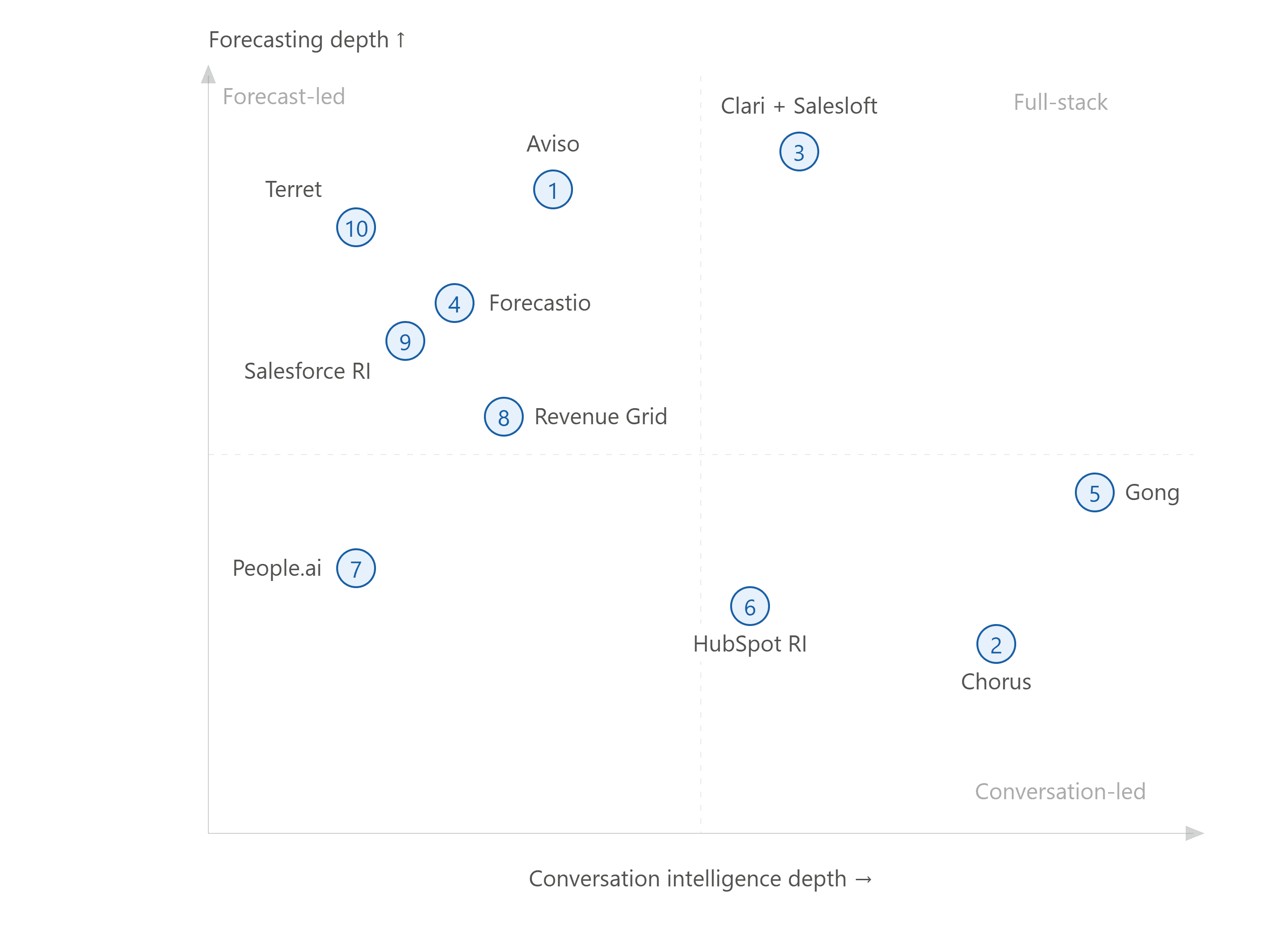
The best deal intelligence software depends on what your team needs to improve: sales conversations, deal health, stakeholder engagement, deal execution, pipeline health, or forecasting. The 10 platforms below are listed in alphabetical order. We compare their core strengths, key limitations, and the types of sales teams and use cases each platform is best suited for.
Aviso is strongest in predictive forecasting, scenario planning, and strategic revenue intelligence, with deal intelligence extending into risk assessment, win/loss analysis, and AI-generated recommendations. Its sophisticated capabilities are designed primarily for large organizations with mature RevOps functions rather than smaller sales teams looking for a lightweight tool.
Best for: 100+ rep organizations with mature RevOps teams that need predictive forecasting and sophisticated revenue analysis.
Key features:
Continuously updated predictive forecasting
Win/loss pattern analysis
Scenario and what-if modeling
AI-powered deal risk assessment and recommendations
AI agent orchestration and no-code agent building
Data analyzed: CRM data, activity tracking, and broader revenue metrics.
CRM integration: Deep Salesforce integration, with HubSpot support covering core data flows.
Pricing: Not publicly disclosed and positioned toward enterprise pricing.
Strengths: Among the more advanced platforms for predictive forecasting and scenario modeling, with strong win/loss analysis to support strategic decisions.
Limitations: More complex to implement and configure than many alternatives, requires meaningful RevOps investment, and is less embedded in day-to-day rep workflows than coaching-first platforms.
Chorus is strongest in conversation intelligence, combining call and meeting analysis with ZoomInfo's account and contact data. It is particularly attractive to teams already invested in the ZoomInfo ecosystem, but its total cost can become significant when it is bundled with the company's broader suite.
Best for: Mid-market and enterprise sales teams already using ZoomInfo for prospecting and account intelligence.
Key features:
Automatic call and meeting transcription
Objection, competitor, and next-step detection
Coaching highlights from sales conversations
Deal-level engagement analysis
Customer-lifecycle insights for sales and customer success
Data analyzed: Calls, meetings, ZoomInfo's account and contact data.
CRM integration: Salesforce, Slack, and other major revenue tools.
Pricing: Not publicly disclosed and frequently bundled into broader ZoomInfo contracts. Third-party reporting cited in our research suggests starting costs around $100 per user/month when purchased as part of a ZoomInfo suite. Current pricing should be confirmed directly with ZoomInfo.
Strengths: Strong fit for organizations already using ZoomInfo, with solid transcription, coaching-moment detection, and intelligence that can be used across sales and customer success.
Limitations: Total cost rises when combined with the broader ZoomInfo suite. Coaching workflows are less structured than dedicated coaching platforms, and the product is less suited to SMB budgets.
Clari + Salesloft is particularly strong for revenue teams focused on forecasting, pipeline inspection, and executive visibility. The combined platform brings together Clari's predictive revenue intelligence with Salesloft's sales engagement capabilities, but its breadth also makes it a relatively complex and expensive option.
Best for: Revenue teams whose primary priorities are forecast accuracy, pipeline inspection, and leadership-level revenue visibility.
Key features:
Predictive forecasting and scenario/commit modeling
Pipeline risk scoring and deal inspection
Conversation intelligence through Clari Copilot
Sales engagement and cadences through Salesloft
Executive roll-up reporting across revenue functions
Data analyzed: CRM data, activity and engagement data, call transcripts, and email engagement.
CRM integration: Deep Salesforce integration, operating primarily as an intelligence layer over the CRM.
Pricing: Pricing is not publicly disclosed. Reported 2026 ranges cited in our research are approximately $100–$120 per user/month for Clari Forecast, $60–$110 for Copilot, and $50–$80 for the Salesloft engagement layer. These are third-party estimates rather than official current prices.
Strengths: Strong forecasting and executive visibility, combined with extensive pipeline inspection and multi-level revenue reporting. The Salesloft combination also gives the platform access to a broader set of engagement signals.
Limitations: Implementation can be complex, and bundled pricing has reportedly moved upward. As of mid-2026, the post-merger portfolio also contains overlapping products and capabilities without a fully unified roadmap.
Note: Clari and Salesloft completed their merger on December 3, 2025. Older comparisons may still present them as separate intelligence platforms.
Forecastio combines AI-powered deal intelligence, customizable risk signals, and autonomous deal review and win/loss agents to identify revenue risks, prioritize opportunities, and turn deal insights into specific actions. It also connects deal intelligence with pipeline intelligence and advanced forecasting, giving revenue leaders visibility from individual deal execution to overall revenue performance.
Best for: HubSpot sales teams and revenue teams that want advanced deal intelligence, AI-powered deal review, and accurate forecasting in one platform.
Key features:
Deal Review Agent that continuously analyzes open opportunities
Customizable signals for stalled deals, inactivity, close-date pushes, missing data, and other deal risk
AI identification of weak multithreading, declining engagement, and deals likely to slip or be lost
Prioritized opportunity lists based on deal importance and risk level
Selling recommendations and operational actions, including CRM updates and task creation
Win/Loss Analysis Agent that identifies patterns behind won and lost deals
Pipeline intelligence and multiple forecasting methods connected with deal-level signals
Data analyzed: Emails, CRM notes, tasks, meetings, pipeline-stage movements, CRM field changes, and other opportunity sales activity.
CRM integration: Deep native integration with HubSpot, with support for other major CRMs, including Salesforce. .
Pricing: $49 to $69 per user per month
Strengths: Forecastio brings deal intelligence, pipeline intelligence, forecasting, and AI-driven action into one connected platform. Rather than simply flagging a risk, it explains why an opportunity requires attention, recommends what to do next, and can automate operational actions.
Limitations: Forecastio isn't a dedicated conversation intelligence platform, so teams looking primarily for call recording, transcription, and real-time conversation coaching may need a specialized tool alongside it.
“Gartner research suggests that by 2026, B2B organizations that unify commercial strategies and leverage multithreaded commercial engagements will realize revenue growth that outperforms their competition by a whopping 50%.”
— Gartner, Use Multithreaded Engagements to Accelerate Revenue Growth


Gong is one of the strongest options for conversation intelligence and sales coaching, analyzing calls, emails, and meetings to surface deal insights and engagement patterns. Its deal intelligence extends into risk and momentum analysis, but forecasting isn't included by default and requires a separate purchase.
Best for: Enterprise sales teams that prioritize conversation intelligence and sales coaching.
Key features:
AI-based deal scoring using engagement and conversation patterns
Talk-to-listen ratio, keyword, and objection tracking
Win/loss and market-trend analysis
Forecasting available as an add-on
Deep Salesforce and HubSpot integrations
Data analyzed: Calls, emails, meeting transcripts, and CRM sales activity.
CRM integration: Strong native integrations with Salesforce and HubSpot, plus a broad ecosystem of connectors.
Pricing: Gong does not publicly disclose pricing. Third-party estimates cited in our research place per-seat licensing at approximately $1,200–$1,600 per user annually, plus a platform fee, with reported setup fees ranging from $5,000 to $50,000. These figures should be treated as directional rather than official pricing.
Strengths: Gong has one of the most mature conversation intelligence engines in the category, with strong enterprise credibility and detailed coaching and manager dashboards.
Limitations: Premium pricing puts it beyond many SMB and mid-market teams. Implementation can require significant time and administrative resources, while forecasting is an add-on rather than a built-in capability. Teams weighing that trade-off can see how Gong compares to nine other options in our full Gong alternatives and competitors comparison.
HubSpot provides native call transcription, conversation insights, pipeline tracking, and AI-assisted deal analysis directly within its CRM. It is a convenient starting point for HubSpot sales teams that do not yet need a dedicated deal intelligence platform, but its deal analysis and forecasting capabilities are less extensive than specialist platforms.
Best for: SMB and mid-market teams running their GTM operations on HubSpot and looking for basic native deal and conversation intelligence.
Key features:
Call transcription and conversation insights
Native deal and sales pipeline tracking
Breeze AI summarization
Deal-health signals
Intelligence tied directly to HubSpot CRM records
Data analyzed: HubSpot CRM customer data, calls, and emails.
CRM integration: Native to HubSpot only.
Pricing: Included in higher-tier HubSpot Sales Hub plans rather than sold as standalone intelligence software. Current pricing depends on the selected Sales Hub edition.
Strengths: Seamless experience for HubSpot customers, no separate integration, and no additional specialist tool required for teams whose needs are covered by the native capabilities.
Limitations: No value outside HubSpot, less depth in conversation intelligence than Gong or Chorus, and more limited advanced forecasting than dedicated revenue intelligence platforms like Forecastio.
Backstory is primarily designed to improve activity capture, relationship intelligence, and CRM data quality at enterprise scale. It is especially useful for organizations selling complex deals involving multiple stakeholders, but it offers less depth in conversation intelligence and coaching than platforms such as Gong or Chorus.
Best for: Enterprise RevOps teams whose main challenge is incomplete or inconsistent CRM activity data.
Key features:
Automatic activity capture without manual data entry
Stakeholder and relationship mapping
Account forensics for identifying at-risk revenue
Automated CRM hygiene
Opportunity and account activity analysis
Data analyzed: Email, calendar, CRM, and messaging-platform activity.
CRM integration: Strong native Salesforce integration.
Pricing: Enterprise/custom pricing only; public pricing is not available.
Strengths: Meaningfully reduces manual data entry, improves the CRM data other revenue tools depend on, and provides strong stakeholder mapping for complex deals.
Limitations: Less depth in conversation intelligence than Gong or Chorus, a thinner coaching layer, and potentially time-intensive onboarding and configuration.
Revenue Grid combines deal intelligence, automatic activity capture, and guided selling inside a Salesforce-centric workflow. Its native Salesforce integration is its primary advantage, but teams need the higher-priced tiers to access its full forecasting, guided-selling, and AI capabilities.
Best for: Salesforce-first organizations that want activity capture and guided selling without moving sales reps away from their CRM workflow.
Key features:
Automated email, meeting, and task capture into Salesforce
AI-powered contextual search across sales data
Guided-selling recommendations
Deal-momentum visibility
Cadences and relationship intelligence at the top tier
Data analyzed: Email, calendar, meetings, and CRM sales activity.
CRM integration: Deep native Salesforce integration.
Pricing: Third-party pricing cited in our research indicates that entry-level activity-capture plans may start around $30 per user/month, while full forecasting, guided selling, and AI capabilities are reportedly available at a top tier around $149 per user/month. Current pricing should be verified with Revenue Grid.
Strengths: Strong operational fit for Salesforce-only organizations, meaningfully reduces manual data entry, and provides more transparent tiered pricing than many enterprise competitors.
Limitations: Advanced forecasting and guided-selling functionality is concentrated in the highest tier, conversation intelligence is less extensive than Gong or Chorus, and the platform is primarily valuable within Salesforce.
Salesforce Revenue Intelligence provides native opportunity scoring, forecasting, and pipeline inspection using data already stored in Sales Cloud. It is a convenient option for Salesforce-standardized organizations that need baseline deal intelligence without another platform, but it offers less specialized depth than dedicated tools, particularly in conversation intelligence.
Best for: Salesforce-standardized enterprises that want baseline deal intelligence without adding another vendor to their tech stack.
Key features:
AI opportunity scoring and win-probability calculation
Adaptable forecasts by team, product line, or territory
Pipeline inspection
Weekly deal-change tracking
Native dashboards inside Sales Cloud
Data analyzed: Native Salesforce customer data, opportunity records, and CRM sales activity.
CRM integration: Native to Sales Cloud rather than a third-party integration.
Pricing: Included in certain Sales Cloud editions, while some capabilities require additional Einstein or Sales Cloud add-on licensing. Current pricing depends on the Salesforce edition and required functionality.
Strengths: No separate procurement or integration is required, and it offers a solid baseline of forecasting and pipeline health capabilities for organizations already standardized on Salesforce.
Limitations: Shallower conversation intelligence than dedicated platforms, no value outside the Salesforce ecosystem, and advanced functionality can require additional licensing.
BoostUp combines AI-powered deal scoring with multidimensional forecasting and scenario modeling. It is a strong option for RevOps teams that want focused deal-risk and forecasting capabilities without the full complexity of larger enterprise platforms, although it relies on integrations rather than providing native conversation intelligence.
Best for: Mid-market and enterprise RevOps teams that want focused deal-risk scoring and forecasting.
Key features:
AI-powered deal scoring and pipeline risk detection
Multidimensional and scenario-based forecasting
Continuous monitoring for forecast gaps and risks
Revenue-agent-style recommendations
Integrations with Gong, Chorus, and other conversation intelligence tools
Data analyzed: CRM records, sales activity, and data from connected intelligence platforms.
CRM integration: Salesforce-centric, with integrations across a broader revenue tech stack, including Outreach, Salesloft, and product-analytics tools.
Pricing: Not publicly disclosed; positioned in the mid-market-to-enterprise range.
Strengths: Strong predictive and scenario forecasting, with a flexible data model that can support customized pipeline structures.
Limitations: Less focused on rep-level execution workflows than some alternatives and dependent on other tools for conversation intelligence. Its value may therefore depend on already having another call-intelligence platform in the tech stack.
Deal Intelligence Software Comparison
The leading deal intelligence platforms differ significantly in what they analyze and where they create the most value. Some specialize in conversation intelligence and coaching, while others focus on deal health, forecasting, CRM data quality, or sales engagement. The table below provides a quick comparison based on each platform's primary intelligence layer, ideal customer profile, pricing signal, and CRM support.
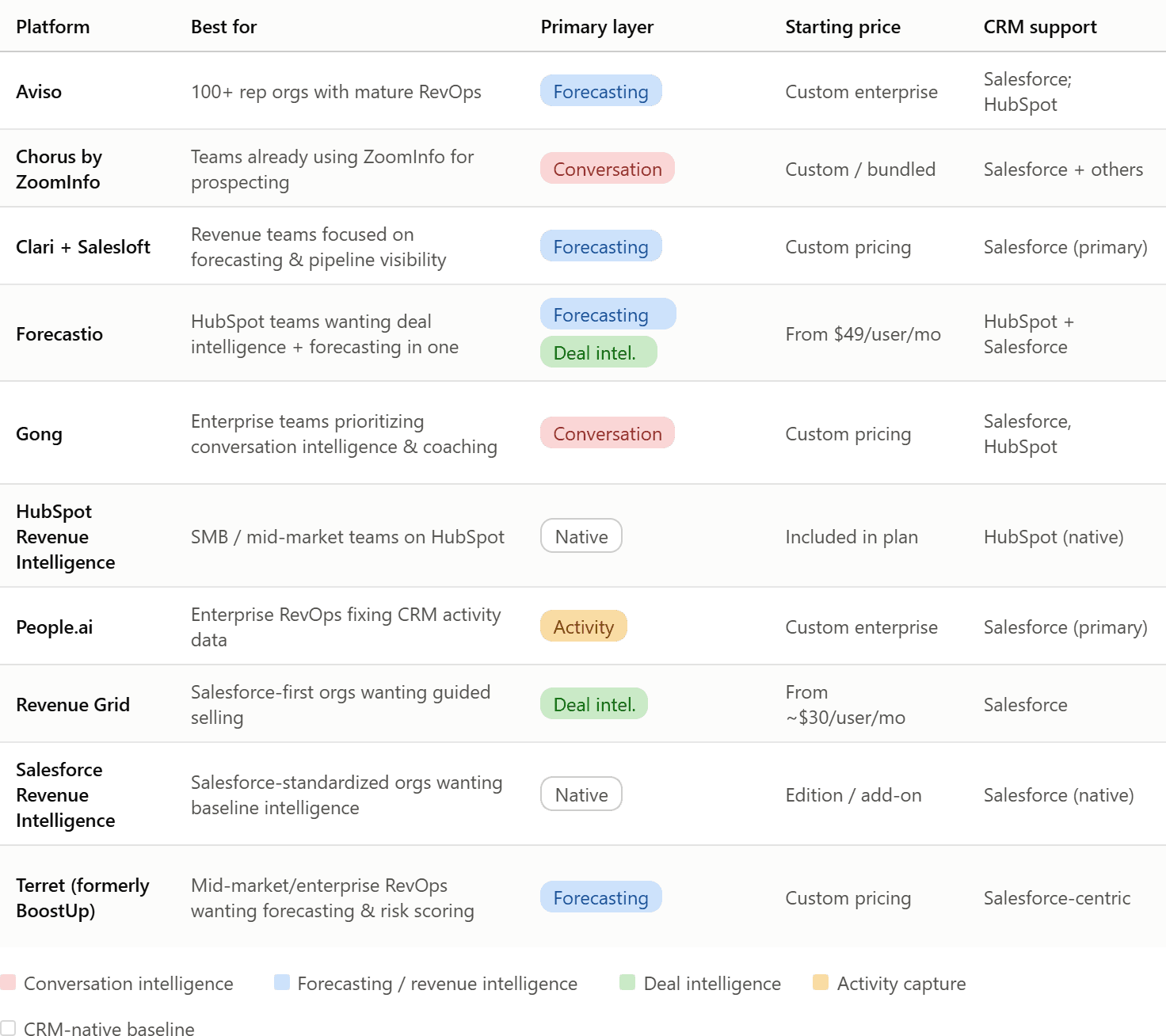
Full comparison data
Platform | Best for | Primary intelligence layer | Starting price signal | CRM support |
|---|---|---|---|---|
Aviso | Large organizations with complex forecasting requirements | Predictive revenue intelligence and forecasting | Custom enterprise pricing | Salesforce; HubSpot support |
Chorus by ZoomInfo | Teams already using the ZoomInfo ecosystem | Conversation intelligence and account intelligence | Custom/bundled pricing | Salesforce and other major CRMs |
Clari + Salesloft | Large revenue teams focused on forecasting | Revenue intelligence, forecasting, sales engagement | Custom pricing | Primarily Salesforce |
Forecastio | Teams that want deal analysis, AI actions, and forecasting in one platform | Deal intelligence, pipeline intelligence, sales forecasting | $49 to $69 per user per month | Deep HubSpot integration; other major CRMs, including Salesforc |
Gong | Enterprise teams focused on coaching | Conversation intelligence and deal intelligence | Custom pricing | Salesforce, HubSpot |
HubSpot Revenue Intelligence | HubSpot customers with basic intelligence requirements | CRM-native deal and conversation intelligence | Included in qualifying plans | HubSpot |
Backstory (formerly People.ai) | Enterprise RevOps teams improving CRM data quality | Activity capture and relationship intelligence | Custom enterprise pricing | Primarily Salesforce |
Revenue Grid | Salesforce teams needing guided selling and activity capture | Deal intelligence and guided selling | From ~$30/user/month* | Salesforce |
Salesforce Revenue Intelligence | Salesforce customers wanting native intelligence | Opportunity and pipeline intelligence | Edition/add-on dependent | Salesforce |
Terret (formerly BoostUp) | Enterprise RevOps teams combining revenue analysis and AI-driven execution | Revenue intelligence, deal intelligence, forecasting | Custom pricing | Salesforce |
*Third-party pricing estimate; current vendor pricing should be verified before purchase.
The comparison also shows why there is no single “best” deal intelligence platform for every organization. A team primarily trying to improve call coaching may place more value on Gong or Chorus, while a team concerned with deal execution, pipeline health, and forecasting may prioritize Forecastio, Clari, Terret, or Aviso. CRM ecosystem, implementation requirements, and the number of multiple tools already in the tech stack should also influence the final choice.
How to Choose a Deal Intelligence Platform
To choose the right deal intelligence platform, start with the problem you need to solve rather than the longest feature list. Determine whether your priority is deal execution, conversation intelligence, forecasting, or CRM data quality, then evaluate CRM compatibility, the complexity of your sales process, implementation requirements, and total cost.
Start With the Problem You Need to Solve
Not every deal intelligence software approaches the category in the same way. Some platforms originated in call recording and conversation intelligence, while others were built around forecasting, CRM activity capture, sales engagement, or broader revenue intelligence.
If the main challenge is understanding what happens during sales conversations and coaching reps, a conversation-first platform may be the best fit. If managers struggle to identify risky opportunities and determine what should happen next, prioritize deal health, deal scoring, risk detection, and recommendations that improve deal execution.
For revenue leaders concerned with the reliability of the overall revenue number, look at how deal-level intelligence connects with pipeline health and forecast accuracy rather than evaluating individual deal features in isolation.
Evaluate the Data Behind the Deal Insights
The quality of deal insights depends heavily on the information a platform can analyze. CRM fields alone provide useful context, but they may not capture everything happening throughout the sales cycle.
Depending on your requirements, evaluate whether the platform can combine multiple data sources, including emails, meetings, calls, notes, tasks, stage changes, close-date movements, stakeholder engagement, and other sales activity.
This is particularly important when CRM data quality is inconsistent. Gartner reports that poor data quality costs organizations at least $12.9 million per year on average. A deal intelligence platform that depends entirely on incomplete CRM fields may reproduce the same blind spots rather than eliminate them.
Consider the Complexity of Your Deals
The right level of intelligence also depends on how your sales teams operate. Short, transactional sales cycles may require relatively simple activity and engagement signals. Long, complex deals often require much deeper visibility into stakeholder involvement, multithreading, deal momentum, stage progression, and changes in buyer engagement.
For complex B2B sales, look for software that provides enough deal context to explain why an opportunity is at risk rather than simply assigning it a score. The ability to distinguish between different types of risk can make the resulting actionable insights much more useful to both sales reps and sales managers.
Check How Well It Fits Your CRM and Tech Stack
A deal intelligence platform should reduce operational friction rather than create another disconnected system. Check the depth of its CRM integration, what information is synchronized automatically, how frequently it updates, and whether reps need to perform additional manual data entry.
CRM choice can substantially narrow the field. Some intelligence platforms are built primarily around Salesforce, others have deeper HubSpot integrations, and CRM-native options keep intelligence inside Sales Cloud or HubSpot itself.
Also consider the rest of your tech stack. A platform that requires separate products for conversation intelligence, forecasting, and sales engagement may provide excellent capabilities, but it can also increase cost, administration, and the number of multiple tools your team needs to manage.
Compare the Total Cost, Not Just the Seat Price
The cost of deal intelligence software can range from relatively accessible per-user subscriptions to custom enterprise pricing. But the license cost alone doesn't show the full investment.
Consider platform fees, required add-ons, implementation and onboarding costs, minimum seat commitments, and whether important capabilities such as forecasting or conversation intelligence must be purchased separately. For larger deployments, also account for the internal RevOps or administrative resources required to configure and maintain the platform.
The best choice isn't necessarily the platform with the lowest price or the largest feature set. It is the one that solves your highest-priority deal management problems while fitting naturally into the way your sales teams already work.
Why Deal Intelligence Is Replacing Manual Deal Reviews
Traditional deal reviews depend heavily on CRM fields, rep updates, and managers manually inspecting opportunities one by one. Deal intelligence software continuously analyzes sales activity, engagement, and changes in deal progress instead. This gives sales managers earlier visibility into deal risk, reduces dependence on incomplete CRM data, and makes deal reviews more consistent and actionable.
Manual Deal Reviews Depend on Incomplete Information
A traditional deal review typically starts with what a rep has entered into the CRM: stage, amount, close date, forecast category, notes, and next steps. The problem is that these fields may be outdated, incomplete, or influenced by the rep's own assessment of the opportunity.
Important signals can exist elsewhere. A buyer may have stopped responding, an important stakeholder may have disappeared from recent meetings, the close date may have moved several times, or the deal may have spent much longer than expected in the same stage.
When sales managers have to uncover these issues manually, the quality of the review depends on how much time they have, how accurately reps maintain the CRM, and which questions the manager happens to ask.
The business impact of poor CRM information can be substantial. Validity's 2025 State of CRM Data Management report found that companies lose an average of 16 sales deals per quarter because of poor-quality data, while 37% of organizations reported losing revenue as a direct consequence of poor data quality.
Deal Intelligence Continuously Monitors Deal Signals
Instead of waiting for a weekly pipeline review, deal intelligence platforms can continuously evaluate opportunities using CRM changes, emails, meetings, tasks, conversation data, engagement patterns, and other data points.
The software can detect signals such as stalled opportunities, repeated close-date pushes, declining engagement, missing next steps, insufficient stakeholder involvement, or unusual time in a particular deal stage.
This shifts deal reviews from asking “What is happening with this deal?” to investigating “Why has this deal been flagged, and what should we do about it?”
It also allows sales teams to review opportunities by exception. Instead of spending equal time on every open deal, managers can prioritize opportunities with the greatest value, highest deal risk, or most urgent need for intervention.
Deal Insights Can Lead Directly to Action
Identifying a risky opportunity is only the first step. The more useful deal intelligence software becomes, the more it can explain the reason behind the risk and translate that information into actionable insights.
For example, identifying weak stakeholder engagement can lead to a recommendation to involve an economic buyer. A deal with no recent activity may require immediate follow-up, while repeated close-date pushes may indicate that the current close date is unrealistic.
Some platforms go further by connecting intelligence with deal execution, allowing sales reps or AI agents to create tasks, update CRM information, prioritize opportunities, or recommend specific next steps.
This shortens the distance between detecting a problem and acting on it, which is difficult to achieve consistently through manual deal reviews alone.
Deal-Level Signals Improve Pipeline and Forecast Visibility
Individual opportunities ultimately determine the health of the overall sales pipeline. When a large portion of the pipeline contains stalled deals, weak engagement, unrealistic close dates, or other risk signals, leadership needs to understand how those issues affect expected revenue.
Aggregating deal insights therefore gives sales leaders a more realistic view of pipeline health. Instead of looking only at pipeline value and CRM stages, they can assess the quality of the opportunities behind those numbers.
Connecting deal health with forecasting can also help improve forecast accuracy. A forecast supported by healthy, actively progressing opportunities is fundamentally different from one that depends heavily on deals showing multiple risk signals, even when both pipelines have the same nominal value.
Manual deal reviews are unlikely to disappear completely. Managers still need judgment, context, and direct conversations with their teams. The role of deal intelligence is to make those reviews more focused: automatically identifying what deserves attention, providing the relevant deal context, and helping managers and reps decide what to do next.
Common Deal Intelligence Software Mistakes
The most common mistakes are choosing deal intelligence software based on features rather than use cases, treating every deal signal as equally important, relying on AI without sufficient data quality, detecting risks without improving deal execution, and analyzing individual deal health without considering the broader pipeline health and forecast impact.
Choosing a Platform Based on Features Instead of the Use Case
Different platforms specialize in conversation intelligence, deal health, forecasting, activity capture, or CRM data quality. Start with the problems your sales teams need to solve, then evaluate which capabilities directly address them.
Treating Every Deal Signal as Equally Important
A signal's importance often depends on the deal stage. A missing amount may be acceptable during qualification but become a serious issue at proposal. Effective deal intelligence platforms should let teams align risk rules with their actual sales process rather than applying the same logic to every deal.
Relying on AI Without Fixing Data Quality
Artificial intelligence cannot compensate for missing or unreliable information. Strong CRM integration, automatic activity capture, and access to relevant customer interactions give the platform the deal context it needs to produce useful insights.
Focusing on Risk Detection Without Deal Execution
A risk score alone doesn't tell a rep what to do. Strong deal intelligence should explain why an opportunity needs attention and provide actionable insights that help sales reps determine the next step or automate appropriate actions.
Evaluating Deals Without Connecting Them to the Broader Pipeline
Individual deal health should be considered alongside pipeline health and forecasting. This helps sales leaders distinguish ordinary deal-level risks from opportunities that could materially affect expected revenue and forecast accuracy.
FAQ
What Is Deal Intelligence Software?
Deal intelligence software analyzes CRM records, sales activity, customer interactions, engagement signals, and other deal data to assess deal health and identify risks and opportunities. It helps sales reps and managers understand what is happening within active deals, where attention is required, and which actions can improve deal execution.
What Is Deal Intelligence in Sales?
Deal intelligence is the process of analyzing the data and signals generated throughout the sales cycle to understand how individual opportunities are progressing. It can reveal stalled deals, declining engagement, weak stakeholder involvement, close-date changes, and other deal risk signals that may not be obvious from standard CRM fields.
How Does Deal Intelligence Software Differ From a CRM?
A CRM primarily stores customer data, activities, and opportunity information, while deal intelligence software analyzes that information and other signals to explain deal progress, identify risks, and recommend actions. In most cases, a deal intelligence platform complements the CRM rather than replacing it.
How Much Does Deal Intelligence Software Cost?
The cost of deal intelligence software varies considerably. Some platforms start with per-user subscriptions, while enterprise vendors use custom enterprise pricing and may charge additional platform, implementation, or add-on fees. Buyers should compare total costs, especially when forecasting, conversation intelligence, or other important capabilities require separate licenses.
What Is the Best Deal Intelligence Software?
There is no single best platform for every sales team. Gong is particularly strong in conversation intelligence and coaching, Clari + Salesloft emphasizes forecasting and revenue intelligence, Forecastio combines AI-powered deal intelligence, customizable risk signals, AI agents, and forecasting, while other platforms specialize in CRM data quality, guided selling, or sales engagement.
How Do I Choose a Deal Intelligence Platform?
Start with the problem you need to solve. Determine whether your priority is improving deal health, coaching sales reps, identifying deal risk, improving forecast accuracy, or reducing manual data entry. Then compare the platforms' data sources, CRM integration, fit with your sales process, implementation requirements, and total cost.
Can Deal Intelligence Software Integrate With Salesforce?
Yes. Many deal intelligence platforms integrate with Salesforce, although the depth of integration varies considerably. Some products are built primarily around Salesforce, while others support several CRMs. Evaluate which CRM data is synchronized, whether activity capture is automatic, and how intelligence and recommended actions flow back into the existing sales process.
How Do I Request a Deal Intelligence Software Demo?
Most vendors allow buyers to request a demo directly from their websites. Before the demo, identify the main deal management problems you want to solve and ask the vendor to demonstrate them using realistic workflows. Pay particular attention to how the platform identifies deal risk, explains its deal insights, recommends actions, and integrates with your CRM.
Share:


![15 Best Sales Engagement Software [2025 Rankings]](https://framerusercontent.com/images/iWZEowZXTxrgAmGADqkvuGtOxjg.jpg?width=1224&height=816)