AI Agents and RevOps: 15 AI Agents Transforming Revenue Operations

Alex Zlotko
CEO at Forecastio
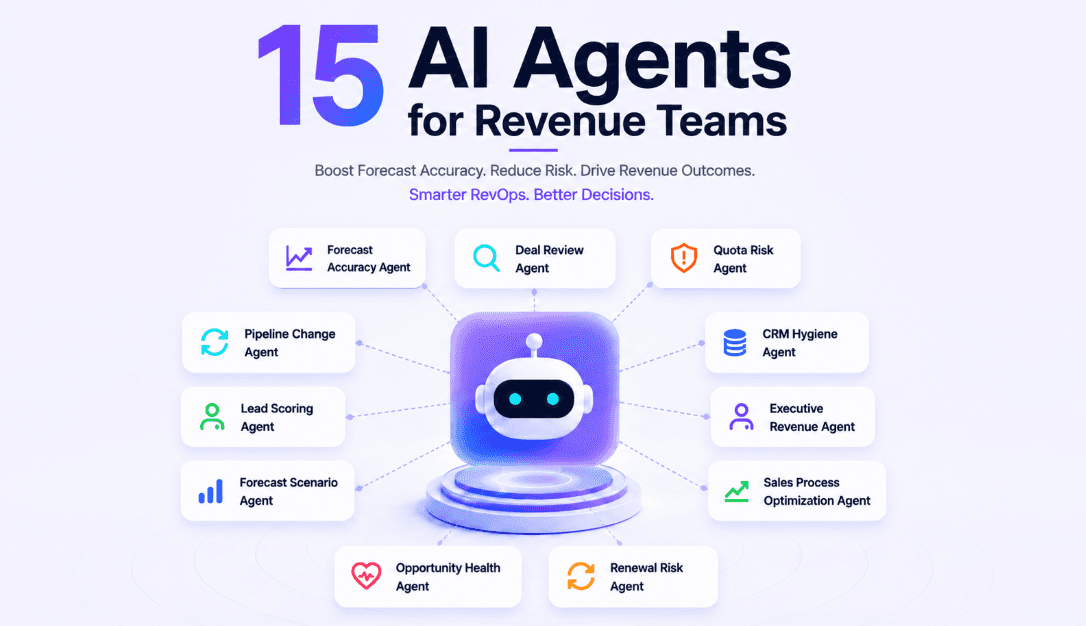
AI agents and RevOps are becoming one of the biggest trends in modern revenue operations. Companies no longer want disconnected tools, manual reporting, and reactive workflows. They want intelligent systems that can analyze revenue data, automate repetitive tasks, and help teams make faster decisions.
Modern AI agents for RevOps can monitor the sales pipeline, analyze customer interactions, improve forecasting accuracy, detect revenue risks, automate lead scoring, and provide real time insights across the entire business. Unlike traditional automation tools, AI agents can reason, make decisions, orchestrate workflows, and proactively recommend actions.
For RevOps teams, this creates a major opportunity. AI agents help unify data across CRM systems, marketing automation platforms, financial systems, and customer success platforms. This reduces data silos, improves data integrity, and creates better revenue visibility across the entire revenue lifecycle.
In this guide, we will cover 15 practical AI agents for RevOps that help sales teams, RevOps teams, and revenue leaders improve forecasting, pipeline management, deal execution, and overall revenue operations efficiency.
What Are AI Agents and RevOps?
AI agents and RevOps combine intelligent automation with modern revenue operations processes. RevOps connects sales, marketing, customer success, and finance teams to improve alignment, revenue visibility, and operational efficiency. AI agents help these teams automate workflows, analyze large amounts of revenue data, and make faster decisions.
Unlike traditional marketing automation or workflow tools, AI agents can reason, make recommendations, and execute multi-step workflows. They work across CRMs, marketing automation platforms, customer success platforms, and financial systems to reduce manual processes and improve collaboration across the entire revenue lifecycle.
Why AI Agents and RevOps Work Together
AI agents for RevOps are becoming popular because modern revenue teams manage too many disconnected systems and repetitive workflows. Many companies still rely on spreadsheets, manual reporting, and siloed tools that create delays and poor visibility across the business.
AI agents help solve these problems by creating a unified view of customer data, pipeline activity, marketing performance, and financial metrics. They break down data silos, automate repetitive tasks, and improve data quality across systems.
AI agents can continuously monitor revenue signals, detect risks, recommend actions, and automate workflows that normally require hours of manual work. Instead of reacting to problems after they happen, teams can use real time insights to improve revenue growth, customer retention, and operational efficiency.
As companies scale, AI agents for RevOps help organizations maintain consistency across complex workflows without adding proportional headcount.
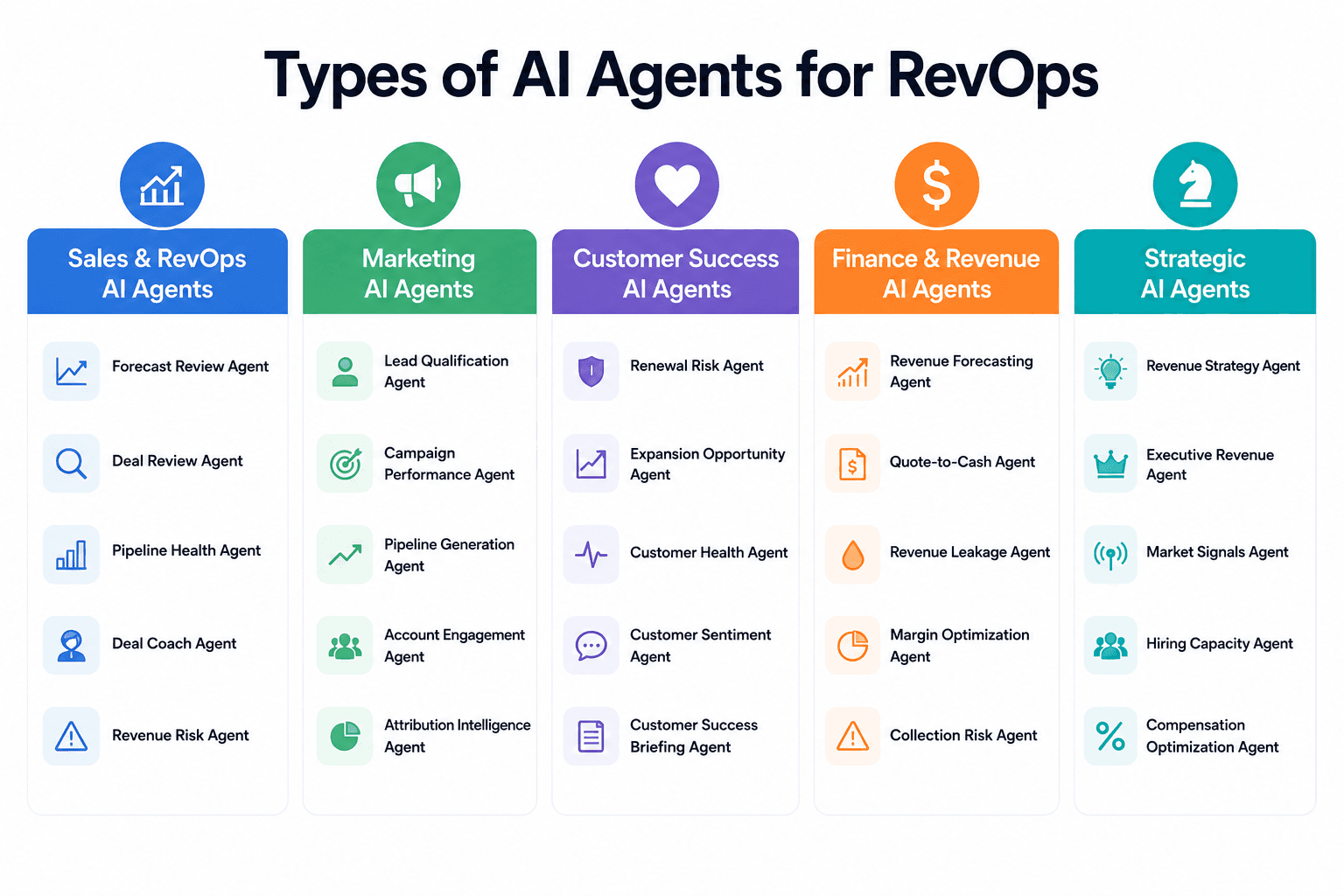
Types of AI Agents for RevOps
Category | Examples |
|---|---|
Sales AI Agents | Forecast Review Agent, Deal Review Agent, Pipeline Health Agent |
Marketing AI Agents | Lead Qualification Agent, Attribution Intelligence Agent |
Customer Success AI Agents | Renewal Risk Agent, Customer Health Agent |
Finance & Revenue AI Agents | Revenue Forecasting Agent, Quote-to-Cash Agent |
Strategic AI Agents | Revenue Strategy Agent, Executive Revenue Agent |
Benefits of AI Agents in Revenue Operations
Benefit | Impact |
|---|---|
Reduced manual work | Less time spent on spreadsheets, reporting, and data entry |
Unified data | Better visibility across disconnected systems |
Better sales forecasting | Improved sales forecasting accuracy and revenue planning |
Faster decisions | Real time insights and automated recommendations |
Revenue growth | Better sales pipeline management and customer retention |
Improved alignment | Better collaboration between marketing, sales, and customer success |
Forecast Review Agent
A Forecast Review Agent is an AI-powered system that analyzes forecasts, pipeline changes, deal risks, and forecast assumptions automatically. It helps sales leaders and RevOps teams understand why forecasts changed and what may impact future revenue outcomes.
Goal
The goal of a Forecast Review Agent is to help sales leaders and RevOps teams quickly analyze the current forecast, understand latest changes, highlight risky assumptions, and recommend actions before forecast calls or leadership meetings.
Actions can include:
exclude risky deals from the forecast
change a deal forecast category
lower deal probability
ask a rep for an update
flag deals for manager review
prepare a forecast summary for leadership
How It Works
The agent connects with CRMs, pipeline data, forecasting models, and historical sales performance. It continuously analyzes:
pipeline movement
slipped deals
conversion rates
deal risks
revenue signals
forecast changes
The agent then prepares automated forecast summaries and highlights the biggest risks that may impact the quarter.
For example, the agent may detect:
an increase in deal slippage
declining conversion rates
unusually large pipeline changes
weak pipeline coverage
overreliance on a few large opportunities
The system can also generate automated reports before forecast calls and leadership meetings.
Key Benefits
Provides more accurate forecasting
Reduces manual forecast reviews
Gives real time insights
Detects forecast risks earlier
Helps leadership make faster decisions
Improves collaboration across RevOps teams
Who Needs It
CROs
Sales leaders
Finance teams
RevOps
Deal Review Agent
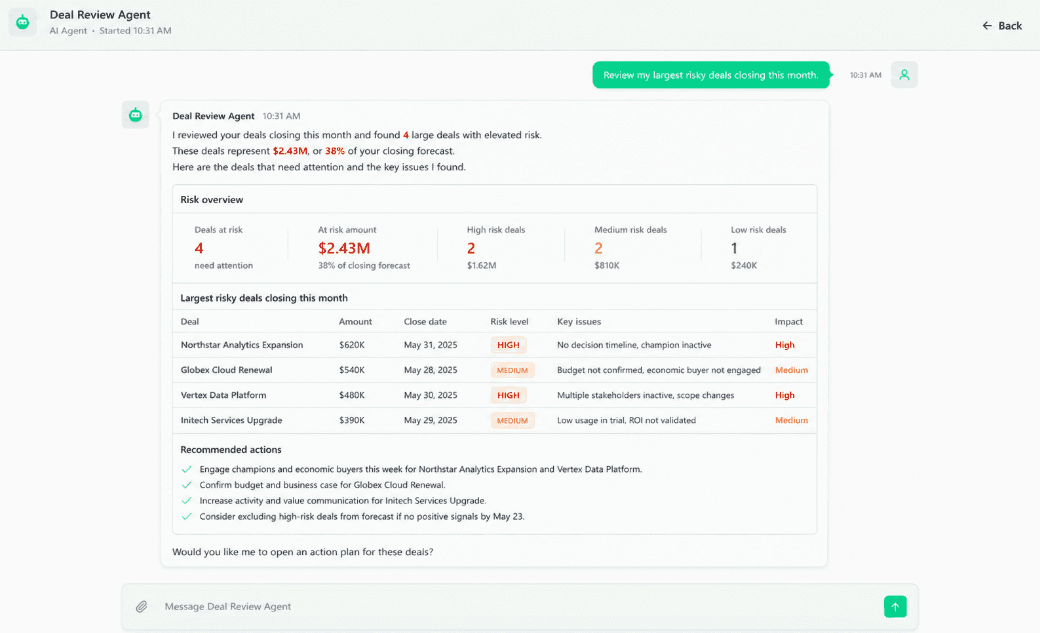
A Deal Review Agent is an AI-powered agent that automatically reviews open opportunities and identifies deals that may require attention from managers or sales representatives — a core function of what's known as deal intelligence software. It analyzes deal activity, engagement, pipeline movement, and risk signals to help sales teams focus on the right opportunities.
Goal
The goal of a Deal Review Agent is to help sales leaders, managers, and reps identify risky deals earlier, improve deal execution, and prevent weak opportunities from distorting the forecast.
How It Works
The agent continuously monitors the sales pipeline and analyzes:
deal activity
email engagement
meeting activity
stage duration
close date changes
buying signals
stakeholder involvement
follow ups
CRM updates
The system can detect problems such as:
stalled deals
missing next steps
inactive opportunities
low engagement
unrealistic close dates
weak multithreading
The agent then recommends or performs actions like:
scheduling follow ups
involving a manager
updating CRM data
excluding a deal from the forecast
lowering deal probability
escalating high-risk opportunities
Some AI agents for RevOps can also generate deal summaries before pipeline review meetings and sales calls.
Key Benefits
Improves pipeline visibility
Detects at-risk deals earlier
Reduces manual deal inspections
Helps reps prioritize work
Improves forecasting accuracy
Gives managers better actionable insights
Helps standardize deal review workflows
Who Needs It
Sales leaders
Sales managers
Sales reps
Pipeline Health Agent
A Pipeline Health Agent is an AI-powered agent that monitors the overall quality of the pipeline and identifies risks that may impact future revenue. It helps RevOps teams and sales managers understand whether the pipeline is healthy enough to support future targets and secure accurate sales forecasting.
Goal
The goal of a Pipeline Health Agent is to improve revenue visibility, identify pipeline risks earlier, and help teams maintain a healthier and more predictable revenue engine.
How It Works
The agent continuously analyzes the entire sales pipeline across different teams, segments, and stages. It monitors:
pipeline coverage
stage aging
conversion rates
deal velocity
inactive opportunities
pipeline creation trends
slipped deals
pipeline concentration
The system can identify:
weak pipeline coverage
stage bottlenecks
declining conversion rates
unhealthy pipeline growth
overdependence on several large deals
increasing slippage rates
poor pipeline data quality
The agent can then recommend or perform actions such as:
generating more pipeline in specific segments
cleaning outdated opportunities
reviewing stalled deals
reallocating resources
escalating pipeline risks to leadership
Some AI agents and RevOps platforms also generate automated pipeline health summaries for weekly forecast and pipeline review meetings.The system can identify declining pipeline creation and weak lead generation trends before they impact future revenue.
Key Benefits
Improves pipeline visibility
Detects risks earlier
Helps improve sales forecasting
Reduces manual reporting
Improves revenue workflows
Supports better decision-making across marketing and sales teams
Who Needs It
RevOps teams
CROs
Sales leaders
Forecast Accuracy Agent
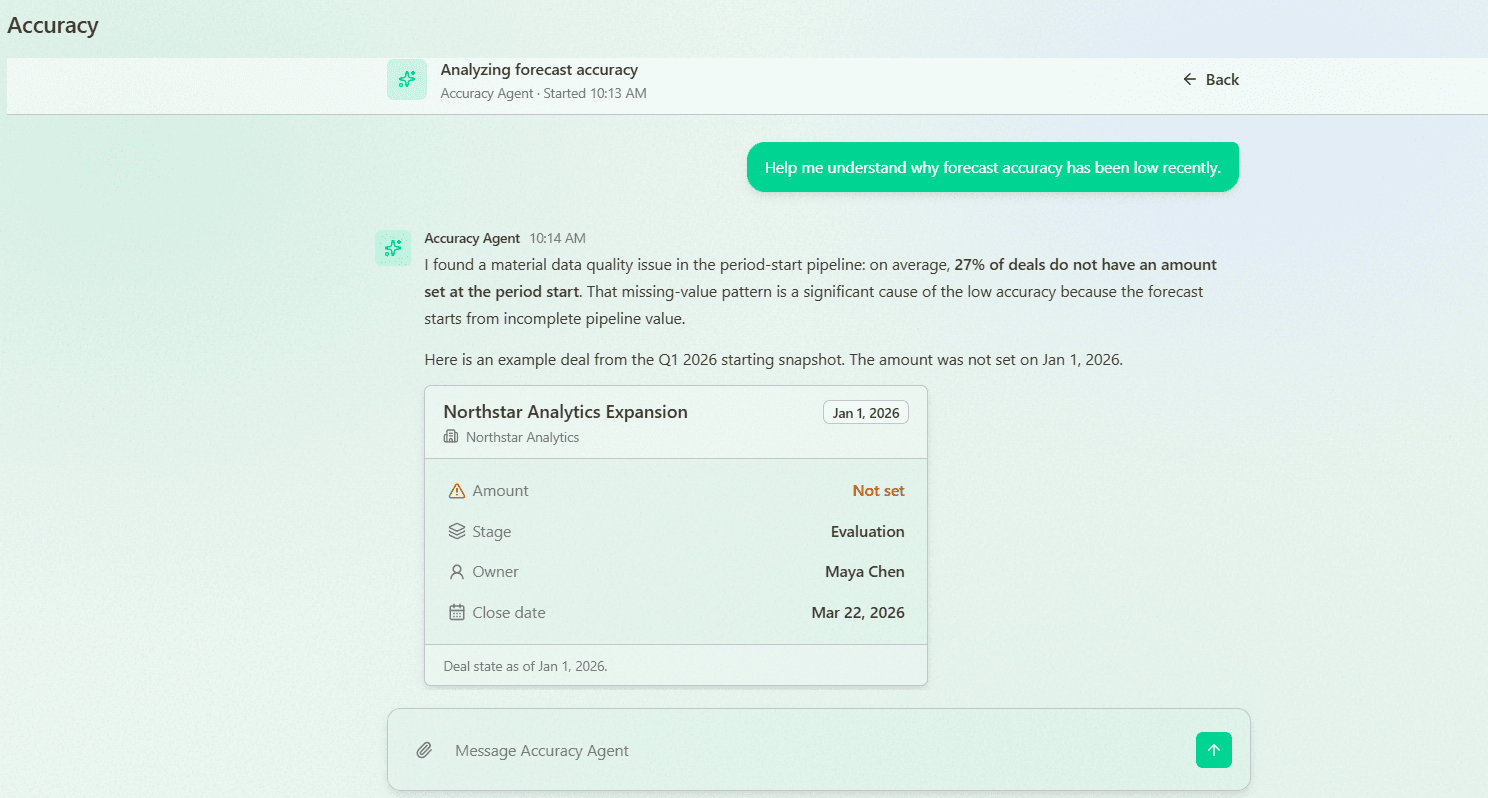
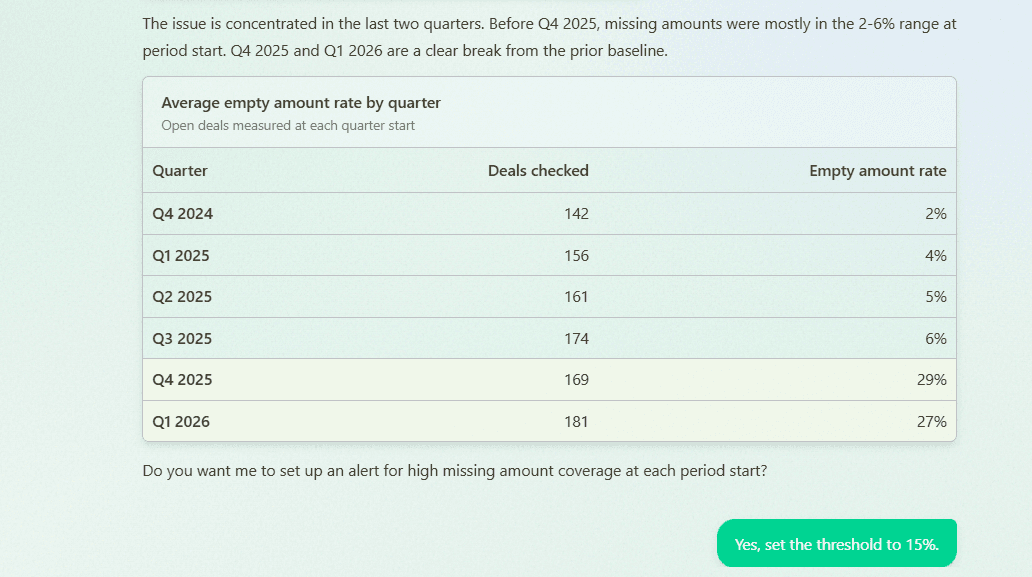
A Forecast Accuracy Agent is an AI-powered agent that analyzes historical forecast performance and helps companies improve the reliability of future forecasts. It identifies forecasting patterns, core reasons that distort forecasts numbers, and segments where predictions regularly fail.
Goal
The goal of a Forecast Accuracy Agent is to improve forecasting accuracy across teams, pipelines, and forecasting methods by identifying what causes inaccurate predictions.
How It Works
The agent continuously compares forecasted revenue with actual results. It analyzes:
forecast submissions
forecast categories
pipeline behavior
Initial deal probabilities and assumptions
slippage rates
B2B sales cycle trends
historical win rates
rep forecasting behavior
forecast variance
The system can identify:
reps that consistently overforecast
pipelines with weak predictability
inaccurate stage probabilities
unrealistic close dates
Missing pipeline data
segments with low forecast reliability
The agent can also compare different forecasting approaches such as:
Some AI agents for revenue operations can automatically recommend recalibration changes, probability adjustments, or improvements to forecast workflows.
Key Benefits
Improves accurate forecasting
Identifies weak forecasting processes
Helps standardize forecast methodologies
Improves trust in forecast numbers
Provides better revenue visibility
Reduces forecast variance
Who Needs It
RevOps teams
Finance teams
CROs
Sales managers
Deal Coach Agent
A Deal Coach Agent is an AI sales agent that helps sales reps and managers improve deal execution. coaching agent that helps sales reps and managers improve deal execution. It analyzes deal activity, sales calls, customer engagement, and historical patterns to recommend the next best actions for active opportunities.
Goal
The goal of a Deal Coach Agent is to help sales teams close more deals, improve deal strategy, and increase conversion rates across the pipeline.
How It Works
The agent analyzes:
meeting transcripts
emails
CRM activity
buyer engagement
historical deal outcomes
stakeholder involvement
follow ups
objections
intent signals
deal progression
The system can identify:
missing stakeholders
weak qualification
low customer engagement
missing next steps
weak discovery calls
inconsistent follow ups
The agent then recommends or performs actions such as:
scheduling additional meetings
involving leadership
improving multithreading
adjusting deal strategy
sending follow-up messages
preparing for objections
prioritizing high value prospects
Some AI agents and RevOps platforms can also generate meeting summaries and suggested action plans automatically after sales calls.
Key Benefits
Improves deal execution
Helps reps focus on the right actions
Increases win rates
Reduces stalled opportunities
Improves coaching consistency
Helps scale sales coaching across larger teams
Who Needs It
Sales reps
Sales managers
SDR teams
VP of Sales
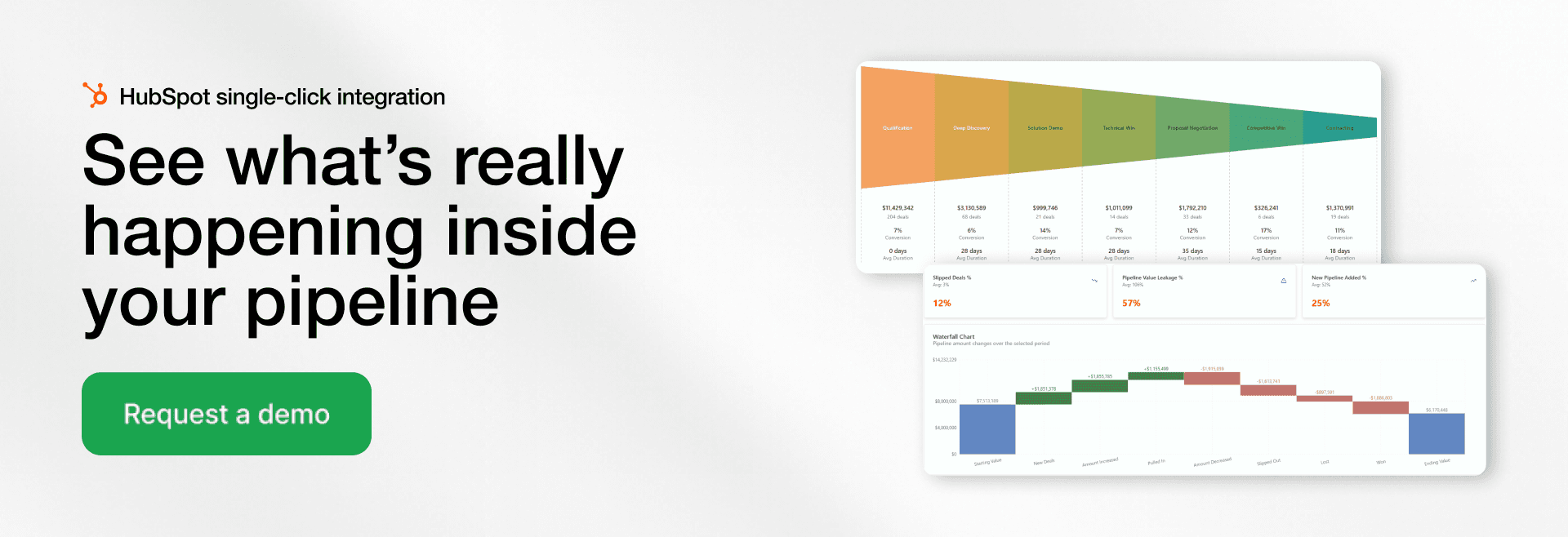
Pipeline Change Agent
A Pipeline Change Agent is an AI-powered agent that tracks and explains what changed in the pipeline over time. It helps RevOps teams and sales leaders understand why forecasts increased or decreased and which deals impacted revenue projections the most.
Goal
The goal of a Pipeline Change Agent is to improve visibility into pipeline movement and help teams quickly understand the reasons behind forecast and pipeline changes.
How It Works
The agent continuously monitors:
pipeline movement
slipped deals
pulled-in deals
amount changes
lost opportunities
new opportunities
probability changes
close date updates
The system compares pipeline snapshots across different time periods and identifies the biggest drivers behind revenue movement.
For example, the agent can detect:
revenue removed from the quarter
deals pushed to future periods
unexpected pipeline growth
declining pipeline quality
The agent can also prepare automated summaries for forecast calls, pipeline review meetings, and executive reporting.
Some AI agents for RevOps can visualize how pipeline movement impacts expected revenue and forecasting trends.
Key Benefits
Improves pipeline transparency
Helps explain forecast changes
Reduces manual analysis
Improves revenue visibility
Detects risks earlier
Helps leadership understand revenue trends
Supports better forecast reviews
Who Needs It
RevOps teams
Sales managers
Sales leaders
Revenue Risk Agent
A Revenue Risk Agent is an AI-powered agent that detects risks that may negatively impact future revenue. It analyzes pipeline trends, conversion patterns, forecasting data, and revenue signals to help leadership identify problems before they affect business performance.
Goal
The goal of a Revenue Risk Agent is to help companies proactively identify revenue risks, reduce forecast uncertainty, and improve strategic decision-making across the business.
How It Works
The agent continuously analyzes:
pipeline coverage
conversion rates
sales velocity
forecast trends
customer retention
pipeline generation
slippage rates
win rates
product usage
revenue concentration
The system can identify:
declining pipeline generation
weak future coverage
slowing deal progression
increasing churn risks
overreliance on a few accounts
declining sales performance
The agent can also monitor multiple systems including:
CRMs
marketing platforms
financial systems
customer success platforms
Some AI agents and RevOps platforms can automatically alert leadership teams when key metrics fall below expected thresholds.
The agent may also recommend or perform actions such as:
increasing pipeline generation
reallocating sales resources
reviewing at-risk accounts
adjusting forecasting assumptions
investigating weak conversion stages
Key Benefits
Improves proactive risk management
Gives better revenue visibility
Helps leadership detect problems earlier
Improves strategic forecasting
Supports better planning decisions
Reduces unexpected revenue gaps
Provides more accurate real time insights
Who Needs It
CROs
CEOs
Finance teams
RevOps teams
Sales leaders
CRM Hygiene Agent
A CRM Hygiene Agent is an AI-powered agent that monitors and improves data quality across CRM systems. It helps companies reduce inaccurate records, outdated opportunities, and inconsistent pipeline data that often damage reporting and forecasting.
Goal
The goal of a CRM Hygiene Agent is to improve data integrity, reduce manual cleanup work, and ensure that teams rely on accurate and consistent revenue data.
How It Works
The agent continuously scans the CRM and analyzes:
missing fields
outdated close dates
duplicate records
inactive opportunities
missing next steps
incomplete customer data
stale deals or inactive deals
The system can identify:
opportunities without activity
deals stuck in stages for too long
missing forecast categories
incomplete contact or deal information
incorrect revenue values
The agent can automatically:
notify reps about missing updates
request CRM corrections
cleanup data
recommend stage changes
Update close dates
flag suspicious records for review
Some AI agents for RevOps can also enrich records using external tools and reduce manual data entry across the organization.
Key Benefits
Improves data quality
Reduces manual CRM cleanup
Improves forecasting accuracy
Creates more reliable reporting
Reduces errors caused by disconnected data
Improves pipeline visibility
Helps teams maintain cleaner revenue workflows
Who Needs It
RevOps teams
Sales Operations
Sales reps
SDR teams
Marketing Operations
Customer success teams
Meeting Intelligence Agent
A Meeting Intelligence Agent is an AI-powered agent that analyzes sales calls, meeting transcripts, emails, and notes to identify important customer signals, risks, objections, and opportunities. It helps sales teams and customer success teams better understand customer interactions and improve follow-up actions.
Goal
The goal of a Meeting Intelligence Agent is to turn customer conversations into actionable insights that improve deal execution, pipeline management, and customer retention.
How It Works
The agent connects with meeting platforms, CRM systems, and communication tools to analyze:
sales calls
meeting transcripts
support interactions
email follow ups
The system can identify:
weak engagement
sentiment changes
missing follow ups
churn risks
pricing concerns
competitive threats
unclear next steps
buying intent
expansion opportunities
The agent can automatically:
generate meeting summaries
update CRM records
recommend next actions
create follow-up tasks
flag risky accounts
notify managers about important deal developments
Some AI agents and RevOps platforms also connect meeting insights with forecasting and pipeline analysis to improve overall revenue visibility.
Key Benefits
Reduces manual note-taking
Improves follow-up consistency
Helps teams identify risks earlier
Improves visibility into customer conversations
Creates better alignment across marketing and sales teams
Improves coaching and onboarding
Helps standardize customer communication workflows
Who Needs It
Sales teams
SDR teams
Customer success teams
RevOps teams
Deal Prioritization Agent
A Deal Prioritization Agent is an AI-powered agent that helps sales teams focus on the opportunities with the highest probability of closing or the biggest potential revenue impact. It analyzes pipeline activity, buyer engagement, and historical patterns to identify which deals deserve immediate attention.
Goal
The goal of a Deal Prioritization Agent is to help sales representatives and managers spend more time on high-impact opportunities and avoid wasting effort on low-quality deals.
How It Works
The agent continuously analyzes:
pipeline activity
buyer engagement
conversion rates
deal velocity
follow ups
intent signals
stakeholder activity
historical sales data
deal size
product usage signals
The system scores opportunities based on:
likelihood to close
urgency
revenue potential
engagement level
pipeline stage
risk indicators
historical deal patterns
The agent can automatically:
rank opportunities by priority
recommend the next best actions
flag neglected high-value deals
identify deals losing momentum
recommend where managers should intervene.
Key Benefits
Helps reps focus on high value prospects
Improves sales productivity
Reduces wasted effort
Improves pipeline efficiency
Increases conversion rates
Improves revenue outcomes
Supports better pipeline management
Who Needs It
Sales reps
SDR teams
Sales leaders
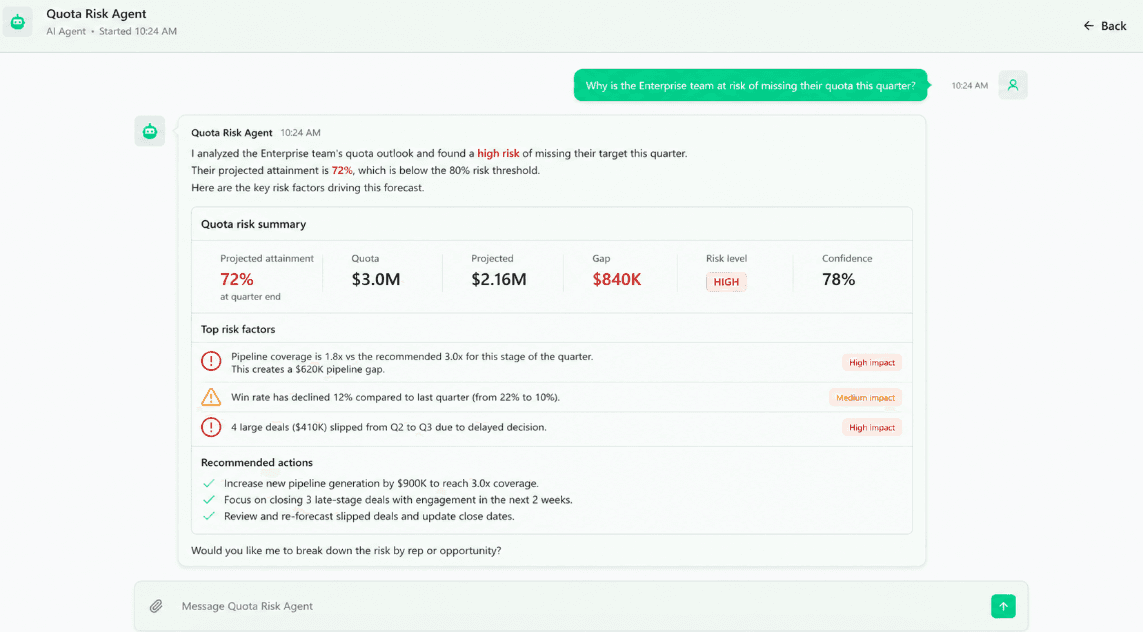
Quota Risk Agent
A Quota Risk Agent is an AI-powered agent that predicts whether reps, teams, or regions are likely to miss revenue targets. It analyzes pipeline activity, forecasting trends, and sales performance to identify quota risks before the end of the quarter.
Goal
The goal of a Quota Risk Agent is to help sales leaders and RevOps teams identify quota attainment risks earlier and take corrective actions before revenue targets are missed.
How It Works
The agent continuously analyzes:
pipeline coverage
forecast trends
sales performance
revenue generation
deal progression
win rates
pipeline creation
historical quota attainment
The system can identify:
reps with insufficient pipeline
declining conversion trends
weak future coverage
overreliance on a few large deals
slowing pipeline generation
unrealistic forecast assumptions
The agent can then recommend actions such as:
generating additional pipeline
reallocating opportunities
increasing outbound activity
reviewing at-risk deals
adjusting forecast expectations
involving managers earlier in large opportunities
Some AI agents and RevOps platforms can also simulate different forecasting scenarios to estimate how pipeline changes may impact quota attainment.
Key Benefits
Improves quota predictability
Detects risks earlier
Helps teams react faster
Improves planning decisions
Supports better forecasting
Improves pipeline management
Gives leadership better real time insights
Who Needs It
CROs
Sales managers
RevOps teams
Finance teams
Forecast Scenario Agent
A Forecast Scenario Agent is an AI-powered agent that helps companies simulate different forecasting scenarios and understand how pipeline changes may impact future revenue. It allows RevOps teams and leadership to test assumptions before making strategic decisions.
Goal
The goal of a Forecast Scenario Agent is to help companies build more reliable forecast plans and better prepare for potential revenue risks and opportunities.
How It Works
The agent analyzes:
pipeline coverage
conversion rates
sales velocity
slippage trends
win rates
revenue trends
historical forecasting data
The system allows users to simulate different scenarios such as:
lowering deal probabilities
excluding risky opportunities
changing conversion assumptions
increasing pipeline generation
delaying large deals
modeling best-case and worst-case outcomes
For example, the agent can estimate:
how much revenue may slip into the next quarter
how conversion declines may impact targets
how pipeline gaps may affect quota attainment
how forecast changes impact revenue planning
Some AI agents for RevOps can automatically generate conservative, realistic, and aggressive forecast scenarios for leadership reviews.
Key Benefits
Improves strategic planning
Helps teams prepare for revenue risks
Improves forecasting accuracy
Supports better decision-making
Improves confidence in forecasts
Gives leadership better revenue visibility
Who Needs It
RevOps teams
Finance teams
CROs
CEOs
Sales leaders
Sales Manager Briefing Agent
A Sales Manager Briefing Agent is an AI-powered agent that prepares automated summaries before pipeline reviews, forecast calls, and 1:1 meetings. It helps managers quickly understand what changed, which deals require attention, and where risks exist across the pipeline.
Goal
The goal of a Sales Manager Briefing Agent is to reduce manual preparation work and help managers make faster and better decisions during forecast and pipeline review meetings.
How It Works
The agent continuously analyzes:
pipeline changes
forecast updates
deal risks
rep activity
conversion trends
slipped deals
inactive opportunities
forecast category changes
follow ups
Before meetings, the system automatically generates summaries that may include:
biggest pipeline changes
risky opportunities
deals requiring manager involvement
reps missing targets
stalled opportunities
weak pipeline coverage
forecast changes since the previous review
Some AI agents and RevOps platforms can also generate recommended talking points and coaching suggestions for managers.
Key Benefits
Reduces manual report generation
Saves time before meetings
Improves pipeline reviews
Gives managers better actionable insights
Improves coaching consistency
Helps identify revenue risks earlier
Improves operational efficiency
Who Needs It
Sales managers
Sales Process Optimization Agent
A Sales Process Optimization Agent is an AI-powered agent that analyzes sales workflows, pipeline stages, and conversion patterns to identify inefficiencies that slow down revenue growth. It helps companies improve their revenue workflows and eliminate bottlenecks across the pipeline.
Goal
The goal of a Sales Process Optimization Agent is to improve pipeline efficiency, reduce friction in the sales process, and help teams build more scalable and predictable revenue operations.
How It Works
The agent continuously analyzes:
conversion rates
sales cycle length
stage aging
pipeline bottlenecks
deal progression
qualification patterns
follow ups
sales activity
CRM workflows
The system can identify:
stages with poor conversion rates
weak qualification processes
slow deal progression
inconsistent sales workflows
excessive manual processes
pipeline leakage
ineffective handoffs between teams
The agent can then recommend actions such as:
Simplifying or modifying pipeline stages
improving qualification criteria
automating repetitive workflows
standardizing follow-up processes
improving lead routing
adjusting sales playbooks
Key Benefits
Improves pipeline efficiency
Reduces manual processes
Helps teams scale more effectively
Increases conversion rates
Improves operational alignment
Helps eliminate revenue leakage
Who Needs It
RevOps teams
Sales Operations
Sales leaders
Executive Revenue Agent
An Executive Revenue Agent is an AI-powered agent that helps executives monitor company-wide revenue performance, forecast risks, and operational trends. It combines insights from sales, forecasting, pipeline management, and customer retention into a single executive-level view.
Goal
The goal of an Executive Revenue Agent is to help leadership teams make faster strategic decisions using unified and real-time revenue intelligence.
How It Works
The agent continuously analyzes:
forecast performance
pipeline health
revenue trends
customer retention
quota attainment
pipeline generation
conversion rates
revenue risks
sales performance
financial data
The system connects multiple sources including:
CRM
financial systems
marketing platforms
customer success platforms
The agent can identify:
declining revenue trends
forecast gaps
weak future pipeline coverage
revenue concentration risks
pipeline bottlenecks
customer churn risks
operational inefficiencies
The system can also generate:
executive summaries
board-level reports
forecast reviews
revenue risk alerts
strategic recommendations
Some AI agents and RevOps platforms can proactively recommend actions based on changing pipeline and forecast conditions. The agent can also monitor long-term metrics such as churn trends, expansion revenue, and net revenue retention.
Key Benefits
Improves executive visibility
Creates a unified view of revenue operations
Helps leadership react faster to risks
Improves strategic forecasting
Reduces manual reporting
Improves alignment across departments
Supports better long-term planning
Who Needs It
CEOs
CROs
CFOs
RevOps teams
Executive leadership teams
How AI Agents Improve Revenue Operations
Modern AI agents and RevOps platforms help companies automate repetitive work, improve decision-making, and create better alignment across the business. Instead of relying on disconnected tools and spreadsheets, organizations can use AI agents to create a centralized and more intelligent revenue engine.
One of the biggest advantages of AI agents for RevOps is their ability to break down data silos. AI agents continuously sync information across:
CRM
marketing automation platforms
financial systems
customer support tools
billing systems
customer success platforms
This creates a unified view of customer data and improves consistency across the entire customer journey.
AI agents enhance the decision-making process through real-time analysis of vast datasets, identifying revenue trends and forecasting customer behavior, which allows RevOps to shift from reactive problem-solving to growth-driven initiatives.
Modern AI agents can autonomously execute complex workflows across CRM, marketing automation, and financial systems without constant human oversight.
AI agents also improve operational efficiency. Many RevOps teams spend 40-60% of their time on repetitive tasks such as:
manual reporting
data cleanup
pipeline reviews
lead routing
forecast preparation
CRM updates
AI agents automate many of these workflows and allow teams to focus on higher-value activities.
Another major benefit is faster decision-making. AI agents continuously analyze vast amounts of sales data, pipeline activity, and customer behavior to identify:
revenue trends
churn risks
forecasting issues
at-risk deals
conversion problems
upsell opportunities
This reduces time-to-insight from days to minutes and helps leadership teams react faster to changing business conditions.
AI agents help companies improve operational efficiency and overall customer satisfaction.
Why Centralized Data Matters in RevOps
Centralized data is at the heart of RevOps, integrating data from multiple sources to create a unified source of truth, which allows teams to track key metrics without relying on multiple spreadsheets or systems.
Many companies still operate with:
disconnected systems
duplicate records
inconsistent reporting
outdated customer information
fragmented revenue workflows
This creates poor visibility across the organization and makes it difficult for teams to track key metrics consistently.
Modern AI agents for RevOps help solve this problem by integrating multiple systems into a centralized source of truth. AI agents continuously sync and analyze:
pipeline activity
customer interactions
marketing performance
billing information
support interactions
financial data
product usage
This unified data foundation improves:
reporting accuracy
forecasting accuracy
collaboration between teams
customer visibility
revenue planning
operational efficiency
As companies scale, centralized data becomes even more important because disconnected workflows often create revenue leakage and inconsistent customer experiences.
Challenges of Implementing AI Agents in RevOps
Although AI agents and RevOps create major operational benefits, implementation is not always simple. Many organizations face technical, operational, and cultural challenges during deployment.
One of the biggest problems is poor data quality. AI agents require a strong data foundation to operate effectively. Inaccurate CRM records, incomplete customer data, and disconnected systems can reduce the reliability of AI-generated insights.
Another common challenge is integration complexity. Many older platforms lack modern APIs, making it difficult to connect:
CRM platforms
marketing tools
financial systems
customer success platforms
internal databases
Organizations may also face resistance from teams that distrust AI-generated recommendations or prefer traditional workflows.
Other common implementation challenges include:
unclear ROI expectations
inconsistent workflow configuration
lack of governance
unrealistic automation expectations
Successful implementation usually requires gradual rollout, testing, and continuous optimization rather than immediate large-scale automation.
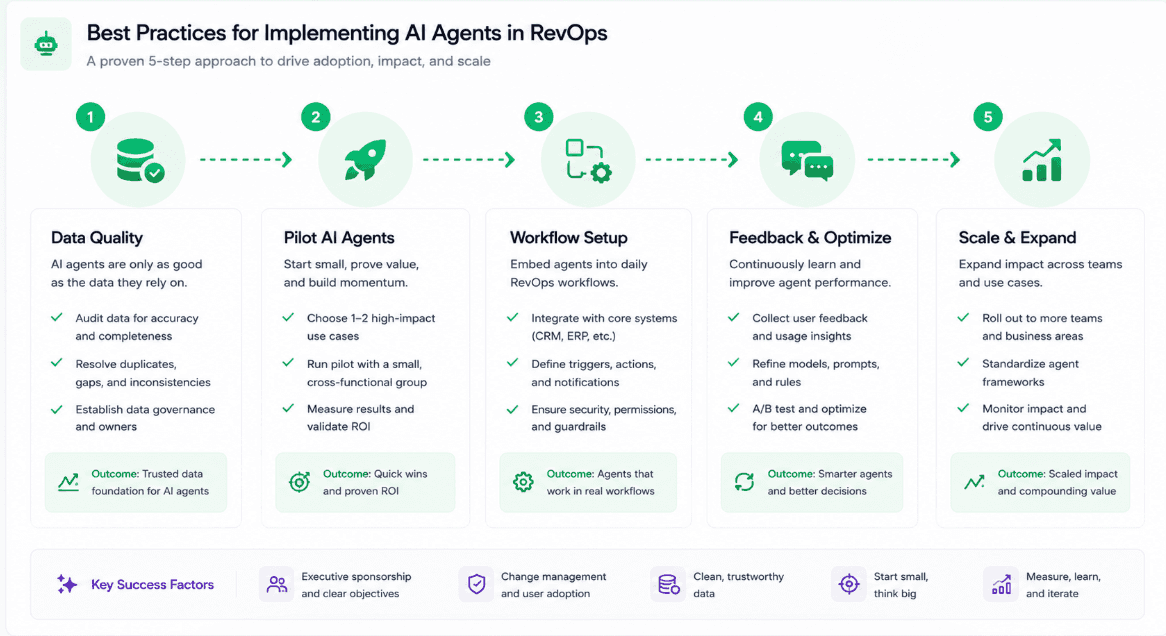
Best Practices for Implementing AI Agents for RevOps
Companies should approach AI agents for RevOps strategically rather than deploying multiple tools without clear business goals.
Before implementing AI agents, organizations should audit current data quality across all systems to identify incomplete records, inconsistent workflows, and unreliable revenue data.
To effectively integrate AI agents into RevOps, organizations should start by reviewing current processes to identify repetitive, time-consuming tasks that are ideal for automation
Common starting points include:
lead scoring
CRM hygiene
pipeline reviews
forecast preparation
report generation
lead routing
customer health monitoring
Organizations should also review current data quality across all systems before implementation. AI agents depend on clean and reliable revenue data.
Another best practice is starting with small pilot projects instead of large deployments.
Companies should roll AI agents out gradually through pilot programs with clear success metrics, quantitative benchmarks, and qualitative feedback from users.
Businesses should:
Define clear success metrics
Test workflows gradually
Collect user feedback
Measure operational impact
Optimize workflows continuously
Organizations should carefully configure AI agents with clear workflows, permissions, and governance rules before large-scale deployment
AI agents also require clear instructions, structured workflows, and ongoing oversight. Even advanced autonomous systems still need governance and human supervision.
The most successful companies focus on measurable business outcomes such as:
improved forecasting accuracy
faster pipeline reviews
better conversion rates
reduced manual workload
improved customer retention
increased revenue growth
The Future of AI Agents and RevOps
The future of AI agents and RevOps will likely move far beyond simple workflow automation. AI agents are evolving into autonomous software systems capable of independent reasoning, workflow orchestration, and proactive decision-making.
Future AI agents may:
autonomously prioritize deals
recommend pricing adjustments
create intelligent lead routing
trigger outreach sequences
coordinate revenue workflows across departments
As more organizations adopt centralized and unified revenue systems, AI agents will become a core part of modern revenue operations.
Companies that successfully integrate AI agents across sales, forecasting, pipeline management, and customer success workflows may gain significant advantages in:
operational efficiency
forecasting accuracy
customer retention
revenue visibility
strategic planning
revenue growth
The biggest long-term opportunity is not replacing people with AI. It is helping sales teams, RevOps teams, and leadership teams make faster and better decisions using real-time and unified revenue intelligence.
FAQ
How long does it take to implement AI agents for RevOps?
Most companies can implement simple AI agents for RevOps within several weeks. More advanced implementations involving multiple systems, forecasting workflows, and complex automation may take several months.
What data do AI agents require to work effectively?
AI agents require clean and centralized revenue data from sources such as CRM systems, marketing platforms, support tools, and financial systems. Strong data quality is critical for reliable forecasting and automation.
What platforms offer AI agents for revenue operations?
Many forecasting platforms, CRM providers, and revenue intelligence tools now offer AI agents for pipeline management, forecasting, workflow automation, and revenue analysis. These capabilities are increasingly becoming part of broader AI solutions for automating revenue operations.
Can small sales teams benefit from AI agents?
Yes. Small sales teams can use AI agents to automate repetitive work, improve pipeline visibility, reduce manual reporting, and improve forecasting without expanding headcount.
What are the biggest risks of implementing AI agents in RevOps?
The biggest risks include inaccurate AI recommendations, unreliable forecasts, inconsistent workflows, and low adoption across teams. These problems are often caused by poor data quality, disconnected systems, unclear ROI expectations, and weak change management during implementation.
Share: