
Clari vs Forecastio: Forecasting and Revenue Intelligence for HubSpot Teams (2026)

Alex Zlotko
CEO at Forecastio
Last updated
Reading time
11 min
Achieve 95% accuracy in HubSpot forecasting

TL;DR
Clari is now part of Salesloft. Only Clari Forecast kept the Clari name. This Clari vs Forecastio comparison covers Clari Forecast, not the full Salesloft platform.
Forecasting is nearly equal. Forecastio is stronger in accuracy tracking and the forecast audit trail. Clari supports consumption-based revenue.
Revenue intelligence: Forecastio includes pipeline analysis, deal reviews, win/loss analysis and revenue analytics in one product. Clari’s deeper pipeline inspection and analytics sit in separate Salesloft products, but Clari Forecast connects risks directly to seller actions in Salesloft.
CRM: Clari is Salesforce-first, and its HubSpot integration is limited. Forecastio is built for HubSpot, with Salesforce coming in January 2027.
Clari pricing isn’t published. Vendr’s median Clari contract is $76,000 a year. Forecastio costs $49 or $69 per seat per month plus a platform fee, about $19,332 a year for 20 users.
Implementation: Clari typically takes 8 to 16 weeks. Forecastio goes live in days, with a full implementation of up to 4 weeks done during a free one-month pilot.
Choose Clari if you run Salesforce, already use Salesloft or forecast consumption-based revenue. Choose Forecastio if you run HubSpot and want forecasting and revenue intelligence in one product with a simpler interface.
How we compared Clari and Forecastio
This comparison is written by the Forecastio team. We spoke with more than 25 customers who have used Clari about how they forecast with it, what works well and where it falls short. We also used Salesloft’s product pages and press releases, Vendr pricing data, G2 and Capterra reviews, and independent guides such as Docket and Weflow. All sources were checked in October 2026.
Clari vs Forecastio: side-by-side comparison
Criteria | Clari Forecast | Forecastio |
|---|---|---|
Best for | Salesforce-based teams, Salesloft users, consumption-based revenue | HubSpot teams that want forecasting and revenue intelligence in one product |
Product status | Part of Salesloft; the only product that kept the Clari name | Standalone sales forecasting and revenue intelligence platform |
CRM support | Salesforce first; Microsoft Dynamics; HubSpot integration more limited | Built for HubSpot; Salesforce integration from January 2027 |
AI forecasting | AI Forecast Agent using deal history and live rep activity | AI and machine learning models, plus weighted pipeline and time-series models |
Revenue streams it can forecast | Subscription, transactional, consumption-based, hybrid | Subscription, transactional, hybrid |
Forecast roll-ups | Multi-level | Multi-level |
Forecast change tracking | Weekly snapshots, rep calls and overrides | Daily, weekly and monthly snapshots, plus a forecast audit trail |
Accuracy tracking | AI projection vs submitted forecast | By method, time horizon, team and rep, plus category discipline |
Pipeline and deal intelligence | Risk flags, AI deal scoring, pipeline coverage; deeper inspection in Salesloft Inspect | Pipeline health, waterfall and slippage analysis, deal signals, stakeholder analysis |
AI agents | AI Forecast Agent | Forecast Review, Forecast Accuracy, Deal Review and Win/Loss Analysis agents |
Call analysis | Through Salesloft Conversation Intelligence | Analyzes calls recorded in HubSpot or other tools |
Sales engagement | Through Salesloft | Not offered |
Pricing | Not published; Vendr median $76,000 a year | $49 or $69 per seat per month, plus a platform fee |
Implementation | 8 to 16 weeks, per independent guides | Live in days; full implementation up to 4 weeks, during a free one-month pilot |
Clari vs Forecastio: Which Is Better for HubSpot Teams in 2026?
Clari is now part of Salesloft. The two companies merged in December 2025, and in September 2026 Salesloft retired the Clari brand. Only Clari Forecast kept the name.
That changes the buying decision. Choosing Clari today means buying a product inside a larger Salesloft platform, with its roadmap, contracts and pricing. Forecastio is a sales forecasting and revenue intelligence platform built for HubSpot.
In this Clari vs Forecastio comparison, we look at Clari Forecast and Forecastio side by side: forecasting and revenue intelligence, pricing, HubSpot fit and implementation. We don’t compare the rest of the Salesloft platform, such as sales engagement or conversation intelligence.
What happened to Clari after the Salesloft merger?
Clari and Salesloft completed their merger on December 3, 2025. On September 2, 2026, the combined company moved to a single Salesloft brand. Clari Forecast is the only product that kept the Clari name. Clari’s other products, such as pipeline inspection and conversation intelligence, now carry the Salesloft name.
Clari and Salesloft merger timeline
August 2025: Clari and Salesloft announce the merger.
December 3, 2025: The merger closes. Steve Cox becomes CEO of the combined company.
December 15, 2025: Gartner names Clari a Leader in its first Magic Quadrant for Revenue Action Orchestration. Salesloft is named a Visionary.
April 14, 2026: Clari Forecast is connected to Salesloft’s execution tools. Managers can create tasks and send AI follow-up emails from the forecast view.
September 2, 2026: Salesloft unveils one brand for the whole company.
What does the merger mean for Clari buyers?
Clari is now part of Salesloft. If you’re asking who owns Clari or whether Salesloft bought Clari, the deal was announced as a merger, and Clari now operates as part of Salesloft. Clari vs Salesloft is no longer a choice between two vendors. Clari Forecast is sold as part of a broader platform that also covers sales engagement and conversation intelligence.
It keeps its own login. Clari Forecast still runs on a separate login from the main Salesloft app.
Pricing and contracts go through Salesloft. Clari’s old pricing page now redirects to a Salesloft sales form.
Not everyone saw the merger as a simple win. At the announcement, a Forrester analyst wrote that it raised “more questions than answers” on product strategy, since both companies already offered forecasting.
What is Clari Forecast?
Clari Forecast is an AI sales forecasting product, now sold by Salesloft. Teams use Clari forecasting to project where the quarter will land, flag at-risk deals and roll forecasts up across teams. It combines historical deal data with live rep activity and is built mainly for large revenue organizations running Salesforce.
How Clari Forecast works
Clari Forecast sits on top of the CRM. It captures snapshots of deals over time in Clari’s revenue database (RevDB), so teams can see how the pipeline changed week by week.
On the Clari Forecast product page, Salesloft lists these capabilities:
AI Forecast Agent that analyzes historical deal data and live rep activity.
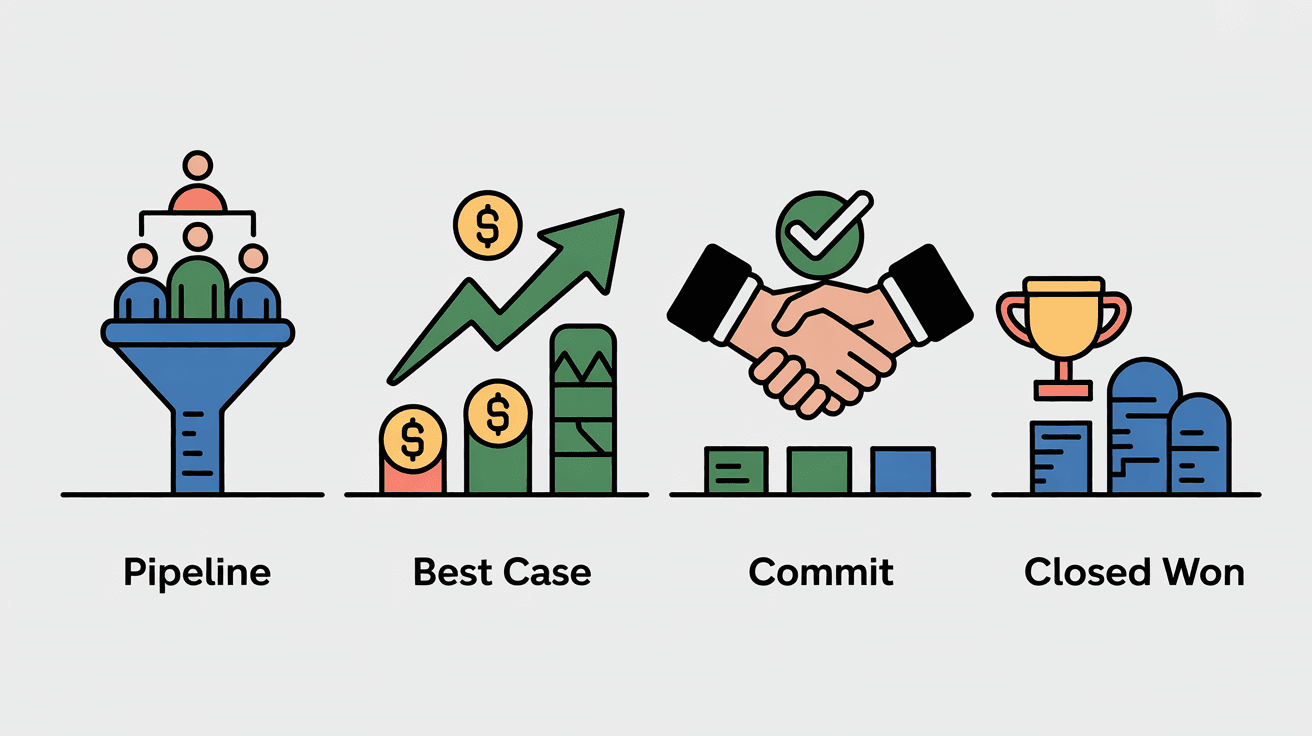
Forecast fields such as Quota, Commit, Best Case and Pipeline, at quarter and month level.
Forecast filters by bookings, renewals, region, segment, account size or time period.
Risk flags for slipping deals, stalled buying activity and execution gaps.
AI-scored opportunities and pipeline coverage.
Next best actions triggered by risks and gaps.
From April 2026, managers can also create Salesloft tasks and send AI follow-up emails directly from the forecast view.
Where Clari Forecast is strong
Complex forecasting at scale. Clari supports roll-ups across many teams and regions, and both subscription and consumption revenue models.
Pipeline history. RevDB snapshots show how deals and forecasts changed over time.
Revenue intelligence inside the forecast. Deal risk flags, AI scoring and coverage sit in the same product as the forecast.
Market recognition. Clari is a Leader in Gartner’s first Magic Quadrant for Revenue Action Orchestration, with a 4.6/5 rating from about 5,600 reviews on G2. Clari has claimed 98% forecast accuracy by week two of the quarter, based on customer results.
Where Clari Forecast falls short
Built for Salesforce first. Clari’s own forecasting page names Salesforce as its core CRM integration. Independent reviews describe the Clari HubSpot integration as more limited. We look at whether Clari works with HubSpot in its own section below.
Long implementation and ongoing RevOps work. Independent guides put a Clari implementation at roughly 8 to 16 weeks, with 10 to 15 hours a week of internal RevOps time. Reviewers say the platform needs a dedicated admin to maintain.
Steep learning curve and limited customization. In Clari reviews on G2, users often describe a complex interface, limits on custom views, and delays before CRM changes show up in Clari.
No published Clari pricing, and rigid contracts. Every deal is a custom quote. Vendr reports that multi-year terms are common, with annual price increases of 5 to 8%. We cover how much Clari costs in the pricing section below.
Deeper pipeline analysis sits in a separate product. Clari Forecast includes deal risk flags and pipeline coverage, but deeper pipeline inspection lives in Inspect, now a separate Salesloft product.
What is Forecastio?
Forecastio is a sales forecasting and revenue intelligence platform for HubSpot. It combines AI sales forecasting with pipeline intelligence, deal intelligence and AI agents in one platform. It connects to HubSpot in minutes, goes live in days, and is priced per seat, starting at $49 per seat per month, billed annually.

How Forecastio works
Forecastio connects to HubSpot and learns from your historical deal data. Its AI models keep recalibrating as new deals open, move and close.
Like any machine learning model, Forecastio’s AI forecast gets more accurate with more data. It works best for teams with at least 5 to 10 AEs, hundreds of open deals and enough deal history.
The platform has four parts:
Sales forecasting. AI, weighted pipeline and time-series models run side by side. Teams can use forecast categories, rep submissions and manager roll-ups, and model what-if scenarios. Forecastio tracks accuracy by method, time horizon, team and rep. Forecasts can be built by organization, team or pipeline, including renewal and expansion revenue.
Forecast audit trail. It shows why the forecast moved: slipped deals, amount changes, category updates, and new or closed deals. For each change, you see what changed, when, who changed it and the impact on the number.
Pipeline and deal intelligence. Pipeline health, stage and velocity analysis, waterfall analysis, deal slippage and pipeline leakage. At the deal level: deal signals, stakeholder and engagement analysis, analysis of calls recorded in HubSpot or other tools, and at-risk deals.
AI agents. The Forecast Review, Forecast Accuracy, Deal Review and Win/Loss Analysis agents review forecasts and deals, flag risks and recommend next actions. For example, they can suggest updating a deal’s close date or amount, or explain why a specific rep loses deals.
Where Forecastio is strong
Built for HubSpot. Setup takes minutes, not a multi-month project with consultants.
Forecasting and revenue intelligence in one platform. Pipeline and deal intelligence and AI agents are part of the product, not separate tools.
Multiple forecasting methods. Teams don’t have to rely only on rep commits or static CRM stage probabilities.
A forecast that explains itself. The audit trail shows exactly what moved the number and who moved it.
Published, per-seat pricing. Two plans, listed on the pricing page, plus a free one-month pilot on your own data.
Where Forecastio falls short
HubSpot only, for now. Forecastio works with HubSpot today. Its Salesforce integration will be available in January 2027.
No built-in call recording. Forecastio analyzes calls recorded in HubSpot or other tools, but it doesn’t record calls itself. It also doesn’t offer live call coaching.
No sales engagement. There are no email sequences or dialers. Teams that need them use a separate tool.
Standard views won’t fit every team. Out-of-the-box dashboards and data views may not cover every reporting need. We build custom views and features on request, at no extra cost
How do Clari and Forecastio compare on forecasting?
Clari and Forecastio offer nearly equal forecasting capabilities. Both use AI to predict where the quarter will land, support multi-level roll-ups and keep a full history of forecast changes. Forecastio is stronger in accuracy tracking and in explaining why the forecast moved. Clari forecasting supports more complex revenue models, such as consumption-based revenue.
Capability | Clari Forecast | Forecastio |
|---|---|---|
AI forecasting | AI Forecast Agent using deal history and live rep activity | AI and machine learning models built on historical patterns and active deal signals |
Other forecasting methods | AI projection compared with rep commit | Rep submissions, weighted pipeline and time series models |
What-if scenarios | Flexible what-if scenarios | Flexible what-if scenarios |
Revenue streams it can forecast | Subscription, transactional, consumption-based, hybrid | Subscription, transactional, hybrid (consumption-based not supported yet) |
Custom forecast models | RevOps can design and test models | Configurable for custom sales processes |
Submissions, roll-ups, and forecast categories | Multi-level, across business units, regions, segments, product lines | Multi-level, across business units, regions, pipelines, deal types |
Forecast change tracking | Weekly snapshots, rep calls and overrides | Daily, weekly and monthly snapshots of all changes for all forecasting methods |
Accuracy tracking | AI projection vs submitted forecast over time | By method, time horizon, pipeline, deal type, team, and rep |
CRM | Salesforce first | HubSpot |
Forecasting methods and AI models
Clari Forecast uses an AI Forecast Agent that analyzes historical deal data and live rep activity. Its AI projection sits next to the team’s commit, so leaders can compare the model with their reps’ judgment. Clari supports subscription, transactional, consumption-based and hybrid revenue models, and lets RevOps teams design and test their own forecast models. It also offers scenario forecasting, where leaders pull deals in and out of the projection.
Forecastio builds forecasts with AI and machine learning models trained on historical patterns and active deal signals. Weighted pipeline and time-series models run side by side with the AI forecast, so teams can compare methods and pick the one that fits each sales motion, from new business to renewals and expansion. What-if scenarios let managers test how deal changes would affect the number. Forecastio supports subscription and transactional sales. Consumption-based forecasting isn’t supported yet.

Forecast submissions and roll-ups
Clari Forecast handles rep submissions, manager overrides and multi-level roll-ups across business units, regions, segments and product lines.
Forecastio also supports multi-level roll-ups for complex org structures. Teams use forecast categories and rep submissions, and roll forecasts up by organization, team or pipeline.
Both handle the weekly forecast process for large, layered sales organizations.

Forecast audit trail: why the number moved
Clari Forecast snapshots deal data over time in its revenue database, so teams can see how the pipeline and forecast changed week by week. It also tracks rep calls and manager overrides.
Forecastio takes daily, weekly and monthly snapshots of every change and movement in the pipeline. On top of that, its forecast audit trail lists each change that moved the forecast: slipped deals, amount changes, category updates, and new or closed deals. For each change, it shows what changed, when, who made the change, and the impact on the number.

Forecast accuracy tracking
Clari Forecast shows forecast accuracy over time and compares the AI projection with submitted forecasts. Clari has claimed 98% forecast accuracy by week two of the quarter, based on customer results.
Forecastio tracks accuracy by forecasting method, time horizon, team and rep. Managers can see which method is most reliable for their business and which reps consistently over- or under-call.
Forecastio also includes a forecast category discipline report. It shows what percentage of deals in each forecast category actually closed or slipped. This highlights which teams and reps assign categories well and which don’t, for example reps whose Commit deals often slip. Managers use it to target training and coaching where it matters most.

Clari vs Forecastio: which is better for forecasting?
On core forecasting, the two are close. Both offer AI forecasts, multi-level roll-ups and forecast history. Forecastio is stronger in accuracy tracking and in the forecast audit trail, which explains every change behind the number. Clari forecasting supports more complex revenue models, including consumption-based revenue. For teams with usage-based pricing, that can be the deciding factor.
How do Clari and Forecastio compare on pipeline and deal intelligence?
Both add revenue intelligence on top of the forecast. Clari Forecast flags at-risk deals, scores opportunities and connects risks to seller actions in Salesloft. Forecastio goes deeper on analysis inside one product: pipeline health, at-risk deals, waterfall analysis, deal reviews and win/loss analysis, supported by AI agents.
Capability | Clari Forecast | Forecastio |
|---|---|---|
Pipeline health and coverage | Pipeline coverage shown next to the forecast | Pipeline coverage shown next to the forecast |
Stage, velocity and sales cycle analysis | Not part of Clari Forecast; deeper inspection is in Inspect, a separate Salesloft product | Stage, velocity and sales cycle analysis |
Waterfall, slippage and leakage analysis | Flags for slipping deals | Waterfall chart, slippage and revenue leakage compared to averages. |
At-risk deals | Flags slipping deals, stalled buying activity and execution gaps; action plans | Assigns risk levels based on different signals. Allows to set up rules |
Deal signals | AI-scored opportunities with change signals, such as a close date moved | AI-scored opportunities with change signals, such as close date moved or engagement deteriorated |
Stakeholder and engagement analysis | Contact change signals, such as a new executive contact | Stakeholder, multithreading, and engagement analysis |
Call analysis | Not part of Clari Forecast; available in Salesloft Conversation Intelligence | Only analysis of recordings made by third-party tools |
Win/loss analysis | Not in Clari Forecast product | Win/Loss Analysis agent |
AI agents | AI Forecast Agent | Forecast Review, Forecast Accuracy, Deal Review and Win/Loss Analysis agents |
Acting on insights | Create Salesloft tasks and AI follow-up emails from the forecast view | Recommends next best selling actions and performs operational actions (create a task, update close date, change deal amount, change forecast category) |
Revenue analytics | Deep analytics available in Salesloft Analytics, a separate product | Built in: custom dimensions, trends, concentration and risk views |
Pipeline analysis
Clari Forecast shows pipeline coverage next to the forecast and flags deals that are slipping. Since the merger, deeper pipeline inspection lives in Inspect, now a separate Salesloft product.
Forecastio includes pipeline analysis in the platform. It covers pipeline health, stage and velocity analysis, sales cycle analysis, waterfall analysis, deal slippage and pipeline leakage. Managers can see where deals stall, which stages leak revenue and how the pipeline moved over the quarter.

Deal intelligence and risk signals
Clari Forecast flags slipping deals, stalled buying activity and execution gaps. Its AI scores each opportunity and surfaces changes, such as a close date pulled in or a new executive contact. Managers can create action plans for at-risk deals.
Forecastio builds deal intelligence from deal signals, deal maps, and stakeholder and engagement analysis. It also analyzes calls recorded in HubSpot or other tools, so call content feeds the deal picture without a separate recorder. At-risk deals are flagged based on these signals. Additionally, Forecastio provides recommendations on next best selling actions and can perform operational tasks automatically.


AI agents
Clari Forecast uses an AI Forecast Agent to analyze deal history and rep activity. From April 2026, managers can turn risks into action directly from the forecast view, by creating Salesloft tasks and sending AI follow-up emails.
Forecastio runs four AI agents. The Forecast Review and Forecast Accuracy agents check the forecast. The Deal Review agent reviews open deals, flags risks and recommends next steps, such as updating a deal’s close date or preparing a proposal. The Win/Loss Analysis agent explains why deals are won or lost, down to the individual team and rep.

Revenue analytics
Clari Forecast gives leaders forecast views by rep and team. Broader analytics is a separate Salesloft product.
Forecastio includes advanced revenue analytics in the platform: custom dimensions, trends, and concentration and risk views. Executives and managers each get their own views of the forecast, pipeline and deals.
Forecastio vs Clari: which is better for revenue intelligence?
Clari is a powerful product, and Clari’s platform offers very deep pipeline inspection and analytics. Since the merger, though, much of that depth sits in separate Salesloft products, such as Inspect and Analytics, not in Clari Forecast itself. Clari Forecast is also stronger at turning risks into seller actions, because it connects directly to Salesloft’s execution tools. If your team already runs Salesloft for outreach, that link matters.
Forecastio includes forecasting, pipeline analysis, deal reviews, win/loss analysis by rep and full revenue intelligence in one product. For HubSpot teams that want deep pipeline and deal intelligence without buying several products, Forecastio covers more in a single platform.
Does Clari work with HubSpot?
Clari can work with HubSpot, but HubSpot isn’t its main focus. Clari’s own forecasting page names Salesforce as its core CRM integration, and independent reviews describe the Clari HubSpot integration as more limited. Forecastio is built for HubSpot, and its Salesforce integration will be available in January 2027.
Clari HubSpot integration
Clari was built on top of Salesforce, and its deepest integration is still there. G2 reviewers often praise its bi-directional Salesforce sync, which lets reps update opportunities without opening Salesforce. Clari also supports Microsoft Dynamics. Vendr lists HubSpot among the CRMs Clari supports, but independent reviews, such as Coffee’s analysis, describe the Clari HubSpot integration as more limited, with deal health models optimized for Salesforce’s data model. Some teams use third-party connectors, such as Workato, to move Clari forecast data into HubSpot. If you run HubSpot, ask Salesloft for a demo on your own HubSpot data, and check which features work and how often data syncs.
Forecastio HubSpot integration
Forecastio is built for HubSpot. Its AI models learn from your historical HubSpot deal data and keep recalibrating as deals move. It works with HubSpot’s deals, forecast categories and pipelines, and analyzes calls recorded in HubSpot, so that context feeds deal intelligence directly. You can test it on your own data first, with a free one-month pilot configured on your HubSpot account. Forecastio’s Salesforce integration will be available in January 2027. Microsoft Dynamics isn’t supported.
Clari pricing: how much does Clari cost compared to Forecastio?
Clari doesn’t publish pricing, and clari.com/pricing now redirects to a Salesloft sales form. Vendr data from 291 purchases puts the median Clari contract at $76,000 per year, ranging from about $19,000 to $415,000. Forecastio publishes its pricing: $49 or $69 per seat per month, billed annually.
Clari pricing
Every Clari deal is a custom quote through Salesloft’s sales team. According to Vendr, the median buyer pays $76,000 a year. Third-party guides estimate Clari price per user at roughly $100 to $125 per month for Clari Forecast. Clari Copilot pricing adds about $60 to $110 per user per month on top, according to Docket.
Budget for more than the license. Vendr reports implementation fees from a few thousand dollars to mid-five figures, and annual price increases of 5 to 8% in many contracts. If you’re negotiating Clari pricing, Vendr notes that multi-year terms can lower annual pricing by 15 to 30%. Clari’s fiscal year ends in January, and quarter-ends in April, July and October often bring better offers.
Forecastio pricing
Forecastio has two plans, both priced per seat and billed annually:
Sales Forecasting: $49 per seat per month, billed annually.
Forecasting and Revenue Intelligence: $69 per seat per month, billed annually.
Custom views are built on request at no extra cost. You can start with a free one-month pilot on your own HubSpot data.
Each plan also has a monthly platform fee that includes the first two seats: $249 for Sales Forecasting and $369 for Forecasting and Revenue Intelligence. For example, a team of 20 users on the full plan pays the $369 platform fee plus 18 × $69, or $1,611 per month. That’s $19,332 a year, about a quarter of Vendr’s median Clari contract. See all details on the pricing page.
How long does Clari implementation take?
A Clari implementation typically takes 8 to 16 weeks, according to independent guides, with 10 to 15 hours a week of internal RevOps time. Forecastio goes live in days. A full implementation takes up to 4 weeks, depending on your requirements, and is done during Forecastio’s free one-month pilot.
Clari implementation
Docket estimates 6 to 8 weeks for teams under 50 users, 8 to 12 weeks for 50 to 500 users, and 12 to 16 weeks for larger enterprise rollouts. It also estimates 10 to 15 hours a week of internal RevOps time during the project. Setting up forecast hierarchies and multiple revenue models takes the most time, and results depend on clean CRM data going in. Once Clari is set up, it can deliver results quickly: Clari’s customer stories include teams that knew where the quarter would land within two weeks of going live.
Forecastio implementation
Forecastio goes live in days. The full implementation takes up to 4 weeks, depending on your specific requirements, existing workflows and forecasting logic. Forecastio’s team runs the entire implementation during the free one-month pilot, so it costs you nothing. It needs about 3 to 4 hours a week of your RevOps team’s time. By the end of the pilot, you’re forecasting on your own HubSpot data, configured to your process.
When should you choose Clari or Forecastio?
Is Clari worth it? For large Salesforce-based teams that already run Salesloft or forecast consumption-based revenue, often yes. For HubSpot teams, Forecastio usually fits better: it covers forecasting and revenue intelligence in one product, goes live in days, and costs a fraction of a typical Clari contract.
Choose Clari Forecast if
You run Salesforce or Microsoft Dynamics today and can’t wait for Forecastio’s Salesforce integration in January 2027.
You already use Salesloft for sales engagement, and want risks in the forecast to turn into seller tasks and emails in one place.
You forecast consumption-based or usage-based revenue.
You want deep analytics across the wider Salesloft platform, and have the budget and RevOps capacity for a longer rollout.
Choose Forecastio if
Your team runs on HubSpot.
You want forecasting, pipeline intelligence, deal intelligence and AI agents in one product.
You want a straightforward, intuitive interface without excessive complexity. In Clari reviews on G2, users often mention a steep learning curve.
You need to see why the forecast moved, and which reps assign forecast categories well, for coaching.
You want published, per-seat pricing and a full implementation done during a free one-month pilot.
Why do teams leave Clari?
Teams that look beyond Clari usually cite a few recurring reasons. Cost is the most common: Vendr’s median Clari contract is $76,000 a year, often with annual price increases of 5 to 8%. Others point to the RevOps time needed to maintain the platform, weaker fit for HubSpot, and uncertainty about packaging after the Salesloft merger.
Switching from Clari to Forecastio
The best time to switch is before your Clari renewal. Start the free one-month pilot a few months ahead, so Forecastio’s team can complete the implementation while Clari is still running. You can then compare both forecasts side by side on the same quarter before you decide. Forecastio learns from the deal history already in HubSpot, so there is no data migration from Clari.
FAQ
Who owns Clari?
Clari is now part of Salesloft. The two companies announced a merger in August 2025 and completed it on December 3, 2025. Since September 2026, the company operates under the Salesloft brand, led by CEO Steve Cox. Clari Forecast is the only product that kept the Clari name.
Does Clari integrate with HubSpot?
Clari can work with HubSpot, but its core CRM integration is Salesforce. Independent reviews describe the Clari HubSpot integration as more limited than its Salesforce integration. HubSpot teams should test Clari on their own data before buying. Forecastio is built for HubSpot, and its Salesforce integration will be available in January 2027.
How much does Clari cost per user?
Clari doesn’t publish pricing. Third-party guides estimate Clari Forecast at roughly $100 to $125 per user per month, with Clari Copilot adding about $60 to $110. Vendr data from 291 purchases puts the median Clari contract at $76,000 per year, plus implementation fees and annual price increases.
Forecastio vs Clari: which is cheaper?
Forecastio is usually much cheaper. It costs $49 or $69 per seat per month, billed annually, plus a platform fee that includes the first two seats. A 20-user team on the full plan pays about $19,332 a year, roughly a quarter of Vendr’s median Clari contract. Implementation is done during a free pilot.
Can Forecastio replace Clari Copilot?
Not fully. Clari Copilot, now part of Salesloft Conversation Intelligence, records and analyzes calls. Forecastio doesn’t record calls, but it analyzes calls recorded in HubSpot or other tools and uses them in deal intelligence. If you need a call recorder or live call coaching, you’ll need a separate tool.
What is the difference between Clari and Salesforce forecasting?
Salesforce has built-in forecasting based on your opportunities and forecast categories. Clari sits on top of Salesforce and adds AI projections, deal history snapshots, risk flags and multi-level roll-ups. Many enterprise teams use Clari because native Salesforce forecasting doesn’t explain why the forecast changed or how accurate each team’s calls are.
What are the main Clari competitors?
The main Clari competitors include Aviso, Forecastio, Gong Forecast, HubSpot Sales Hub’s built-in forecasting and Salesforce Sales Cloud. The right choice depends on your CRM, team size and how much revenue intelligence you need. See our full comparison of Clari alternatives and competitors.
TL;DR
Clari is now part of Salesloft. Only Clari Forecast kept the Clari name. This Clari vs Forecastio comparison covers Clari Forecast, not the full Salesloft platform.
Forecasting is nearly equal. Forecastio is stronger in accuracy tracking and the forecast audit trail. Clari supports consumption-based revenue.
Revenue intelligence: Forecastio includes pipeline analysis, deal reviews, win/loss analysis and revenue analytics in one product. Clari’s deeper pipeline inspection and analytics sit in separate Salesloft products, but Clari Forecast connects risks directly to seller actions in Salesloft.
CRM: Clari is Salesforce-first, and its HubSpot integration is limited. Forecastio is built for HubSpot, with Salesforce coming in January 2027.
Clari pricing isn’t published. Vendr’s median Clari contract is $76,000 a year. Forecastio costs $49 or $69 per seat per month plus a platform fee, about $19,332 a year for 20 users.
Implementation: Clari typically takes 8 to 16 weeks. Forecastio goes live in days, with a full implementation of up to 4 weeks done during a free one-month pilot.
Choose Clari if you run Salesforce, already use Salesloft or forecast consumption-based revenue. Choose Forecastio if you run HubSpot and want forecasting and revenue intelligence in one product with a simpler interface.
How we compared Clari and Forecastio
This comparison is written by the Forecastio team. We spoke with more than 25 customers who have used Clari about how they forecast with it, what works well and where it falls short. We also used Salesloft’s product pages and press releases, Vendr pricing data, G2 and Capterra reviews, and independent guides such as Docket and Weflow. All sources were checked in October 2026.
Clari vs Forecastio: side-by-side comparison
Criteria | Clari Forecast | Forecastio |
|---|---|---|
Best for | Salesforce-based teams, Salesloft users, consumption-based revenue | HubSpot teams that want forecasting and revenue intelligence in one product |
Product status | Part of Salesloft; the only product that kept the Clari name | Standalone sales forecasting and revenue intelligence platform |
CRM support | Salesforce first; Microsoft Dynamics; HubSpot integration more limited | Built for HubSpot; Salesforce integration from January 2027 |
AI forecasting | AI Forecast Agent using deal history and live rep activity | AI and machine learning models, plus weighted pipeline and time-series models |
Revenue streams it can forecast | Subscription, transactional, consumption-based, hybrid | Subscription, transactional, hybrid |
Forecast roll-ups | Multi-level | Multi-level |
Forecast change tracking | Weekly snapshots, rep calls and overrides | Daily, weekly and monthly snapshots, plus a forecast audit trail |
Accuracy tracking | AI projection vs submitted forecast | By method, time horizon, team and rep, plus category discipline |
Pipeline and deal intelligence | Risk flags, AI deal scoring, pipeline coverage; deeper inspection in Salesloft Inspect | Pipeline health, waterfall and slippage analysis, deal signals, stakeholder analysis |
AI agents | AI Forecast Agent | Forecast Review, Forecast Accuracy, Deal Review and Win/Loss Analysis agents |
Call analysis | Through Salesloft Conversation Intelligence | Analyzes calls recorded in HubSpot or other tools |
Sales engagement | Through Salesloft | Not offered |
Pricing | Not published; Vendr median $76,000 a year | $49 or $69 per seat per month, plus a platform fee |
Implementation | 8 to 16 weeks, per independent guides | Live in days; full implementation up to 4 weeks, during a free one-month pilot |
Clari vs Forecastio: Which Is Better for HubSpot Teams in 2026?
Clari is now part of Salesloft. The two companies merged in December 2025, and in September 2026 Salesloft retired the Clari brand. Only Clari Forecast kept the name.
That changes the buying decision. Choosing Clari today means buying a product inside a larger Salesloft platform, with its roadmap, contracts and pricing. Forecastio is a sales forecasting and revenue intelligence platform built for HubSpot.
In this Clari vs Forecastio comparison, we look at Clari Forecast and Forecastio side by side: forecasting and revenue intelligence, pricing, HubSpot fit and implementation. We don’t compare the rest of the Salesloft platform, such as sales engagement or conversation intelligence.
What happened to Clari after the Salesloft merger?
Clari and Salesloft completed their merger on December 3, 2025. On September 2, 2026, the combined company moved to a single Salesloft brand. Clari Forecast is the only product that kept the Clari name. Clari’s other products, such as pipeline inspection and conversation intelligence, now carry the Salesloft name.
Clari and Salesloft merger timeline
August 2025: Clari and Salesloft announce the merger.
December 3, 2025: The merger closes. Steve Cox becomes CEO of the combined company.
December 15, 2025: Gartner names Clari a Leader in its first Magic Quadrant for Revenue Action Orchestration. Salesloft is named a Visionary.
April 14, 2026: Clari Forecast is connected to Salesloft’s execution tools. Managers can create tasks and send AI follow-up emails from the forecast view.
September 2, 2026: Salesloft unveils one brand for the whole company.
What does the merger mean for Clari buyers?
Clari is now part of Salesloft. If you’re asking who owns Clari or whether Salesloft bought Clari, the deal was announced as a merger, and Clari now operates as part of Salesloft. Clari vs Salesloft is no longer a choice between two vendors. Clari Forecast is sold as part of a broader platform that also covers sales engagement and conversation intelligence.
It keeps its own login. Clari Forecast still runs on a separate login from the main Salesloft app.
Pricing and contracts go through Salesloft. Clari’s old pricing page now redirects to a Salesloft sales form.
Not everyone saw the merger as a simple win. At the announcement, a Forrester analyst wrote that it raised “more questions than answers” on product strategy, since both companies already offered forecasting.
What is Clari Forecast?
Clari Forecast is an AI sales forecasting product, now sold by Salesloft. Teams use Clari forecasting to project where the quarter will land, flag at-risk deals and roll forecasts up across teams. It combines historical deal data with live rep activity and is built mainly for large revenue organizations running Salesforce.
How Clari Forecast works
Clari Forecast sits on top of the CRM. It captures snapshots of deals over time in Clari’s revenue database (RevDB), so teams can see how the pipeline changed week by week.
On the Clari Forecast product page, Salesloft lists these capabilities:
AI Forecast Agent that analyzes historical deal data and live rep activity.
Forecast fields such as Quota, Commit, Best Case and Pipeline, at quarter and month level.
Forecast filters by bookings, renewals, region, segment, account size or time period.
Risk flags for slipping deals, stalled buying activity and execution gaps.
AI-scored opportunities and pipeline coverage.
Next best actions triggered by risks and gaps.
From April 2026, managers can also create Salesloft tasks and send AI follow-up emails directly from the forecast view.
Where Clari Forecast is strong
Complex forecasting at scale. Clari supports roll-ups across many teams and regions, and both subscription and consumption revenue models.
Pipeline history. RevDB snapshots show how deals and forecasts changed over time.
Revenue intelligence inside the forecast. Deal risk flags, AI scoring and coverage sit in the same product as the forecast.
Market recognition. Clari is a Leader in Gartner’s first Magic Quadrant for Revenue Action Orchestration, with a 4.6/5 rating from about 5,600 reviews on G2. Clari has claimed 98% forecast accuracy by week two of the quarter, based on customer results.
Where Clari Forecast falls short
Built for Salesforce first. Clari’s own forecasting page names Salesforce as its core CRM integration. Independent reviews describe the Clari HubSpot integration as more limited. We look at whether Clari works with HubSpot in its own section below.
Long implementation and ongoing RevOps work. Independent guides put a Clari implementation at roughly 8 to 16 weeks, with 10 to 15 hours a week of internal RevOps time. Reviewers say the platform needs a dedicated admin to maintain.
Steep learning curve and limited customization. In Clari reviews on G2, users often describe a complex interface, limits on custom views, and delays before CRM changes show up in Clari.
No published Clari pricing, and rigid contracts. Every deal is a custom quote. Vendr reports that multi-year terms are common, with annual price increases of 5 to 8%. We cover how much Clari costs in the pricing section below.
Deeper pipeline analysis sits in a separate product. Clari Forecast includes deal risk flags and pipeline coverage, but deeper pipeline inspection lives in Inspect, now a separate Salesloft product.
What is Forecastio?
Forecastio is a sales forecasting and revenue intelligence platform for HubSpot. It combines AI sales forecasting with pipeline intelligence, deal intelligence and AI agents in one platform. It connects to HubSpot in minutes, goes live in days, and is priced per seat, starting at $49 per seat per month, billed annually.
How Forecastio works
Forecastio connects to HubSpot and learns from your historical deal data. Its AI models keep recalibrating as new deals open, move and close.
Like any machine learning model, Forecastio’s AI forecast gets more accurate with more data. It works best for teams with at least 5 to 10 AEs, hundreds of open deals and enough deal history.
The platform has four parts:
Sales forecasting. AI, weighted pipeline and time-series models run side by side. Teams can use forecast categories, rep submissions and manager roll-ups, and model what-if scenarios. Forecastio tracks accuracy by method, time horizon, team and rep. Forecasts can be built by organization, team or pipeline, including renewal and expansion revenue.
Forecast audit trail. It shows why the forecast moved: slipped deals, amount changes, category updates, and new or closed deals. For each change, you see what changed, when, who changed it and the impact on the number.
Pipeline and deal intelligence. Pipeline health, stage and velocity analysis, waterfall analysis, deal slippage and pipeline leakage. At the deal level: deal signals, stakeholder and engagement analysis, analysis of calls recorded in HubSpot or other tools, and at-risk deals.
AI agents. The Forecast Review, Forecast Accuracy, Deal Review and Win/Loss Analysis agents review forecasts and deals, flag risks and recommend next actions. For example, they can suggest updating a deal’s close date or amount, or explain why a specific rep loses deals.
Where Forecastio is strong
Built for HubSpot. Setup takes minutes, not a multi-month project with consultants.
Forecasting and revenue intelligence in one platform. Pipeline and deal intelligence and AI agents are part of the product, not separate tools.
Multiple forecasting methods. Teams don’t have to rely only on rep commits or static CRM stage probabilities.
A forecast that explains itself. The audit trail shows exactly what moved the number and who moved it.
Published, per-seat pricing. Two plans, listed on the pricing page, plus a free one-month pilot on your own data.
Where Forecastio falls short
HubSpot only, for now. Forecastio works with HubSpot today. Its Salesforce integration will be available in January 2027.
No built-in call recording. Forecastio analyzes calls recorded in HubSpot or other tools, but it doesn’t record calls itself. It also doesn’t offer live call coaching.
No sales engagement. There are no email sequences or dialers. Teams that need them use a separate tool.
Standard views won’t fit every team. Out-of-the-box dashboards and data views may not cover every reporting need. We build custom views and features on request, at no extra cost
How do Clari and Forecastio compare on forecasting?
Clari and Forecastio offer nearly equal forecasting capabilities. Both use AI to predict where the quarter will land, support multi-level roll-ups and keep a full history of forecast changes. Forecastio is stronger in accuracy tracking and in explaining why the forecast moved. Clari forecasting supports more complex revenue models, such as consumption-based revenue.
Capability | Clari Forecast | Forecastio |
|---|---|---|
AI forecasting | AI Forecast Agent using deal history and live rep activity | AI and machine learning models built on historical patterns and active deal signals |
Other forecasting methods | AI projection compared with rep commit | Rep submissions, weighted pipeline and time series models |
What-if scenarios | Flexible what-if scenarios | Flexible what-if scenarios |
Revenue streams it can forecast | Subscription, transactional, consumption-based, hybrid | Subscription, transactional, hybrid (consumption-based not supported yet) |
Custom forecast models | RevOps can design and test models | Configurable for custom sales processes |
Submissions, roll-ups, and forecast categories | Multi-level, across business units, regions, segments, product lines | Multi-level, across business units, regions, pipelines, deal types |
Forecast change tracking | Weekly snapshots, rep calls and overrides | Daily, weekly and monthly snapshots of all changes for all forecasting methods |
Accuracy tracking | AI projection vs submitted forecast over time | By method, time horizon, pipeline, deal type, team, and rep |
CRM | Salesforce first | HubSpot |
Forecasting methods and AI models
Clari Forecast uses an AI Forecast Agent that analyzes historical deal data and live rep activity. Its AI projection sits next to the team’s commit, so leaders can compare the model with their reps’ judgment. Clari supports subscription, transactional, consumption-based and hybrid revenue models, and lets RevOps teams design and test their own forecast models. It also offers scenario forecasting, where leaders pull deals in and out of the projection.
Forecastio builds forecasts with AI and machine learning models trained on historical patterns and active deal signals. Weighted pipeline and time-series models run side by side with the AI forecast, so teams can compare methods and pick the one that fits each sales motion, from new business to renewals and expansion. What-if scenarios let managers test how deal changes would affect the number. Forecastio supports subscription and transactional sales. Consumption-based forecasting isn’t supported yet.
Forecast submissions and roll-ups
Clari Forecast handles rep submissions, manager overrides and multi-level roll-ups across business units, regions, segments and product lines.
Forecastio also supports multi-level roll-ups for complex org structures. Teams use forecast categories and rep submissions, and roll forecasts up by organization, team or pipeline.
Both handle the weekly forecast process for large, layered sales organizations.
Forecast audit trail: why the number moved
Clari Forecast snapshots deal data over time in its revenue database, so teams can see how the pipeline and forecast changed week by week. It also tracks rep calls and manager overrides.
Forecastio takes daily, weekly and monthly snapshots of every change and movement in the pipeline. On top of that, its forecast audit trail lists each change that moved the forecast: slipped deals, amount changes, category updates, and new or closed deals. For each change, it shows what changed, when, who made the change, and the impact on the number.
Forecast accuracy tracking
Clari Forecast shows forecast accuracy over time and compares the AI projection with submitted forecasts. Clari has claimed 98% forecast accuracy by week two of the quarter, based on customer results.
Forecastio tracks accuracy by forecasting method, time horizon, team and rep. Managers can see which method is most reliable for their business and which reps consistently over- or under-call.
Forecastio also includes a forecast category discipline report. It shows what percentage of deals in each forecast category actually closed or slipped. This highlights which teams and reps assign categories well and which don’t, for example reps whose Commit deals often slip. Managers use it to target training and coaching where it matters most.
Clari vs Forecastio: which is better for forecasting?
On core forecasting, the two are close. Both offer AI forecasts, multi-level roll-ups and forecast history. Forecastio is stronger in accuracy tracking and in the forecast audit trail, which explains every change behind the number. Clari forecasting supports more complex revenue models, including consumption-based revenue. For teams with usage-based pricing, that can be the deciding factor.
How do Clari and Forecastio compare on pipeline and deal intelligence?
Both add revenue intelligence on top of the forecast. Clari Forecast flags at-risk deals, scores opportunities and connects risks to seller actions in Salesloft. Forecastio goes deeper on analysis inside one product: pipeline health, at-risk deals, waterfall analysis, deal reviews and win/loss analysis, supported by AI agents.
Capability | Clari Forecast | Forecastio |
|---|---|---|
Pipeline health and coverage | Pipeline coverage shown next to the forecast | Pipeline coverage shown next to the forecast |
Stage, velocity and sales cycle analysis | Not part of Clari Forecast; deeper inspection is in Inspect, a separate Salesloft product | Stage, velocity and sales cycle analysis |
Waterfall, slippage and leakage analysis | Flags for slipping deals | Waterfall chart, slippage and revenue leakage compared to averages. |
At-risk deals | Flags slipping deals, stalled buying activity and execution gaps; action plans | Assigns risk levels based on different signals. Allows to set up rules |
Deal signals | AI-scored opportunities with change signals, such as a close date moved | AI-scored opportunities with change signals, such as close date moved or engagement deteriorated |
Stakeholder and engagement analysis | Contact change signals, such as a new executive contact | Stakeholder, multithreading, and engagement analysis |
Call analysis | Not part of Clari Forecast; available in Salesloft Conversation Intelligence | Only analysis of recordings made by third-party tools |
Win/loss analysis | Not in Clari Forecast product | Win/Loss Analysis agent |
AI agents | AI Forecast Agent | Forecast Review, Forecast Accuracy, Deal Review and Win/Loss Analysis agents |
Acting on insights | Create Salesloft tasks and AI follow-up emails from the forecast view | Recommends next best selling actions and performs operational actions (create a task, update close date, change deal amount, change forecast category) |
Revenue analytics | Deep analytics available in Salesloft Analytics, a separate product | Built in: custom dimensions, trends, concentration and risk views |
Pipeline analysis
Clari Forecast shows pipeline coverage next to the forecast and flags deals that are slipping. Since the merger, deeper pipeline inspection lives in Inspect, now a separate Salesloft product.
Forecastio includes pipeline analysis in the platform. It covers pipeline health, stage and velocity analysis, sales cycle analysis, waterfall analysis, deal slippage and pipeline leakage. Managers can see where deals stall, which stages leak revenue and how the pipeline moved over the quarter.
Deal intelligence and risk signals
Clari Forecast flags slipping deals, stalled buying activity and execution gaps. Its AI scores each opportunity and surfaces changes, such as a close date pulled in or a new executive contact. Managers can create action plans for at-risk deals.
Forecastio builds deal intelligence from deal signals, deal maps, and stakeholder and engagement analysis. It also analyzes calls recorded in HubSpot or other tools, so call content feeds the deal picture without a separate recorder. At-risk deals are flagged based on these signals. Additionally, Forecastio provides recommendations on next best selling actions and can perform operational tasks automatically.
AI agents
Clari Forecast uses an AI Forecast Agent to analyze deal history and rep activity. From April 2026, managers can turn risks into action directly from the forecast view, by creating Salesloft tasks and sending AI follow-up emails.
Forecastio runs four AI agents. The Forecast Review and Forecast Accuracy agents check the forecast. The Deal Review agent reviews open deals, flags risks and recommends next steps, such as updating a deal’s close date or preparing a proposal. The Win/Loss Analysis agent explains why deals are won or lost, down to the individual team and rep.
Revenue analytics
Clari Forecast gives leaders forecast views by rep and team. Broader analytics is a separate Salesloft product.
Forecastio includes advanced revenue analytics in the platform: custom dimensions, trends, and concentration and risk views. Executives and managers each get their own views of the forecast, pipeline and deals.
Forecastio vs Clari: which is better for revenue intelligence?
Clari is a powerful product, and Clari’s platform offers very deep pipeline inspection and analytics. Since the merger, though, much of that depth sits in separate Salesloft products, such as Inspect and Analytics, not in Clari Forecast itself. Clari Forecast is also stronger at turning risks into seller actions, because it connects directly to Salesloft’s execution tools. If your team already runs Salesloft for outreach, that link matters.
Forecastio includes forecasting, pipeline analysis, deal reviews, win/loss analysis by rep and full revenue intelligence in one product. For HubSpot teams that want deep pipeline and deal intelligence without buying several products, Forecastio covers more in a single platform.
Does Clari work with HubSpot?
Clari can work with HubSpot, but HubSpot isn’t its main focus. Clari’s own forecasting page names Salesforce as its core CRM integration, and independent reviews describe the Clari HubSpot integration as more limited. Forecastio is built for HubSpot, and its Salesforce integration will be available in January 2027.
Clari HubSpot integration
Clari was built on top of Salesforce, and its deepest integration is still there. G2 reviewers often praise its bi-directional Salesforce sync, which lets reps update opportunities without opening Salesforce. Clari also supports Microsoft Dynamics. Vendr lists HubSpot among the CRMs Clari supports, but independent reviews, such as Coffee’s analysis, describe the Clari HubSpot integration as more limited, with deal health models optimized for Salesforce’s data model. Some teams use third-party connectors, such as Workato, to move Clari forecast data into HubSpot. If you run HubSpot, ask Salesloft for a demo on your own HubSpot data, and check which features work and how often data syncs.
Forecastio HubSpot integration
Forecastio is built for HubSpot. Its AI models learn from your historical HubSpot deal data and keep recalibrating as deals move. It works with HubSpot’s deals, forecast categories and pipelines, and analyzes calls recorded in HubSpot, so that context feeds deal intelligence directly. You can test it on your own data first, with a free one-month pilot configured on your HubSpot account. Forecastio’s Salesforce integration will be available in January 2027. Microsoft Dynamics isn’t supported.
Clari pricing: how much does Clari cost compared to Forecastio?
Clari doesn’t publish pricing, and clari.com/pricing now redirects to a Salesloft sales form. Vendr data from 291 purchases puts the median Clari contract at $76,000 per year, ranging from about $19,000 to $415,000. Forecastio publishes its pricing: $49 or $69 per seat per month, billed annually.
Clari pricing
Every Clari deal is a custom quote through Salesloft’s sales team. According to Vendr, the median buyer pays $76,000 a year. Third-party guides estimate Clari price per user at roughly $100 to $125 per month for Clari Forecast. Clari Copilot pricing adds about $60 to $110 per user per month on top, according to Docket.
Budget for more than the license. Vendr reports implementation fees from a few thousand dollars to mid-five figures, and annual price increases of 5 to 8% in many contracts. If you’re negotiating Clari pricing, Vendr notes that multi-year terms can lower annual pricing by 15 to 30%. Clari’s fiscal year ends in January, and quarter-ends in April, July and October often bring better offers.
Forecastio pricing
Forecastio has two plans, both priced per seat and billed annually:
Sales Forecasting: $49 per seat per month, billed annually.
Forecasting and Revenue Intelligence: $69 per seat per month, billed annually.
Custom views are built on request at no extra cost. You can start with a free one-month pilot on your own HubSpot data.
Each plan also has a monthly platform fee that includes the first two seats: $249 for Sales Forecasting and $369 for Forecasting and Revenue Intelligence. For example, a team of 20 users on the full plan pays the $369 platform fee plus 18 × $69, or $1,611 per month. That’s $19,332 a year, about a quarter of Vendr’s median Clari contract. See all details on the pricing page.
How long does Clari implementation take?
A Clari implementation typically takes 8 to 16 weeks, according to independent guides, with 10 to 15 hours a week of internal RevOps time. Forecastio goes live in days. A full implementation takes up to 4 weeks, depending on your requirements, and is done during Forecastio’s free one-month pilot.
Clari implementation
Docket estimates 6 to 8 weeks for teams under 50 users, 8 to 12 weeks for 50 to 500 users, and 12 to 16 weeks for larger enterprise rollouts. It also estimates 10 to 15 hours a week of internal RevOps time during the project. Setting up forecast hierarchies and multiple revenue models takes the most time, and results depend on clean CRM data going in. Once Clari is set up, it can deliver results quickly: Clari’s customer stories include teams that knew where the quarter would land within two weeks of going live.
Forecastio implementation
Forecastio goes live in days. The full implementation takes up to 4 weeks, depending on your specific requirements, existing workflows and forecasting logic. Forecastio’s team runs the entire implementation during the free one-month pilot, so it costs you nothing. It needs about 3 to 4 hours a week of your RevOps team’s time. By the end of the pilot, you’re forecasting on your own HubSpot data, configured to your process.
When should you choose Clari or Forecastio?
Is Clari worth it? For large Salesforce-based teams that already run Salesloft or forecast consumption-based revenue, often yes. For HubSpot teams, Forecastio usually fits better: it covers forecasting and revenue intelligence in one product, goes live in days, and costs a fraction of a typical Clari contract.
Choose Clari Forecast if
You run Salesforce or Microsoft Dynamics today and can’t wait for Forecastio’s Salesforce integration in January 2027.
You already use Salesloft for sales engagement, and want risks in the forecast to turn into seller tasks and emails in one place.
You forecast consumption-based or usage-based revenue.
You want deep analytics across the wider Salesloft platform, and have the budget and RevOps capacity for a longer rollout.
Choose Forecastio if
Your team runs on HubSpot.
You want forecasting, pipeline intelligence, deal intelligence and AI agents in one product.
You want a straightforward, intuitive interface without excessive complexity. In Clari reviews on G2, users often mention a steep learning curve.
You need to see why the forecast moved, and which reps assign forecast categories well, for coaching.
You want published, per-seat pricing and a full implementation done during a free one-month pilot.
Why do teams leave Clari?
Teams that look beyond Clari usually cite a few recurring reasons. Cost is the most common: Vendr’s median Clari contract is $76,000 a year, often with annual price increases of 5 to 8%. Others point to the RevOps time needed to maintain the platform, weaker fit for HubSpot, and uncertainty about packaging after the Salesloft merger.
Switching from Clari to Forecastio
The best time to switch is before your Clari renewal. Start the free one-month pilot a few months ahead, so Forecastio’s team can complete the implementation while Clari is still running. You can then compare both forecasts side by side on the same quarter before you decide. Forecastio learns from the deal history already in HubSpot, so there is no data migration from Clari.
FAQ
Who owns Clari?
Clari is now part of Salesloft. The two companies announced a merger in August 2025 and completed it on December 3, 2025. Since September 2026, the company operates under the Salesloft brand, led by CEO Steve Cox. Clari Forecast is the only product that kept the Clari name.
Does Clari integrate with HubSpot?
Clari can work with HubSpot, but its core CRM integration is Salesforce. Independent reviews describe the Clari HubSpot integration as more limited than its Salesforce integration. HubSpot teams should test Clari on their own data before buying. Forecastio is built for HubSpot, and its Salesforce integration will be available in January 2027.
How much does Clari cost per user?
Clari doesn’t publish pricing. Third-party guides estimate Clari Forecast at roughly $100 to $125 per user per month, with Clari Copilot adding about $60 to $110. Vendr data from 291 purchases puts the median Clari contract at $76,000 per year, plus implementation fees and annual price increases.
Forecastio vs Clari: which is cheaper?
Forecastio is usually much cheaper. It costs $49 or $69 per seat per month, billed annually, plus a platform fee that includes the first two seats. A 20-user team on the full plan pays about $19,332 a year, roughly a quarter of Vendr’s median Clari contract. Implementation is done during a free pilot.
Can Forecastio replace Clari Copilot?
Not fully. Clari Copilot, now part of Salesloft Conversation Intelligence, records and analyzes calls. Forecastio doesn’t record calls, but it analyzes calls recorded in HubSpot or other tools and uses them in deal intelligence. If you need a call recorder or live call coaching, you’ll need a separate tool.
What is the difference between Clari and Salesforce forecasting?
Salesforce has built-in forecasting based on your opportunities and forecast categories. Clari sits on top of Salesforce and adds AI projections, deal history snapshots, risk flags and multi-level roll-ups. Many enterprise teams use Clari because native Salesforce forecasting doesn’t explain why the forecast changed or how accurate each team’s calls are.
What are the main Clari competitors?
The main Clari competitors include Aviso, Forecastio, Gong Forecast, HubSpot Sales Hub’s built-in forecasting and Salesforce Sales Cloud. The right choice depends on your CRM, team size and how much revenue intelligence you need. See our full comparison of Clari alternatives and competitors.
Share:
Alex is the CEO at Forecastio, bringing nearly 20 years of experience as a B2B sales leader in the tech industry. His expertise spans Revenue Intelligence, Revenue Operations, sales forecasting, go-to-market strategy, and sales process optimization, with a focus on helping revenue teams improve performance, increase forecast accuracy, and make better data-driven decisions.
Alex is the CEO at Forecastio, bringing nearly 20 years of experience as a B2B sales leader in the tech industry. His expertise spans Revenue Intelligence, Revenue Operations, sales forecasting, go-to-market strategy, and sales process optimization, with a focus on helping revenue teams improve performance, increase forecast accuracy, and make better data-driven decisions.
Related articles

Sales Tools
Oct 28, 2026
15 min

Oct 27, 2026
14 min
Sales Forecasting
Oct 22, 2026
9 min
Sales Tools
Oct 28, 2026
15 min
Oct 27, 2026
14 min
Sales Tools
Oct 28, 2026
15 min
Oct 27, 2026
14 min
Sales Planning
Sales Forecasting
Sales Performance Insights
Sales Planning
Sales Forecasting
Sales Performance Insights
Sales Planning
Sales Forecasting
Sales Performance Insights

Product
© 2025 Forecastio, All rights reserved.
Sales Planning
Sales Forecasting
Sales Performance Insights
Sales Planning
Sales Forecasting
Sales Performance Insights
Sales Planning
Sales Forecasting
Sales Performance Insights
Product
© 2025 Forecastio, All rights reserved.
Sales Planning
Sales Forecasting
Sales Performance Insights
Sales Planning
Sales Forecasting
Sales Performance Insights
Sales Planning
Sales Forecasting
Sales Performance Insights
Product
© 2025 Forecastio, All rights reserved.