Why Top Sales Teams Measure Deal Velocity in 2026

Alex Zlotko
CEO at Forecastio

Key takeaways
Deal velocity shows how fast opportunities move through your sales pipeline from initial contact to deals closed. It reflects your sales cycle length, deal progression, and how efficiently your sales teams convert prospects..
In simple words, if you want to know how quickly your team turns qualified opportunities into revenue, you measure deal velocity. A high deal velocity usually means a more efficient sales process, shorter sales cycles, and healthier revenue generation. A low deal velocity often signals bottlenecks, stalled deals, or weak qualification.
Here are the main points to remember:
Deal velocity measures speed, not just volume.
It directly impacts cash flow, forecast revenue, and overall business growth.
It helps sales leaders detect pipeline risk early.
It is different from sales velocity, which focuses more on revenue generation dynamics.
It can be segmented by deal size, team, region, or pipeline stage.
If you want to increase revenue and improve sales performance, tracking deal velocity should be part of your core key metrics.
What is deal velocity in sales?
Deal velocity is the speed at which individual deals move through the sales process from first interaction to closing. It focuses on the average time it takes for deals to progress.
Unlike simple pipeline metrics that count the number of opportunities, deal velocity looks at time. It answers this question: how fast do our deals progress through the pipeline?
Most teams are already familiar with the concept of sales cycle length, which is the number of days from the first conversation to a signed contract. It measures how long it takes to close won deals.
Deal velocity goes a step further. It does not focus only on deals closed as won. It looks at how all deals progress through the sales process, including those that slow down, stall, or are eventually lost.
A few important elements define deal velocity:
Total sales cycle time
Stage to stage movement
Delays caused by contract review or legal teams
Complex decision making processes
Number of sales interactions required
The shorter the average sales cycle, the faster the deal velocity. The longer deals stall, the slower it becomes.
For example, if your average time from initial contact to deal closed is 90 days, that is your baseline. If you reduce it to 60 days without harming win rate or average deal size, you improve deal velocity and free up capacity for more deals.
In modern revenue teams, deal velocity is often treated as a leading indicator of sales efficiency. If deals suddenly take longer to move, it can mean:
Prospects lose interest
Qualification is weak
There are pipeline bottlenecks
Sales reps are focusing on low quality leads
Monitoring deal velocity gives sales managers a clear signal about pipeline health and sales productivity.
Why deal velocity is important
Deal velocity matters because speed directly affects revenue generation, forecasting accuracy, and cash flow. The faster deals move, the sooner your business generates revenue.
A slow sales cycle means:
Delayed revenue
Higher acquisition costs
Lower sales efficiency
Risk of deals stalling or being lost
When you improve deal velocity, you:
Increase sales velocity
Close more deals in the same period
Improve sales productivity
Strengthen overall business growth
Harvard Business Review has reported that companies with strong sales pipeline management practices see up to 28 percent higher revenue growth. One major reason is their ability to detect bottlenecks early and reduce total sales cycle time.
High deal velocity does not mean rushing prospects. It means:
Working with high quality prospects
Removing friction from the buying process
Using the right tools
Minimizing time spent on unqualified opportunities
For sales leaders and sales managers, deal velocity is one of the key factors that influence total revenue. It also improves predictability. When deals progress consistently, forecasting becomes more reliable.
According to Gartner, measuring sales effectiveness is critical for improving overall sales performance and revenue generation. Their research highlights the importance of tracking the right key metrics, not just total revenue, but also the underlying drivers that influence sales efficiency and business growth.
You can read more about measuring sales effectiveness here.
If your goal is boosting deal velocity and increasing revenue without hiring more reps, focusing on deal velocity measures is one of the most practical strategies.
How to calculate deal velocity
Deal velocity is calculated by measuring how fast all deals move through your sales pipeline until they reach an outcome. It reflects the real speed of your sales process, including both won and lost deals.
Unlike sales velocity (Salesforce explains how sales velocity is calculated and why the four key factors matter for revenue generation) deal velocity does not include revenue, average deal value, or win rate. It focuses only on movement and time. It shows how long deals stay inside your pipeline before they exit.
Salesforce explains how sales velocity is calculated and why the four key factors matter for revenue generation:
To properly calculate deal velocity, you need to measure:
Time from deal creation to close (won or lost)
Time spent in each pipeline stage
The number of deals that exit the pipeline during a given period
This allows sales leaders and sales managers to understand how efficiently deals progress and whether the pipeline is slowing down.
Deal velocity is a measure of flow efficiency inside the sales organization. When it improves, the entire system becomes faster and more responsive. When it slows down, deals stall, prospects lose interest, and sales efficiency declines.
Deal velocity formula
The correct deal velocity equation focuses only on time and deal movement:
Deal Velocity = Total time deals spent in the pipeline (won + lost) ÷ Total number of deals closed (won + lost)
In structured terms:
Average Deal Velocity = Total Sales Cycle Time for All Deals ÷ Number of Deals Closed
Important clarification:
Total Sales Cycle Time here includes both successful and unsuccessful deals.
This is different from the traditional average sales cycle, which often measures only won deals.
You can also calculate stage level deal velocity measures:
Stage Velocity = Total time spent in a specific stage ÷ Number of deals that passed through that stage
This helps identify bottlenecks inside the sales pipeline and makes the sales process more transparent.
Deal velocity is about speed of movement, not revenue generation and not the sales velocity formula.
Example of deal velocity calculation
Let’s look at a simple example.
During one quarter:
120 deals exited the pipeline
70 were won
50 were lost
Combined total time inside pipeline for all 120 deals = 9,600 days
Now we calculate:
9,600 ÷ 120 = 80 days
Your deal velocity is 80 days.
This means the average deal stays inside your pipeline for 80 days before reaching an outcome.
If next quarter the same type of deals exit in 65 days on average, you have managed to improve deal velocity.
Notice what is not included:
No average deal size
No win rate
No revenue
No sales velocity measures
We measure only how quickly deals move.
Common mistakes when calculating deal velocity
Many sales teams confuse deal velocity with sales velocity or traditional sales cycle length.
Here are the most common mistakes:
Measuring only won deals
Ignoring lost deals
Including revenue metrics
Using the classic sales velocity formula by mistake
Mixing median and average without clarity
Another common issue is excluding stalled deals that eventually close. Deals that take too long still represent inefficiency in the sales process.
True deal velocity measures must reflect the entire pipeline reality.
If your pipeline contains many slow moving or abandoned deals, deal velocity will reveal it. That is why it is a powerful leading indicator for sales performance, sales productivity, and overall business growth.
Tools like Forecastio help revenue teams track deal speed automatically, detect when deals stall, and highlight where sales efforts are being wasted.
When you measure it correctly, deal velocity becomes one of the most practical key metrics inside your sales organization.
The difference between deal velocity and sales velocity
Deal velocity focuses on how quickly individual deals move through the sales pipeline. Sales velocity measures how fast revenue is generated overall. Both are important, but they answer different questions.
If deal velocity is about movement speed, sales velocity measures revenue generation speed.
You can also read a detailed explanation of sales velocity on the HubSpot blog, where they break down the sales velocity formula and its components:
When to use deal velocity
Use deal velocity when you want to:
Improve deal progression
Identify stage bottlenecks
Detect longer sales cycles
Improve deal velocity within specific segments
It is especially useful for sales managers who want to optimize the sales process and accelerate deal velocity.
When to use sales velocity
Use sales velocity when your goal is:
Measuring sales velocity at company level
Tracking sales velocity across revenue teams
Evaluating overall sales performance
Forecast revenue and total revenue growth
Both metrics work best together. Many sales leaders track both deal velocity and sales velocity measures to balance speed and revenue generation.
When one of deal velocity or sales velocity is strong and the other is weak, it can cost your team time, money, and trust. A pipeline may look active, but revenue generation may lag. Or revenue may look strong temporarily, while deals are slowing underneath the surface.
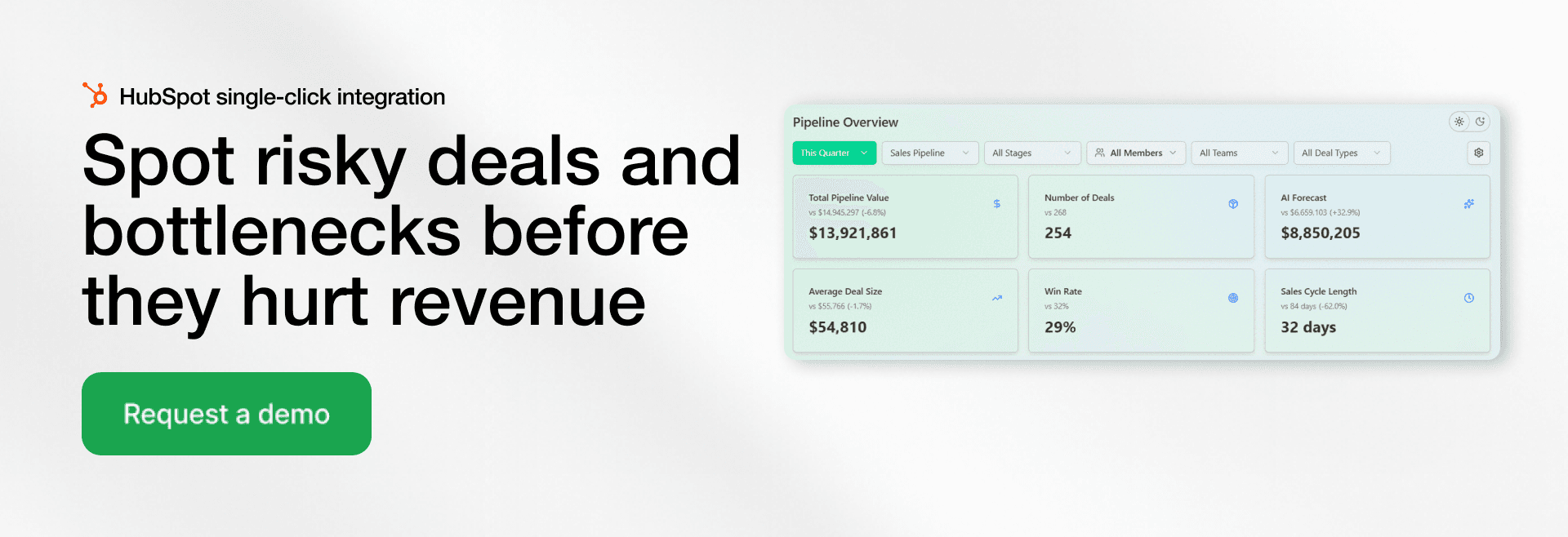
Deal velocity analysis
Deal velocity analysis helps sales leaders understand why deals progress quickly or slowly. It goes beyond averages and looks at patterns, outliers, and stage movement.
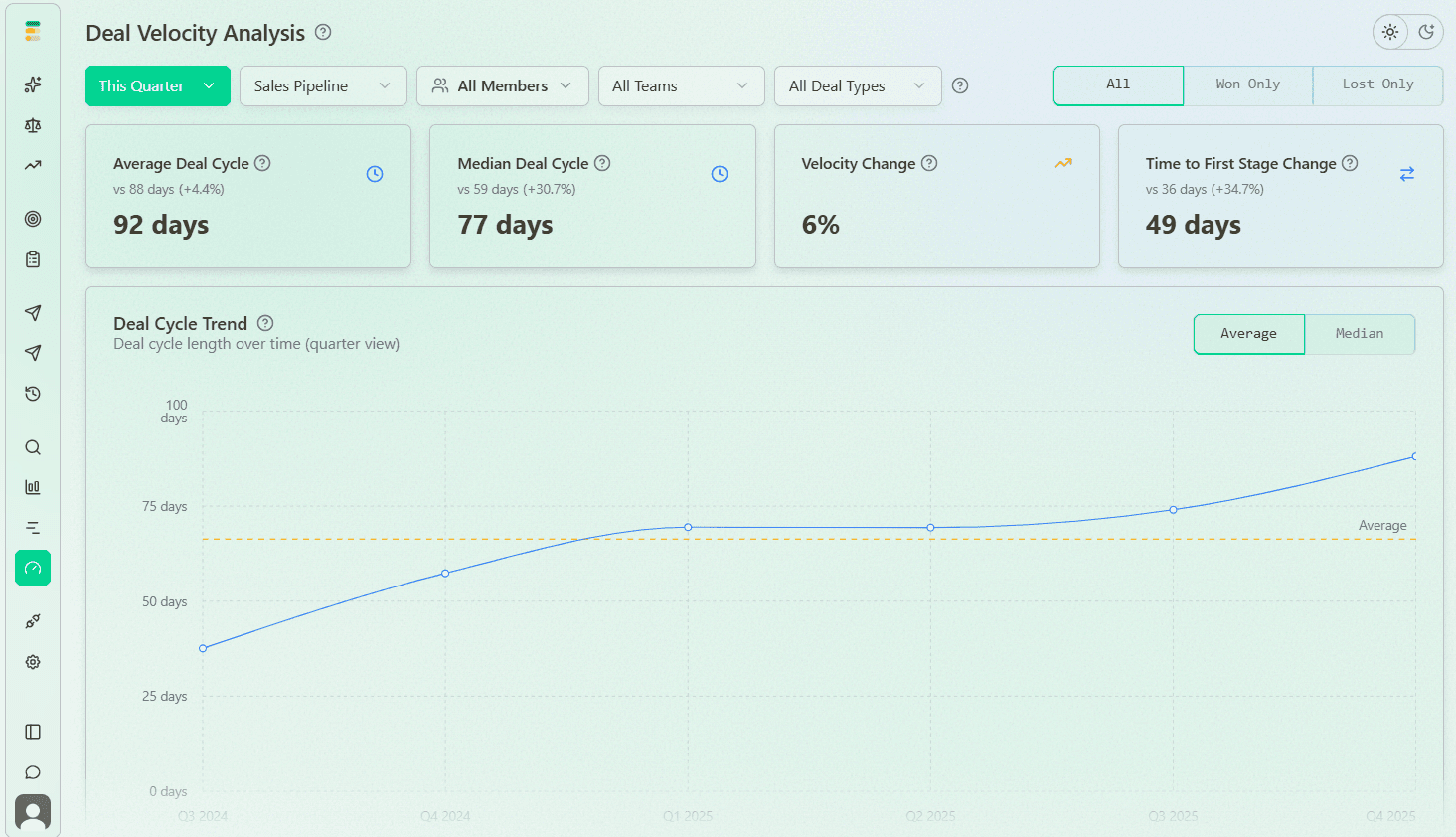
Deal velocity trend over time (average vs median)
An average sales cycle can be distorted by a few extremely long deals. Median values often provide a clearer picture.
Tracking trend lines over time helps you detect:
Seasonal changes
Performance impact of sales training
Effects of new pricing or contract review processes
Velocity breakdown by pipeline stages
Breaking deal velocity by stage shows where deals stall.
For example:
Long delays in contract review
Slow legal team approval
Complex decision making processes with multiple stakeholders
This analysis highlights key metrics and allows for a more efficient sales process.

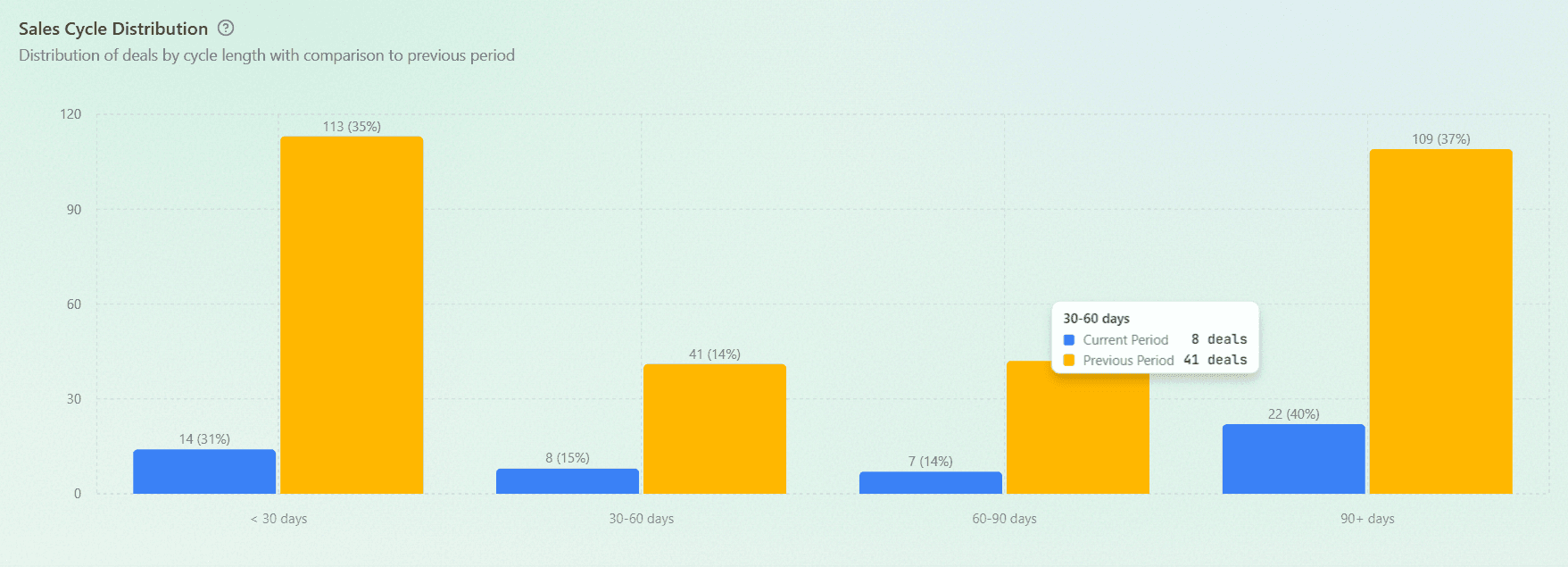
Deal Cycle Distribution
Instead of looking only at average time, analyze distribution:
What percentage closes within 30 days
What percentage takes over 120 days
This reveals patterns in buying process complexity.
Velocity Outliers Analysis
Outliers often reveal hidden problems:
Deals that never move
Deals that suddenly close very quickly
Opportunities with too many sales interactions
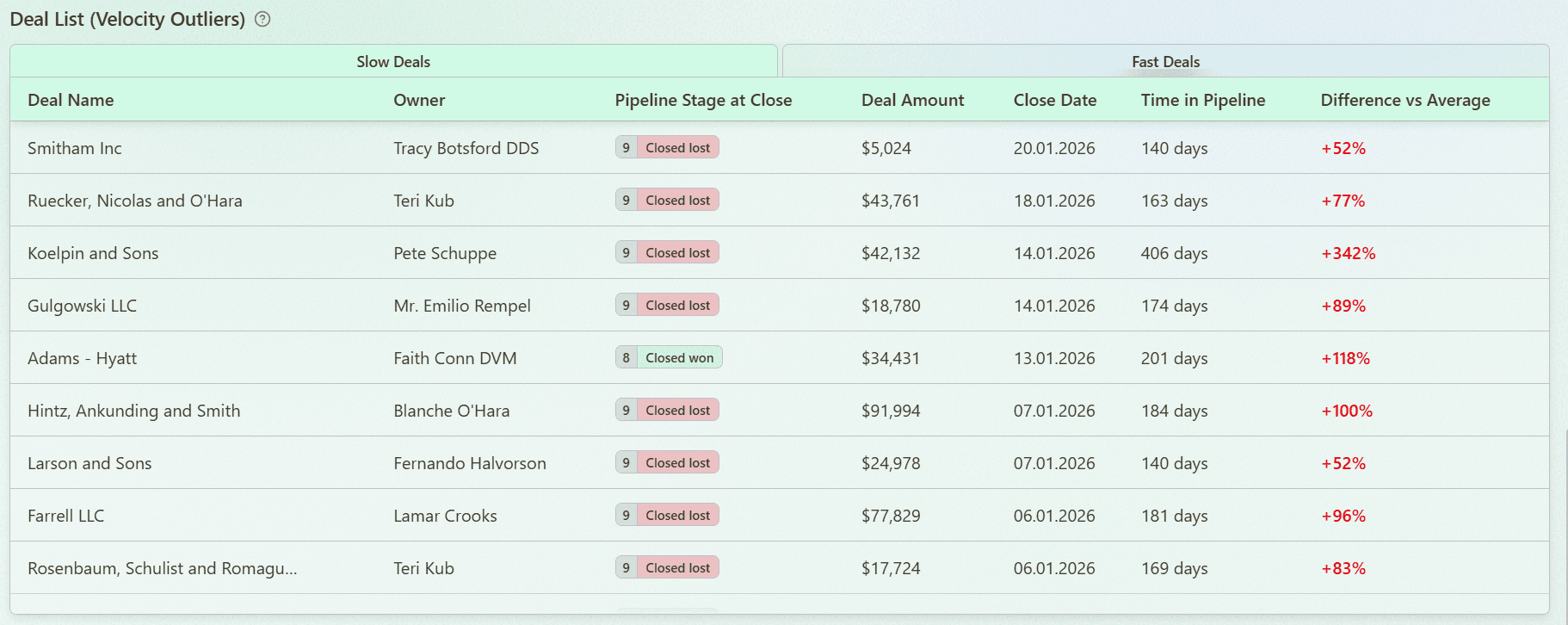
Forecastio provides visibility into deals progress and highlights unusual velocity patterns automatically.
How to improve deal velocity
To improve deal velocity, focus on removing friction and increasing clarity in the sales process. The goal is not to rush prospects but to create a smoother journey.
Improve deal qualification early
The fastest way to improve deal velocity is to stop weak deals from entering the sales pipeline in the first place. Poor qualification leads to longer sales cycles, stalled opportunities, and wasted sales efforts.
Businesses should focus on rigorous lead qualification to increase deal progression speed. Using structured frameworks like MEDDIC helps sales reps evaluate budget, authority, need, decision criteria, and timing before investing too much time. This ensures that only high quality prospects move forward in the sales process.
Early qualification improves:
Win rate
Sales efficiency
Average sales cycle
Overall sales productivity
In addition, building urgency can accelerate deal velocity. Limited-time offers, clear implementation timelines, or defined next steps reduce delays in the buying process. When prospects understand the cost of waiting, decision-making becomes faster.
Strong qualification combined with urgency creates a more efficient sales process and supports sustainable revenue growth.
Remove pipeline bottlenecks
Analyze where deals stall:
Contract review
Legal teams
Internal approvals
Fixing one bottleneck can significantly increase deal speed.
Strengthen stage exit criteria
Each stage should have clear requirements.
For example:
Confirmed budget
Identified multiple stakeholders
Clear next steps
This creates a more efficient sales process and supports sales productivity.
Focus on stalled deals
Regularly review deals with no activity. Deals stall when:
Prospects lose interest
There is no follow up
Complex decision making processes slow momentum
Proactive follow up can accelerate deal progression and increase revenue.
Identify key stakeholders early
One of the biggest reasons for longer sales cycles is late involvement of decision-makers. Many deals stall because multiple stakeholders or legal teams enter the conversation too late in the buying process.
To increase deal speed, sales reps should identify key stakeholders early. This includes economic buyers, influencers, technical evaluators, and final approvers. When all relevant people are engaged early, objections surface sooner and decision-making becomes faster.
Early stakeholder mapping reduces delays, improves win rate, and helps create urgency across the sales organization.
Enhance the product experience
A weak product experience slows deals. Prospects hesitate when value is unclear.
Enhancing the product experience through personalized and interactive content can significantly accelerate deal velocity. This includes tailored demos, ROI simulations, interactive case studies, and clear onboarding previews.
When prospects clearly understand value, objections decrease. Decision-making becomes easier. Deals move quickly through the sales pipeline.
A strong product experience supports a more efficient sales process and reduces the total sales cycle time.
Use AI-powered sales tools
Modern revenue teams rely on AI-powered tools to maintain high deal speed. Manual tracking often misses early warning signs.
AI-powered sales tools provide real-time insights into deal health, stage duration, and pipeline risk. They highlight when deals stall, when sales interactions decrease, or when sales cycle length increases unexpectedly.
This allows sales leaders to act early, not after revenue is lost. Tools like Forecastio help teams monitor deal progression, detect slow-moving opportunities, and improve forecasting accuracy.
Using the right tools increases sales efficiency and supports sustainable revenue growth.
Deal velocity by average deal size
Deal size has a direct impact on deal progression. Larger deals usually involve more stakeholders, more negotiation, and longer decision cycles.
Why larger deals usually move slower
Large deals often require:
Multiple stakeholders
Detailed contract review
Legal team approval
Complex decision making processes
This leads to longer sales cycles and lower high deal speed.
Segmenting velocity by deal size tiers
Segment your pipeline:
Small deals
Mid market deals
Enterprise deals
Each segment has a different average deal size and total sales cycle time.
By tracking deal velocity per segment, sales managers can set realistic expectations and improve forecasting accuracy. Forecastio allows teams to segment deal velocity by deal size, team, or region for better analysis.
Deal velocity and sales forecasting
Deal velocity directly impacts sales forecasting accuracy. If deals move consistently, forecast revenue becomes more predictable.
Using deal velocity for short term forecasts
Short term forecasts rely heavily on:
Current pipeline movement
Average time to close
Number of deals closed recently
High deal velocity increases confidence in short term forecast revenue projections.
Velocity as an early risk signal
A sudden increase in sales cycle length is a warning.
It may signal:
Weak qualification
Lower sales productivity
Problems in the buying process
Because deal velocity is a leading indicator, sales leaders can act before total revenue declines.
How Forecastio helps track deal velocity
Forecastio is built for revenue teams that want clear, real time visibility into deal velocity and overall sales performance.
Real time deal velocity monitoring
Forecastio tracks:
Total deal cycle time
Stage duration
Deals progress across the pipeline
Number of deals closed
Sales leaders can instantly see changes in deal velocity measures.
Automatic detection of slow and stalled deals
The platform highlights:
Deals with no recent activity
Opportunities with unusually long average time in stage
Sudden increases in sales cycle length
This helps teams accelerate deal velocity and prevent revenue leakage.
Velocity insights across teams and sales pipelines
Forecastio allows segmentation by:
Sales pipeline
Sales reps
Revenue teams
This enables a data driven approach to boosting deal velocity, increasing revenue, and supporting overall business growth.
If your goal is to improve deal velocity, increase sales efficiency, and create a more predictable sales organization, tracking deal velocity with the right tools is essential.
FAQ
What does deal velocity mean?
Deal velocity means how fast sales opportunities move through the sales pipeline from initial contact to deals closed. It measures the speed of your sales process and reflects the total sales cycle length. High deal velocity means your sales teams are progressing qualified opportunities efficiently and generating revenue faster. Low deal velocity often signals that deals stall, prospects lose interest, or there are bottlenecks in the buying process. For sales leaders, it is one of the key metrics that impacts forecasting accuracy and overall business growth.
What is the formula for deal velocity?
There is no single universal deal velocity equation like the traditional sales velocity formula. Deal velocity is usually calculated as:
Total sales cycle time ÷ Number of deals closed
In practice, when teams calculate deal velocity, they measure the average time it takes for deals to progress through the pipeline. Some teams also calculate velocity per stage to identify where deals stall.
Unlike sales velocity, deal velocity focuses on time and deal progression, not revenue per day.
What is another word for deal velocity?
There is no perfect synonym, but deal velocity is often described as pipeline speed, deal progression speed, or opportunity movement rate. Some people confuse it with sales velocity, but they are different metrics.
Deal velocity measures how quickly deals progress through the pipeline. Sales velocity measures how quickly revenue is generated based on the number of opportunities, win rate, average deal size, and sales cycle length. Keeping this distinction clear is important for measuring sales velocity correctly.
What is the difference between deal velocity and sales cycle?
The sales cycle is usually measured only for deals closed as won. It shows the total sales cycle length from initial contact to paying customers, but only for successful outcomes.
Deal velocity looks at speed across the whole sales pipeline, not only at won deals. It takes into account all deals and how quickly they progress through stages, including deals that slow down, deals that stall, and deals that are lost.
Share: