Sales Operations Software: The Complete 2026 Guide for B2B Teams

Dec 11, 2025
Dec 11, 2025

Alex Zlotko
CEO at Forecastio
Last updated
Dec 11, 2025
Reading time
13 min
Share:
Share
Table of Contents


What Is Sales Operations Software?
Sales operations software is a set of tools that help sales teams streamline processes, manage data, improve forecasting, and increase overall sales efficiency. It supports sales leaders and ops teams by automating repetitive tasks, creating visibility into the pipeline, and providing accurate analytics for better decision-making. The goal of sales operations software is to make the entire sales engine more predictable, scalable, and data driven.
Definition of Sales Operations
Sales operations is the function responsible for making the entire sales process more predictable and efficient, combining strategy, data, and technology to support the sales team. (See Salesforce’s definition of sales operations for an industry perspective.) A strong sales operations team supports sales reps, improves sales efficiency, manages customer data, and ensures that companies base decisions on data driven insights, not intuition.
Role of Sales Operations in Modern B2B Sales
In modern B2B organizations, sales ops teams act as the backbone of revenue. They run forecasting, reporting, planning, training, and technology management for the entire sales team. They ensure that sales strategy, sales workflow, and operations planning align.
Without a structured approach supported by reliable sales operations tools, even the strongest product or sales methodology will underperform. Companies today rely on accurate demand forecasts, cleaner customer insights, and more efficient sales efforts, which makes sales operations one of the most critical functions in business growth.
What Sales Operations Software Actually Does
Sales operations software centralizes and automates the work of the ops team. It helps with:
data management and contact management
building and maintaining forecasting models
creating accurate forecast data
running comprehensive analytics
managing sales tools and integrations
improving team productivity
providing actionable insights that support closing deals
The right sales operations software helps teams streamline work, reduce data entry, analyze historical data, and improve customer interactions at every stage of the sales cycle.

How Sales Operations Software Supports Sales Leaders and RevOps
Modern sales ops tools help leaders:
Improve sales performance visibility
Measure team capacity and sales readiness
Support data driven decision making
Build repeatable follow up strategies
Identify pipeline risks using advanced analytics
Support RevOps alignment
Platforms like Forecastio, for example, help revenue leaders use AI-powered sales forecasting software to analyze historical sales data, improve sales forecasting accuracy, and produce accurate forecasts without manual spreadsheet work.
Why Sales Operations Software Matters in 2026
Here are a few key factors why sales organizations employ sales operations tools.
The Rise of Data-Driven Sales Teams
Today’s winning sales organizations are built around data analysis, customer engagement, and real-time reporting. Sales operations software provides the structure and visibility needed to turn all the data inside a CRM into meaningful data driven insights. Teams that rely on spreadsheets fall behind, while those with proper tools achieve significant growth. According to Gartner, sales operations are evolving from transactional activities to strategic capability, requiring stronger analytics and cross-functional alignment.
The Shift Toward Automated Revenue Processes
Companies automate more repetitive tasks than ever before.
This is especially true for:
data enrichment tools
sales acceleration software
sales enablement tools
collaboration tools
forecasting and reporting technologies
conversational intelligence
Automation helps reduce operational overhead and allows sales reps to focus on customer interactions and more deals, not admin work.
Why Manual Operations Lead to Low Sales Forecasting Accuracy
When forecasting is manual, teams struggle with:
inconsistent data entry
outdated CRM fields
missing historical data
subjective judgement
This leads to late surprises, missed quotas, and unreliable planning.
Tools like Forecastio replace manual processes with sales forecasting software to improve forecast accuracy, using objective data and AI.
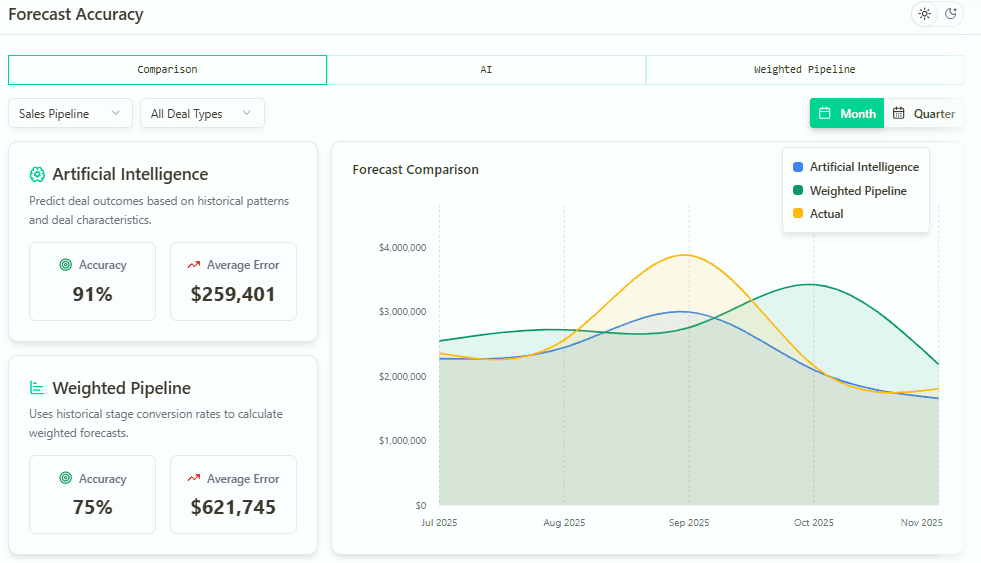
Tracking Forecasting Accuracy with Forecastio
How Sales Operations Software Improves Efficiency and Performance
The right system reduces operational drag and improves team efficiency.
It gives leaders:
more visibility into the sales funnel
clearer insights into open deals
strong alignment with marketing teams
faster operations planning
improved customer satisfaction
This creates a scalable foundation for predictable revenue.
Core Capabilities of Sales Operations Software
This chapter describes what key features sales operations tools should include.
Data Management and CRM Hygiene
Clean customer data is the foundation of efficient sales operations and data-driven decisions.
Good sales operations software enforces:
consistent field usage
correct pipeline stages
accurate segmentation
reliable customer relationship management
standard sales workflow processes
Without good hygiene, automation and analytics break down. Effective data management ensures high-quality records that fuel forecasting, reporting, and analytics, which is why modern CRM platforms invest heavily in structured customer data solutions
Forecasting and Pipeline Visibility
Top tools provide:
Accurate sales forecasts and real-time pipeline insights
AI models that evaluate deal probabilities
insights into sales cycle trends and sales process bottlenecks
alerts for deals at risk of slipping
Forecastio, for example, offers both traditional and AI-driven forecasting models, including deal probability assessment, risky deals detection, and close dates prediction.
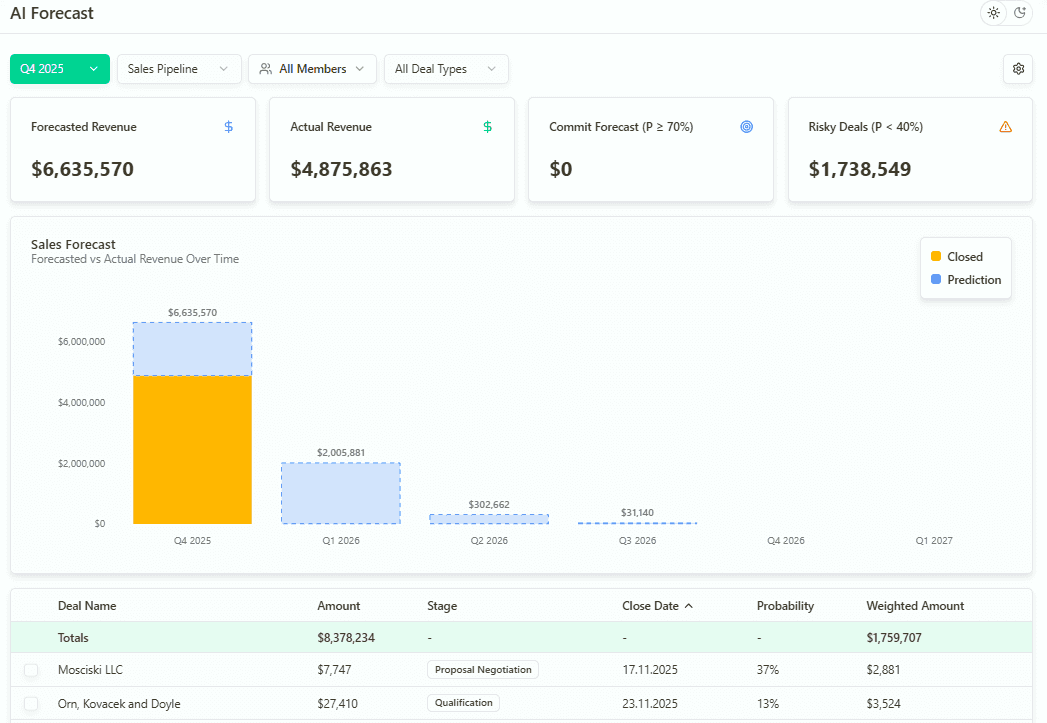
AI Sales Forecasting and Deal Probabilities with Forecastio

Activity Tracking and Sales Performance Measurement
Ops teams rely on comprehensive analytics to understand behaviors and outcomes.
They monitor:
rep activity
email volume
call quality
meeting frequency
pipeline coverage trends
These insights support skills development, coaching, and sales performance improvement.
Automation of Repeatable Tasks and Workflows
Modern sales automation tools can automate tasks like:
email sequences
internal notifications
quote creation
approval processes
lead routing
This increases team productivity and frees ops team capacity for strategic work.
Main Categories of Sales Operations Software
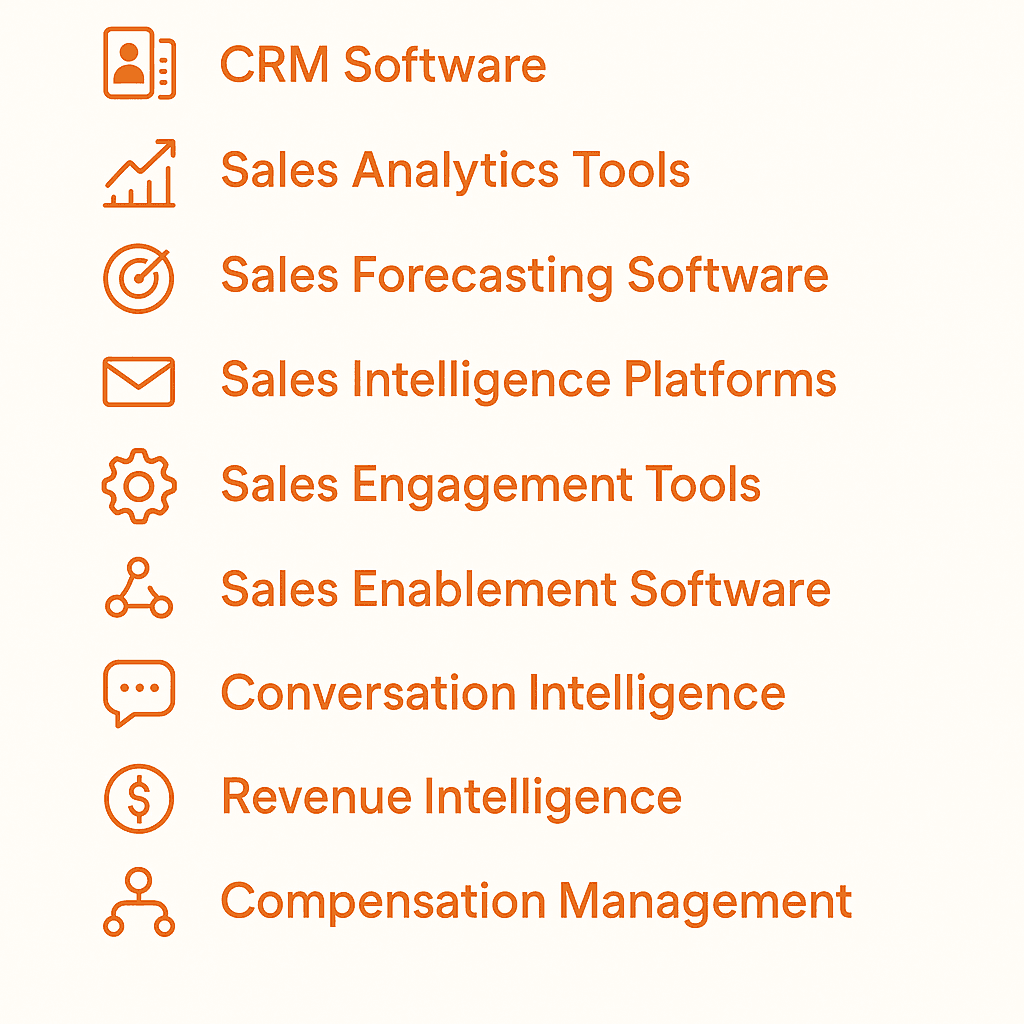
Here is a list of key software categories in the sales operations field.
CRM Software
CRM software is the central system where all customer data, customer interactions, and deal activities are stored. It helps sales ops teams organize the sales process, manage pipelines, and support contact management at scale. A CRM creates structure for the entire sales team, ensuring data consistency and visibility across every stage of the sales cycle. Without a reliable CRM, no other sales operations software or sales tools can function effectively.
Sales Analytics Tools
Sales analytics tools transform raw CRM records into dashboards, performance reports, and data driven insights. They help leaders understand rep activity, pipeline trends, conversion drivers, and bottlenecks in the sales funnel. These tools support sales operations by providing clear, actionable insights for coaching and operational decisions. High-quality analytics solutions also improve sales performance and guide more accurate planning.
Sales Forecasting Software
Sales forecasting software uses historical sales data, pipeline trends, and activity signals to generate accurate forecasts and improve sales forecasting accuracy. Modern tools include AI models, predictive scoring, and automated reporting that reduce manual work for the ops team. Solutions like Forecastio give leaders reliable forecast visibility and support revenue planning with advanced analytics.
Sales Intelligence Platforms
Sales intelligence tools enrich your CRM with company data, technographics, buying intent, and lead insights to improve targeting. These platforms help sales reps prioritize the right accounts and run more effective outbound sales motions. By integrating intelligence into the sales process, ops teams increase prospecting efficiency and improve customer engagement quality. Tools such as LinkedIn Sales Navigator, Apollo, or Zoominfo are common examples of intelligence platforms used by B2B teams.
Sales Engagement Tools
Sales engagement tools help reps automate outreach through email sequences, calling workflows, and multi-step cadences. They reduce repetitive tasks and ensure consistent follow-ups that improve closing deals. These tools also track activity data, helping sales operations analyze rep behavior and enhance sales efficiency. The combination of automation and engagement improves both rep productivity and customer responsiveness.
Sales Enablement Software
Sales enablement tools help sellers access the right sales content, product sheets, competitor assets, and playbooks at the right time. They also support skills development, onboarding, and ongoing coaching for the sales team. These tools ensure reps are prepared for every conversation and improve the overall customer experience. Strong enablement directly impacts quota attainment and team productivity.
Sales Automation Tools
Sales automation tools streamline manual administrative work so that reps can focus on revenue-generating activities. They automate tasks such as lead routing, notifications, approvals, and CRM updates, reducing errors and increasing team efficiency. Automation allows sales operations to build scalable, repeatable processes without adding extra team members. These tools often integrate with CRMs and forecasting systems to power more advanced workflows.
Conversation Intelligence and Call Analysis Tools
Conversation intelligence platforms analyze sales calls, identify patterns, and help managers coach reps more effectively. They capture insights from customer conversations to improve objection handling and customer satisfaction. By feeding engagement data back into CRM or forecasting systems, these tools enhance historical data quality and strengthen predictive models. They are especially useful for improving rep performance and sales readiness.
Revenue Intelligence Software
Revenue intelligence software combines forecasting, analytics, and pipeline inspection into a single platform. It helps leaders understand deal health, identify risks early, and manage the entire sales funnel with deeper clarity. These systems use advanced analytics to consolidate all revenue insights, making planning and coaching far more effective. They support data driven decision making for both sales ops and revenue leadership.
Compensation and Commission Management Tools
These tools automate commission calculations, quota tracking, and payout approvals, removing the friction of spreadsheet-based compensation management. They ensure accuracy, transparency, and trust between reps and leadership. Proper compensation tools also integrate performance data, supporting broader sales operations goals and aligning incentives across the sales team. As companies grow, automated sales compensation management becomes essential to maintaining operational stability and motivation.
Deep Dive: CRM Software for Sales Operations
Every sales process starts in the CRM. Companies rely on crm software to track deals, store customer interactions, and monitor the sales funnel.
Modern CRM platforms remain the foundation of sales operations software, helping teams manage customer data, track activities, and guide deals through the pipeline. Salesforce is the most powerful choice for enterprises due to its customization capabilities. HubSpot and Zoho support small and mid-sized businesses with user-friendly interfaces, while Microsoft Dynamics aligns with companies in the Microsoft ecosystem. Startups often choose Pipedrive for its intuitive pipeline views. CRM selection depends on team size, process complexity, and budget.
Key CRM Features That Support Sales Operations
lead and contact tracking
pipeline management
activity management
Reporting
CRMs increasingly support integrations with sales automation tools, sales enablement, and sales forecasting software, allowing ops teams to build a unified system of record. Platforms like Salesforce and HubSpot offer advanced data management capabilities and built-in automation. When paired with tools like Forecastio, CRMs provide cleaner forecast data, enabling more accurate forecasts and better strategic planning.
CRM Limitations That Require Additional Sales Ops Tools
CRMs rarely provide:
deep advanced analytics
AI forecasting
predictive lead scoring
automated forecasting audits
Because of these limitations, teams often add specialized sales operations software tools. Enterprises adopt tools like Tableau or Power BI for analytics and Clari or Forecastio for advanced forecasting and deal intelligence. The right combination depends on a company’s goals, data needs, and revenue motion.
Deep Dive: Sales Forecasting Software
Forecasting software uses historical and current data to predict revenue, improve pipeline health, and inform decision-making. Clari and Forecastio stand out for AI-powered forecasting and pipeline inspection, while Anaplan is preferred by large enterprises for complex scenario modeling. BoostUp and Aviso offer real-time risk detection and deal scoring for mid-market teams. For smaller businesses, CRM-native tools (like Salesforce Forecasting or HubSpot) may suffice. The trend is shifting from manual spreadsheets to AI-enhanced, automated systems that reduce bias and improve accuracy.
Why Sales Forecasting Is Critical for Revenue Predictability
Companies depend on sales forecasting tools for revenue planning to ensure predictable revenue and proper operations planning. Without reliable forecasts, leaders cannot plan hiring, budgets, or speak to investors.
AI-Driven Forecasting vs. Traditional Weighted Pipeline
Traditional weighted pipelines are simple but often inaccurate. AI-driven models can analyze:
historical data
rep behavior
deal activity
engagement signals
timelines
Tools like Forecastio bring together all these signals using AI-powered sales forecasting software to deliver more accurate predictions and lower costs of inaccurate forecasting.
What Sales Ops Teams Should Look for in Forecasting Tools
A good forecasting solution should include:
easy setup
deep CRM integration
reliable AI models
clear data driven insights
customizable reports
comprehensive forecast audit trail
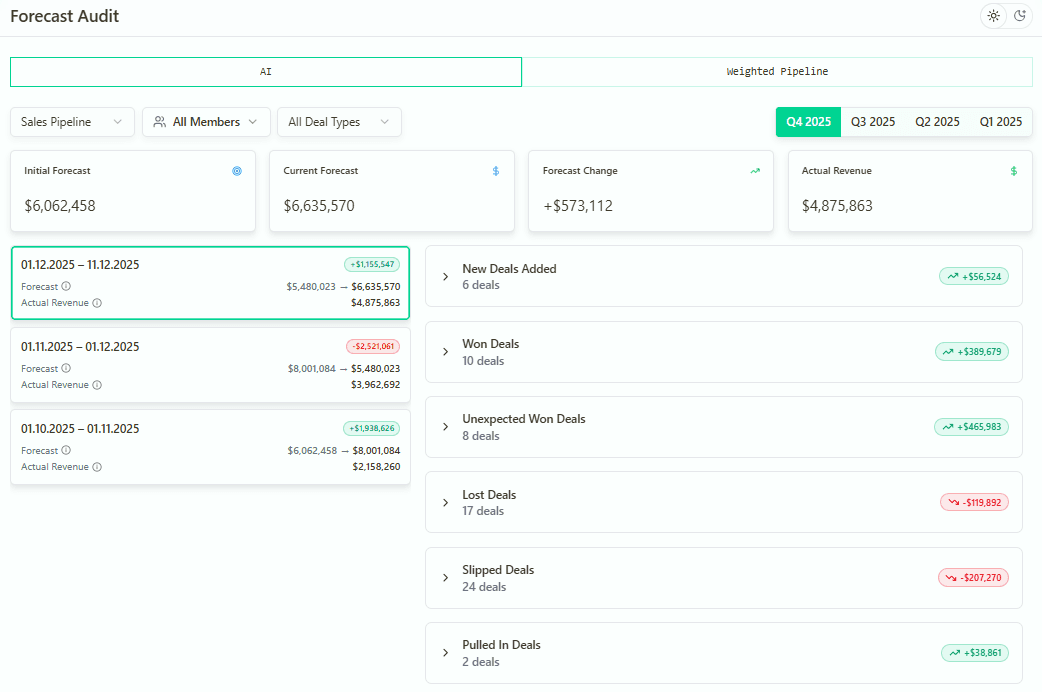
Comprehensive Sales Forecast Audit Trail with Forecastio
It should answer questions like how to choose the best sales forecasting software and support medium sized businesses as well as enterprise teams.

Deep Dive: Sales Analytics and Reporting Tools
Sales analytics tools turn CRM and performance data into insights through dashboards and reports. Clari leads in pipeline and forecast visibility for B2B teams, while Tableau and Power BI are favored for customizable visualizations. HubSpot and Salesforce include native reporting, but BI platforms allow deeper analysis. These tools are essential for identifying bottlenecks, improving rep performance, and tracking KPIs. Enterprises often choose Clari or Tableau for advanced modeling, while SMBs benefit from lighter options like HubSpot analytics or Power BI.
KPIs Every Sales Operations Team Should Track
Sales ops teams must track:
win rates
pipeline velocity
forecast accuracy
quota attainment
activity metrics
customer lifetime value
These KPIs support data driven decision making across the organization.
How Analytics Tools Improve Pipeline and Rep Performance
With the right tools, ops can:
find bottlenecks
support coaching
improve sales efforts
monitor closing deals
evaluate competitor analysis habits
This helps teams achieve consistent performance and significant growth.
Deep Dive: Sales Intelligence and Data Providers
Sales intelligence tools enrich lead data and help reps target the right prospects. ZoomInfo is the enterprise leader with the most comprehensive database, while LinkedIn Sales Navigator is widely used for social selling across all company sizes. Apollo.io combines lead data and email outreach, making it ideal for startups. 6sense and Clearbit offer advanced intent and enrichment features for account-based strategies. These platforms help sales teams prioritize outreach, personalize messages, and increase conversion rates.
How Intelligence Tools Improve Prospecting Quality
Sales intelligence tools offer enriched firmographic data, buying signals, and decision-maker insights.
This leads to:
better targeting
higher outbound efficiency
improved customer satisfaction
more accurate forecast data
When Sales Ops Should Invest in Intelligence Platforms
Ops teams should invest when:
outbound is a major acquisition channel
reps struggle to find qualified prospects
company plans to scale
Tools like LinkedIn Sales Navigator or other intelligence platforms play a vital role.
Deep Dive: Sales Engagement and Automation Platforms
Sales engagement platforms automate outbound communication through email sequences, calling, and follow-ups. Outreach and Salesloft are the leaders for enterprise and mid-market teams, offering robust sequencing and analytics. Groove provides a simpler, Salesforce-integrated option for smaller teams. Apollo.io delivers built-in outreach capabilities for startups. These tools help scale prospecting efforts, keep reps organized, and improve response rates through consistent, multichannel outreach.
What Are Sales Engagement Tools For
These platforms streamline:
email sequences
calling workflows
multichannel outreach
They support sales acceleration efforts that improve rep efficiency.
How Engagement Tools Integrate with Sales Operations Workflows
They feed activity data into CRM and forecasting platforms like Forecastio, enriching historical sales data and helping generate more accurate forecasts.
Deep Dive: Sales Enablement Tools
Sales enablement platforms give reps access to content, training, and coaching resources to close deals more effectively. Highspot and Seismic dominate the enterprise market with AI-driven content management and advanced training capabilities. Showpad and Mindtickle serve mid-market teams with blended content and learning tools. Smaller teams may opt for more affordable or focused tools like SalesHood. Enablement platforms reduce onboarding time, increase rep confidence, and ensure consistent messaging across the sales team.
What Sales Enablement Tools Provide
Enablement tools store:
pitch decks
product sheets
case studies
competitor battle cards
They ensure sellers always have access to the best sales content. Sales enablement tools also include training and coaching features to support skills development, onboarding, and learning
Deep Dive: Compensation and Commission Management Tools
Compensation and commission management tools automate complex payout structures, reduce admin work, and ensure fair, transparent compensation for sales teams. Xactly and Varicent dominate the enterprise market with powerful rule engines and compliance-focused capabilities.
CaptivateIQ and Spiff appeal to mid-market and fast-growing teams thanks to their flexible logic, modern UI, and fast setup. Smaller organizations often choose Everstage or QuotaPath for their simplicity, quick onboarding, and real-time rep dashboards. These platforms reduce manual errors, improve rep motivation, and help companies maintain accurate compensation operations at scale.
What Compensation and Commission Management Tools Provide
Compensation platforms automate:
commission calculations
quota attainment tracking
payout approvals
earnings dashboards
They ensure reps always understand how their performance translates into earnings. Compensation tools also integrate with CRM and forecasting systems, helping revenue teams align incentives, improve accuracy, and eliminate spreadsheet-driven mistakes.
How to Choose the Right Sales Operations Software
Here is what to look for when selecting sales operations software.
Start With Your Sales Ops Maturity Level
Choosing the right sales operations software begins with understanding where your team stands today. Early-stage companies often need simple sales tools to manage customer data, automate basics, and improve sales workflow efficiency. More mature organizations require deeper functionality like sales forecasting software, advanced analytics, and automation that supports complex sales operations processes. Evaluating your maturity ensures you invest in tools that match your current needs while allowing room for growth.
Evaluate Your CRM Limitations
Your CRM defines what your sales operations team can and cannot do. If your CRM lacks robust reporting, automation, or integration support, layering additional sales operations tools becomes essential. Teams using HubSpot or Salesforce often rely on add-on platforms like Forecastio to improve sales forecasting accuracy, pipeline visibility, and operational insights. Understanding CRM gaps helps you avoid tool overlap and ensures you build a scalable system.
Define Sales Operations Metrics That Matter for Your Team
Before investing, teams should decide which KPIs matter most: sales performance, pipeline velocity, quota attainment, or accurate forecasts. Different tools excel in different areas-analytics tools help track rep activity, while AI-powered sales forecasting software improves prediction quality using historical sales data. Identifying priority metrics ensures you select technologies that strengthen decision-making and support meaningful improvements across your sales process.
Integration Depth With HubSpot or Salesforce
Your sales operations software must integrate seamlessly with your CRM to avoid fragmented data and duplicated workflows. Deep integrations support better data management, more reliable forecast data, and stronger collaboration across revenue teams. Poor integration leads to inefficiency and inaccurate reporting.
Total Cost of Ownership: Tools vs. All-in-One Platforms
It's easy to underestimate the cost of managing multiple disconnected tools. Subscription fees, admin time, onboarding, and maintenance all contribute to total cost of ownership. Larger organizations may choose an all-in-one platform for centralized sales operations, while medium sized businesses may prefer modular tools. Consider whether a single tool can replace several smaller ones, reducing complexity and improving alignment.
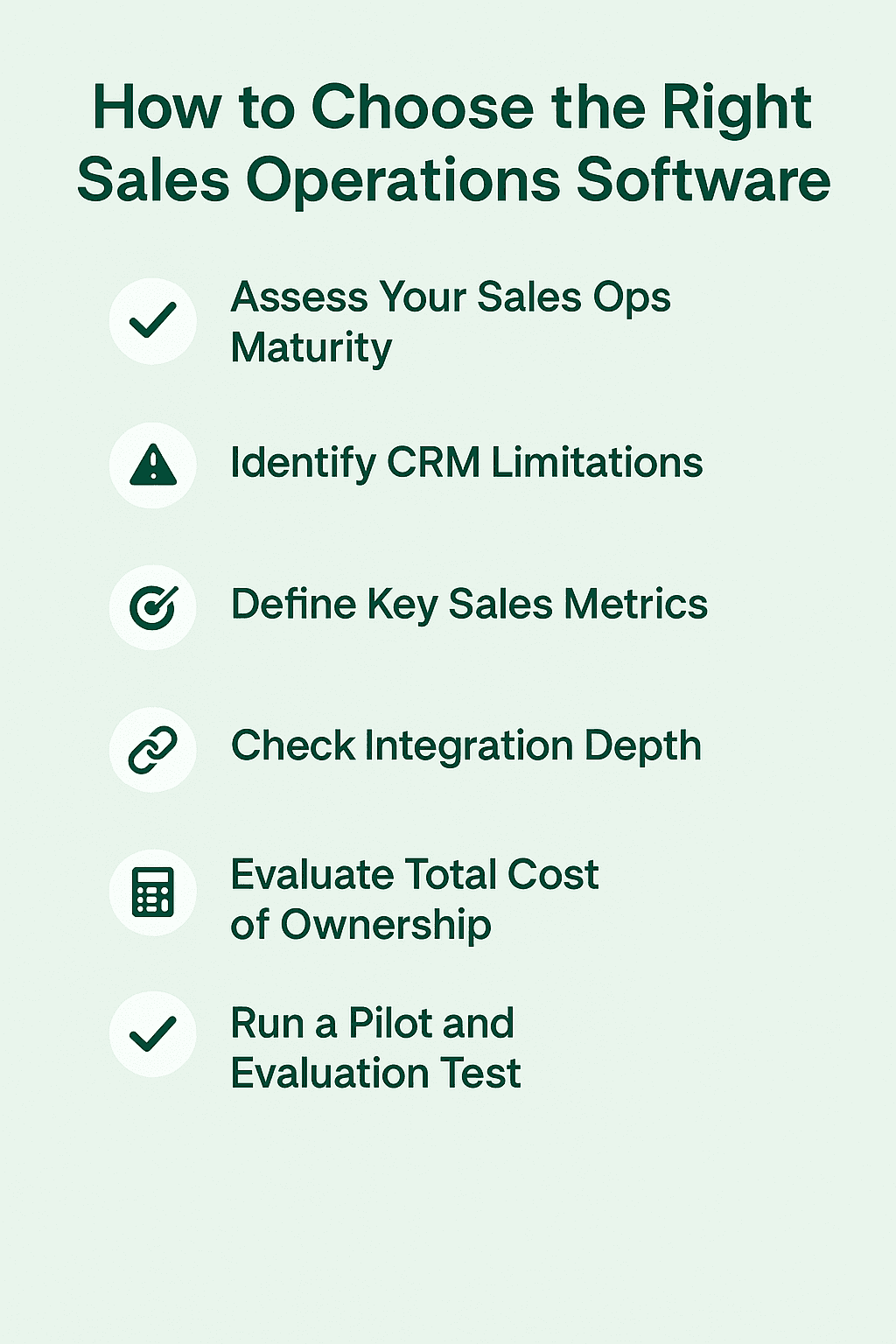
Trial, Pilot, and Evaluation Framework for Sales Ops Teams
Always test new software in real conditions before committing. Run a structured pilot using real deals, real reps, and a defined evaluation period. Measure improvements in sales efficiency, pipeline visibility, and sales forecasting accuracy to ensure the tool delivers value. A clear evaluation framework helps revenue leaders avoid low-adoption tools and select solutions that genuinely enhance the sales operations software stack.
Evaluate categories like Sales & Ops Planning software to ensure your tools support collaboration across sales, finance, and operations teams - a key driver of predictable and scalable growth.
The Future of Sales Operations Software
Here are the key strategic areas where sales operations software will evolve.
AI-Powered Sales Operations
AI will redefine how sales operations work by automating analysis, predicting outcomes, and eliminating manual tasks. Instead of relying on spreadsheets or subjective judgment, teams will use AI-powered sales forecasting software to evaluate deal health, identify risks, and improve accuracy. AI will also enhance sales automation tools, helping revenue teams scale operations without increasing headcount. This shift will make AI a mandatory component of modern sales operations software.
Predictive and Prescriptive Analytics
The next wave of analytics goes beyond reporting what happened, it will predict what will happen and prescribe actions. Tools that deliver data driven insights will guide reps on which deals to prioritize, suggest the best follow-up strategy, and reveal bottlenecks in the sales funnel. Predictive analytics will analyze historical data, customer behavior, and rep activity to support smarter operations planning. This will help sales leaders make faster and more accurate decisions.
Unified Sales Leadership Platforms
The future belongs to platforms that combine forecasting, analytics, pipeline management, and coaching into one unified system. Instead of stitching together multiple point solutions, companies will adopt platforms that integrate sales forecasting tools, deal intelligence, and performance insights. Solutions like Forecastio are already moving in this direction by offering forecasting, pipeline risk detection, and actionable insights in one place. This consolidation will simplify tech stacks and improve forecasting accuracy across revenue teams.
The Shift Toward End-to-End Revenue Operating Systems
Sales operations is evolving into a broader discipline that covers marketing, customer success, and finance. Future platforms will integrate sales enablement tools, analytics, and compensation systems into a single operating layer. These end-to-end systems will eliminate data silos and create a unified view of customer interactions, revenue performance, and pipeline health. As companies scale, they will rely on connected ecosystems to support strategic planning, closing deals, and driving significant growth.
What Is Sales Operations Software?
Sales operations software is a set of tools that help sales teams streamline processes, manage data, improve forecasting, and increase overall sales efficiency. It supports sales leaders and ops teams by automating repetitive tasks, creating visibility into the pipeline, and providing accurate analytics for better decision-making. The goal of sales operations software is to make the entire sales engine more predictable, scalable, and data driven.
Definition of Sales Operations
Sales operations is the function responsible for making the entire sales process more predictable and efficient, combining strategy, data, and technology to support the sales team. (See Salesforce’s definition of sales operations for an industry perspective.) A strong sales operations team supports sales reps, improves sales efficiency, manages customer data, and ensures that companies base decisions on data driven insights, not intuition.
Role of Sales Operations in Modern B2B Sales
In modern B2B organizations, sales ops teams act as the backbone of revenue. They run forecasting, reporting, planning, training, and technology management for the entire sales team. They ensure that sales strategy, sales workflow, and operations planning align.
Without a structured approach supported by reliable sales operations tools, even the strongest product or sales methodology will underperform. Companies today rely on accurate demand forecasts, cleaner customer insights, and more efficient sales efforts, which makes sales operations one of the most critical functions in business growth.
What Sales Operations Software Actually Does
Sales operations software centralizes and automates the work of the ops team. It helps with:
data management and contact management
building and maintaining forecasting models
creating accurate forecast data
running comprehensive analytics
managing sales tools and integrations
improving team productivity
providing actionable insights that support closing deals
The right sales operations software helps teams streamline work, reduce data entry, analyze historical data, and improve customer interactions at every stage of the sales cycle.

How Sales Operations Software Supports Sales Leaders and RevOps
Modern sales ops tools help leaders:
Improve sales performance visibility
Measure team capacity and sales readiness
Support data driven decision making
Build repeatable follow up strategies
Identify pipeline risks using advanced analytics
Support RevOps alignment
Platforms like Forecastio, for example, help revenue leaders use AI-powered sales forecasting software to analyze historical sales data, improve sales forecasting accuracy, and produce accurate forecasts without manual spreadsheet work.
Why Sales Operations Software Matters in 2026
Here are a few key factors why sales organizations employ sales operations tools.
The Rise of Data-Driven Sales Teams
Today’s winning sales organizations are built around data analysis, customer engagement, and real-time reporting. Sales operations software provides the structure and visibility needed to turn all the data inside a CRM into meaningful data driven insights. Teams that rely on spreadsheets fall behind, while those with proper tools achieve significant growth. According to Gartner, sales operations are evolving from transactional activities to strategic capability, requiring stronger analytics and cross-functional alignment.
The Shift Toward Automated Revenue Processes
Companies automate more repetitive tasks than ever before.
This is especially true for:
data enrichment tools
sales acceleration software
sales enablement tools
collaboration tools
forecasting and reporting technologies
conversational intelligence
Automation helps reduce operational overhead and allows sales reps to focus on customer interactions and more deals, not admin work.
Why Manual Operations Lead to Low Sales Forecasting Accuracy
When forecasting is manual, teams struggle with:
inconsistent data entry
outdated CRM fields
missing historical data
subjective judgement
This leads to late surprises, missed quotas, and unreliable planning.
Tools like Forecastio replace manual processes with sales forecasting software to improve forecast accuracy, using objective data and AI.

Tracking Forecasting Accuracy with Forecastio
How Sales Operations Software Improves Efficiency and Performance
The right system reduces operational drag and improves team efficiency.
It gives leaders:
more visibility into the sales funnel
clearer insights into open deals
strong alignment with marketing teams
faster operations planning
improved customer satisfaction
This creates a scalable foundation for predictable revenue.
Core Capabilities of Sales Operations Software
This chapter describes what key features sales operations tools should include.
Data Management and CRM Hygiene
Clean customer data is the foundation of efficient sales operations and data-driven decisions.
Good sales operations software enforces:
consistent field usage
correct pipeline stages
accurate segmentation
reliable customer relationship management
standard sales workflow processes
Without good hygiene, automation and analytics break down. Effective data management ensures high-quality records that fuel forecasting, reporting, and analytics, which is why modern CRM platforms invest heavily in structured customer data solutions
Forecasting and Pipeline Visibility
Top tools provide:
Accurate sales forecasts and real-time pipeline insights
AI models that evaluate deal probabilities
insights into sales cycle trends and sales process bottlenecks
alerts for deals at risk of slipping
Forecastio, for example, offers both traditional and AI-driven forecasting models, including deal probability assessment, risky deals detection, and close dates prediction.

AI Sales Forecasting and Deal Probabilities with Forecastio

Activity Tracking and Sales Performance Measurement
Ops teams rely on comprehensive analytics to understand behaviors and outcomes.
They monitor:
rep activity
email volume
call quality
meeting frequency
pipeline coverage trends
These insights support skills development, coaching, and sales performance improvement.
Automation of Repeatable Tasks and Workflows
Modern sales automation tools can automate tasks like:
email sequences
internal notifications
quote creation
approval processes
lead routing
This increases team productivity and frees ops team capacity for strategic work.
Main Categories of Sales Operations Software
Here is a list of key software categories in the sales operations field.
CRM Software
CRM software is the central system where all customer data, customer interactions, and deal activities are stored. It helps sales ops teams organize the sales process, manage pipelines, and support contact management at scale. A CRM creates structure for the entire sales team, ensuring data consistency and visibility across every stage of the sales cycle. Without a reliable CRM, no other sales operations software or sales tools can function effectively.
Sales Analytics Tools
Sales analytics tools transform raw CRM records into dashboards, performance reports, and data driven insights. They help leaders understand rep activity, pipeline trends, conversion drivers, and bottlenecks in the sales funnel. These tools support sales operations by providing clear, actionable insights for coaching and operational decisions. High-quality analytics solutions also improve sales performance and guide more accurate planning.
Sales Forecasting Software
Sales forecasting software uses historical sales data, pipeline trends, and activity signals to generate accurate forecasts and improve sales forecasting accuracy. Modern tools include AI models, predictive scoring, and automated reporting that reduce manual work for the ops team. Solutions like Forecastio give leaders reliable forecast visibility and support revenue planning with advanced analytics.
Sales Intelligence Platforms
Sales intelligence tools enrich your CRM with company data, technographics, buying intent, and lead insights to improve targeting. These platforms help sales reps prioritize the right accounts and run more effective outbound sales motions. By integrating intelligence into the sales process, ops teams increase prospecting efficiency and improve customer engagement quality. Tools such as LinkedIn Sales Navigator, Apollo, or Zoominfo are common examples of intelligence platforms used by B2B teams.
Sales Engagement Tools
Sales engagement tools help reps automate outreach through email sequences, calling workflows, and multi-step cadences. They reduce repetitive tasks and ensure consistent follow-ups that improve closing deals. These tools also track activity data, helping sales operations analyze rep behavior and enhance sales efficiency. The combination of automation and engagement improves both rep productivity and customer responsiveness.
Sales Enablement Software
Sales enablement tools help sellers access the right sales content, product sheets, competitor assets, and playbooks at the right time. They also support skills development, onboarding, and ongoing coaching for the sales team. These tools ensure reps are prepared for every conversation and improve the overall customer experience. Strong enablement directly impacts quota attainment and team productivity.

Sales Automation Tools
Sales automation tools streamline manual administrative work so that reps can focus on revenue-generating activities. They automate tasks such as lead routing, notifications, approvals, and CRM updates, reducing errors and increasing team efficiency. Automation allows sales operations to build scalable, repeatable processes without adding extra team members. These tools often integrate with CRMs and forecasting systems to power more advanced workflows.
Conversation Intelligence and Call Analysis Tools
Conversation intelligence platforms analyze sales calls, identify patterns, and help managers coach reps more effectively. They capture insights from customer conversations to improve objection handling and customer satisfaction. By feeding engagement data back into CRM or forecasting systems, these tools enhance historical data quality and strengthen predictive models. They are especially useful for improving rep performance and sales readiness.
Revenue Intelligence Software
Revenue intelligence software combines forecasting, analytics, and pipeline inspection into a single platform. It helps leaders understand deal health, identify risks early, and manage the entire sales funnel with deeper clarity. These systems use advanced analytics to consolidate all revenue insights, making planning and coaching far more effective. They support data driven decision making for both sales ops and revenue leadership.
Compensation and Commission Management Tools
These tools automate commission calculations, quota tracking, and payout approvals, removing the friction of spreadsheet-based compensation management. They ensure accuracy, transparency, and trust between reps and leadership. Proper compensation tools also integrate performance data, supporting broader sales operations goals and aligning incentives across the sales team. As companies grow, automated sales compensation management becomes essential to maintaining operational stability and motivation.
Deep Dive: CRM Software for Sales Operations
Every sales process starts in the CRM. Companies rely on crm software to track deals, store customer interactions, and monitor the sales funnel.
Modern CRM platforms remain the foundation of sales operations software, helping teams manage customer data, track activities, and guide deals through the pipeline. Salesforce is the most powerful choice for enterprises due to its customization capabilities. HubSpot and Zoho support small and mid-sized businesses with user-friendly interfaces, while Microsoft Dynamics aligns with companies in the Microsoft ecosystem. Startups often choose Pipedrive for its intuitive pipeline views. CRM selection depends on team size, process complexity, and budget.
Key CRM Features That Support Sales Operations
lead and contact tracking
pipeline management
activity management
Reporting
CRMs increasingly support integrations with sales automation tools, sales enablement, and sales forecasting software, allowing ops teams to build a unified system of record. Platforms like Salesforce and HubSpot offer advanced data management capabilities and built-in automation. When paired with tools like Forecastio, CRMs provide cleaner forecast data, enabling more accurate forecasts and better strategic planning.
CRM Limitations That Require Additional Sales Ops Tools
CRMs rarely provide:
deep advanced analytics
AI forecasting
predictive lead scoring
automated forecasting audits
Because of these limitations, teams often add specialized sales operations software tools. Enterprises adopt tools like Tableau or Power BI for analytics and Clari or Forecastio for advanced forecasting and deal intelligence. The right combination depends on a company’s goals, data needs, and revenue motion.
Deep Dive: Sales Forecasting Software
Forecasting software uses historical and current data to predict revenue, improve pipeline health, and inform decision-making. Clari and Forecastio stand out for AI-powered forecasting and pipeline inspection, while Anaplan is preferred by large enterprises for complex scenario modeling. BoostUp and Aviso offer real-time risk detection and deal scoring for mid-market teams. For smaller businesses, CRM-native tools (like Salesforce Forecasting or HubSpot) may suffice. The trend is shifting from manual spreadsheets to AI-enhanced, automated systems that reduce bias and improve accuracy.
Why Sales Forecasting Is Critical for Revenue Predictability
Companies depend on sales forecasting tools for revenue planning to ensure predictable revenue and proper operations planning. Without reliable forecasts, leaders cannot plan hiring, budgets, or speak to investors.
AI-Driven Forecasting vs. Traditional Weighted Pipeline
Traditional weighted pipelines are simple but often inaccurate. AI-driven models can analyze:
historical data
rep behavior
deal activity
engagement signals
timelines
Tools like Forecastio bring together all these signals using AI-powered sales forecasting software to deliver more accurate predictions and lower costs of inaccurate forecasting.
What Sales Ops Teams Should Look for in Forecasting Tools
A good forecasting solution should include:
easy setup
deep CRM integration
reliable AI models
clear data driven insights
customizable reports
comprehensive forecast audit trail

Comprehensive Sales Forecast Audit Trail with Forecastio
It should answer questions like how to choose the best sales forecasting software and support medium sized businesses as well as enterprise teams.

Deep Dive: Sales Analytics and Reporting Tools
Sales analytics tools turn CRM and performance data into insights through dashboards and reports. Clari leads in pipeline and forecast visibility for B2B teams, while Tableau and Power BI are favored for customizable visualizations. HubSpot and Salesforce include native reporting, but BI platforms allow deeper analysis. These tools are essential for identifying bottlenecks, improving rep performance, and tracking KPIs. Enterprises often choose Clari or Tableau for advanced modeling, while SMBs benefit from lighter options like HubSpot analytics or Power BI.
KPIs Every Sales Operations Team Should Track
Sales ops teams must track:
win rates
pipeline velocity
forecast accuracy
quota attainment
activity metrics
customer lifetime value
These KPIs support data driven decision making across the organization.
How Analytics Tools Improve Pipeline and Rep Performance
With the right tools, ops can:
find bottlenecks
support coaching
improve sales efforts
monitor closing deals
evaluate competitor analysis habits
This helps teams achieve consistent performance and significant growth.
Deep Dive: Sales Intelligence and Data Providers
Sales intelligence tools enrich lead data and help reps target the right prospects. ZoomInfo is the enterprise leader with the most comprehensive database, while LinkedIn Sales Navigator is widely used for social selling across all company sizes. Apollo.io combines lead data and email outreach, making it ideal for startups. 6sense and Clearbit offer advanced intent and enrichment features for account-based strategies. These platforms help sales teams prioritize outreach, personalize messages, and increase conversion rates.
How Intelligence Tools Improve Prospecting Quality
Sales intelligence tools offer enriched firmographic data, buying signals, and decision-maker insights.
This leads to:
better targeting
higher outbound efficiency
improved customer satisfaction
more accurate forecast data
When Sales Ops Should Invest in Intelligence Platforms
Ops teams should invest when:
outbound is a major acquisition channel
reps struggle to find qualified prospects
company plans to scale
Tools like LinkedIn Sales Navigator or other intelligence platforms play a vital role.
Deep Dive: Sales Engagement and Automation Platforms
Sales engagement platforms automate outbound communication through email sequences, calling, and follow-ups. Outreach and Salesloft are the leaders for enterprise and mid-market teams, offering robust sequencing and analytics. Groove provides a simpler, Salesforce-integrated option for smaller teams. Apollo.io delivers built-in outreach capabilities for startups. These tools help scale prospecting efforts, keep reps organized, and improve response rates through consistent, multichannel outreach.
What Are Sales Engagement Tools For
These platforms streamline:
email sequences
calling workflows
multichannel outreach
They support sales acceleration efforts that improve rep efficiency.
How Engagement Tools Integrate with Sales Operations Workflows
They feed activity data into CRM and forecasting platforms like Forecastio, enriching historical sales data and helping generate more accurate forecasts.
Deep Dive: Sales Enablement Tools
Sales enablement platforms give reps access to content, training, and coaching resources to close deals more effectively. Highspot and Seismic dominate the enterprise market with AI-driven content management and advanced training capabilities. Showpad and Mindtickle serve mid-market teams with blended content and learning tools. Smaller teams may opt for more affordable or focused tools like SalesHood. Enablement platforms reduce onboarding time, increase rep confidence, and ensure consistent messaging across the sales team.
What Sales Enablement Tools Provide
Enablement tools store:
pitch decks
product sheets
case studies
competitor battle cards
They ensure sellers always have access to the best sales content. Sales enablement tools also include training and coaching features to support skills development, onboarding, and learning
Deep Dive: Compensation and Commission Management Tools
Compensation and commission management tools automate complex payout structures, reduce admin work, and ensure fair, transparent compensation for sales teams. Xactly and Varicent dominate the enterprise market with powerful rule engines and compliance-focused capabilities.
CaptivateIQ and Spiff appeal to mid-market and fast-growing teams thanks to their flexible logic, modern UI, and fast setup. Smaller organizations often choose Everstage or QuotaPath for their simplicity, quick onboarding, and real-time rep dashboards. These platforms reduce manual errors, improve rep motivation, and help companies maintain accurate compensation operations at scale.
What Compensation and Commission Management Tools Provide
Compensation platforms automate:
commission calculations
quota attainment tracking
payout approvals
earnings dashboards
They ensure reps always understand how their performance translates into earnings. Compensation tools also integrate with CRM and forecasting systems, helping revenue teams align incentives, improve accuracy, and eliminate spreadsheet-driven mistakes.
How to Choose the Right Sales Operations Software
Here is what to look for when selecting sales operations software.
Start With Your Sales Ops Maturity Level
Choosing the right sales operations software begins with understanding where your team stands today. Early-stage companies often need simple sales tools to manage customer data, automate basics, and improve sales workflow efficiency. More mature organizations require deeper functionality like sales forecasting software, advanced analytics, and automation that supports complex sales operations processes. Evaluating your maturity ensures you invest in tools that match your current needs while allowing room for growth.
Evaluate Your CRM Limitations
Your CRM defines what your sales operations team can and cannot do. If your CRM lacks robust reporting, automation, or integration support, layering additional sales operations tools becomes essential. Teams using HubSpot or Salesforce often rely on add-on platforms like Forecastio to improve sales forecasting accuracy, pipeline visibility, and operational insights. Understanding CRM gaps helps you avoid tool overlap and ensures you build a scalable system.
Define Sales Operations Metrics That Matter for Your Team
Before investing, teams should decide which KPIs matter most: sales performance, pipeline velocity, quota attainment, or accurate forecasts. Different tools excel in different areas-analytics tools help track rep activity, while AI-powered sales forecasting software improves prediction quality using historical sales data. Identifying priority metrics ensures you select technologies that strengthen decision-making and support meaningful improvements across your sales process.
Integration Depth With HubSpot or Salesforce
Your sales operations software must integrate seamlessly with your CRM to avoid fragmented data and duplicated workflows. Deep integrations support better data management, more reliable forecast data, and stronger collaboration across revenue teams. Poor integration leads to inefficiency and inaccurate reporting.
Total Cost of Ownership: Tools vs. All-in-One Platforms
It's easy to underestimate the cost of managing multiple disconnected tools. Subscription fees, admin time, onboarding, and maintenance all contribute to total cost of ownership. Larger organizations may choose an all-in-one platform for centralized sales operations, while medium sized businesses may prefer modular tools. Consider whether a single tool can replace several smaller ones, reducing complexity and improving alignment.

Trial, Pilot, and Evaluation Framework for Sales Ops Teams
Always test new software in real conditions before committing. Run a structured pilot using real deals, real reps, and a defined evaluation period. Measure improvements in sales efficiency, pipeline visibility, and sales forecasting accuracy to ensure the tool delivers value. A clear evaluation framework helps revenue leaders avoid low-adoption tools and select solutions that genuinely enhance the sales operations software stack.
Evaluate categories like Sales & Ops Planning software to ensure your tools support collaboration across sales, finance, and operations teams - a key driver of predictable and scalable growth.
The Future of Sales Operations Software
Here are the key strategic areas where sales operations software will evolve.
AI-Powered Sales Operations
AI will redefine how sales operations work by automating analysis, predicting outcomes, and eliminating manual tasks. Instead of relying on spreadsheets or subjective judgment, teams will use AI-powered sales forecasting software to evaluate deal health, identify risks, and improve accuracy. AI will also enhance sales automation tools, helping revenue teams scale operations without increasing headcount. This shift will make AI a mandatory component of modern sales operations software.
Predictive and Prescriptive Analytics
The next wave of analytics goes beyond reporting what happened, it will predict what will happen and prescribe actions. Tools that deliver data driven insights will guide reps on which deals to prioritize, suggest the best follow-up strategy, and reveal bottlenecks in the sales funnel. Predictive analytics will analyze historical data, customer behavior, and rep activity to support smarter operations planning. This will help sales leaders make faster and more accurate decisions.
Unified Sales Leadership Platforms
The future belongs to platforms that combine forecasting, analytics, pipeline management, and coaching into one unified system. Instead of stitching together multiple point solutions, companies will adopt platforms that integrate sales forecasting tools, deal intelligence, and performance insights. Solutions like Forecastio are already moving in this direction by offering forecasting, pipeline risk detection, and actionable insights in one place. This consolidation will simplify tech stacks and improve forecasting accuracy across revenue teams.
The Shift Toward End-to-End Revenue Operating Systems
Sales operations is evolving into a broader discipline that covers marketing, customer success, and finance. Future platforms will integrate sales enablement tools, analytics, and compensation systems into a single operating layer. These end-to-end systems will eliminate data silos and create a unified view of customer interactions, revenue performance, and pipeline health. As companies scale, they will rely on connected ecosystems to support strategic planning, closing deals, and driving significant growth.
Share:

Alex is the CEO at Forecastio, bringing over 15 years of experience as a seasoned B2B sales expert and leader in the tech industry. His expertise lies in streamlining sales operations, developing robust go-to-market strategies, enhancing sales planning and forecasting, and refining sales processes.
Related articles
Revenue Operations
Nov 28, 2025
14 min
Revenue Operations
Nov 28, 2025
14 min
Nov 20, 2025
12 min
Nov 20, 2025
12 min
Nov 3, 2025
8 min
Nov 3, 2025
8 min
Revenue Operations
Nov 28, 2025
14 min
Nov 20, 2025
12 min
Revenue Operations
Nov 28, 2025
14 min
Nov 20, 2025
12 min
Sales Planning
Sales Forecasting
Sales Performance Insights
Sales Planning
Sales Forecasting
Sales Performance Insights
Sales Planning
Sales Forecasting
Sales Performance Insights
© 2025 Forecastio, All rights reserved.
Sales Planning
Sales Forecasting
Sales Performance Insights
Sales Planning
Sales Forecasting
Sales Performance Insights
Sales Planning
Sales Forecasting
Sales Performance Insights
© 2025 Forecastio, All rights reserved.
Sales Planning
Sales Forecasting
Sales Performance Insights
Sales Planning
Sales Forecasting
Sales Performance Insights
Sales Planning
Sales Forecasting
Sales Performance Insights
© 2025 Forecastio, All rights reserved.
Sales Planning
Sales Forecasting
Sales Performance Insights
Sales Planning
Sales Forecasting
Sales Performance Insights
Sales Planning
Sales Forecasting
Sales Performance Insights
© 2025 Forecastio, All rights reserved.