How AI is Transforming Business Forecasting Beyond Traditional Analytics
Cybernews Editorial Team
Technology & AI Editorial Team


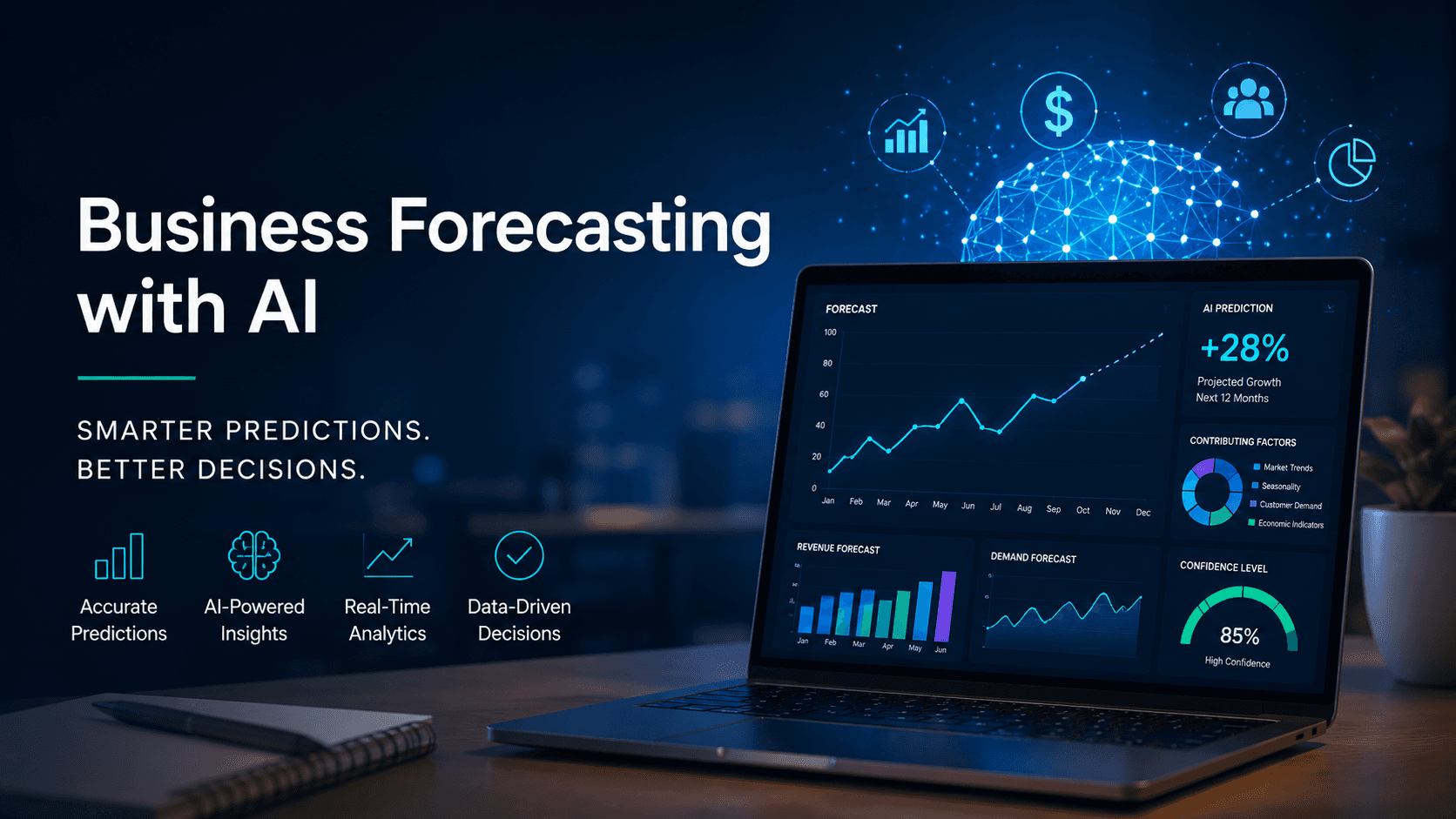
Business forecasting sometimes feels like magic. For business owners, it means reading the market and consumer behavior to perfectly time a product launch, run ads, and switch marketing strategies. If you’ve ever seen a business post that “fits the season”, then you’ve seen business forecasting done right. Basically, knowing when to switch things up is what business forecasting is all about, and it’s what keeps businesses relevant no matter how dramatic the market gets.
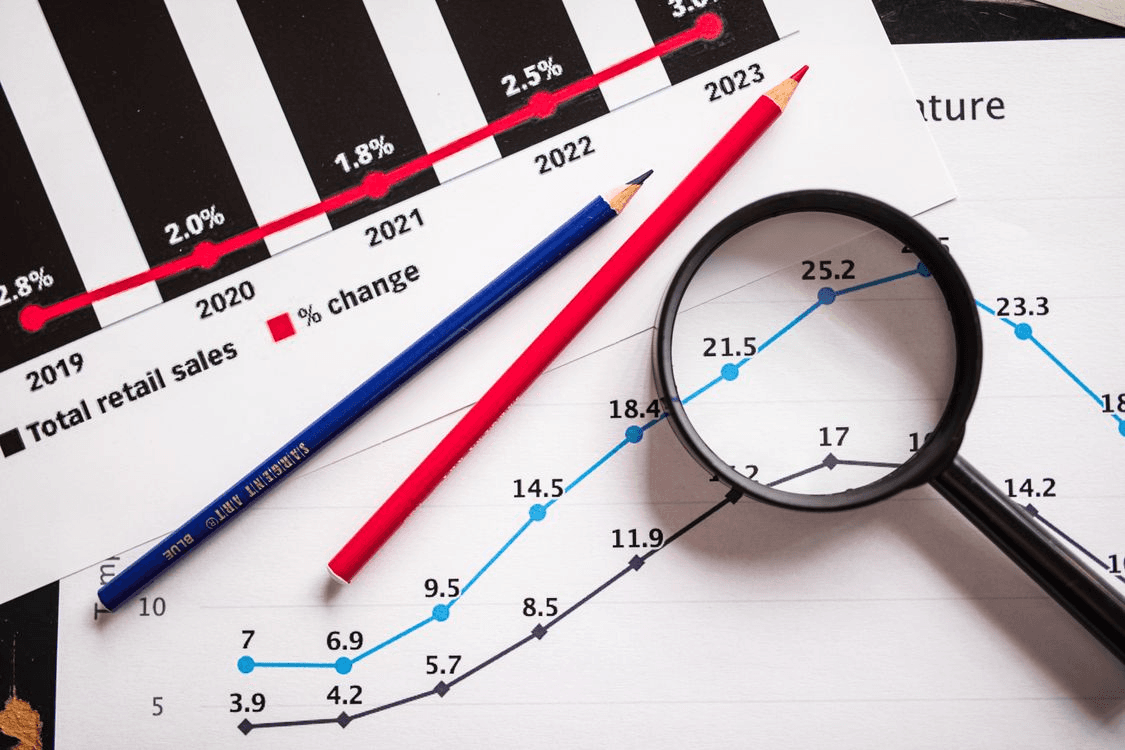
Photo by RDNE Stock project from Pexels: https://www.pexels.com/photo/colored-pencils-and-a-magnifying-glass-over-documents-with-graphs-7948055/
Traditionally, business forecasting involves carefully analysing historical market data, trends, and consumer behavior to predict changes in demand. For instance, a clothing brand knows when to switch from its summer to winter catalog by observing key data like climate reports, consumer behavior, and the rising trend in winter wear. If it were a global brand serving different markets, it would then tailor both its ad campaigns and catalogs to fit each market’s latest demand.
As with every form of analytics, business forecasting takes time and care. You need the right market analytics tools to monitor and collate real-time data, the patience to accurately interpret the data, and the speed to switch up your business strategy in time to align with the market. Typically, this costs a lot and is only really affordable for big businesses. But that leaves out small-to-medium scale businesses who have to resort to erratic DIY (do-it-yourself) methods such as observing competitor strategies and manually monitoring consumer platforms for trends. Thankfully, AI is here to level the playing field.
AI in Business Forecasting
Simply speaking, AI in business forecasting is about using AI to analyze real-time market trends to predict demand. Rather than manually reading market charts, historical data, and monitoring consumer lifestyle platforms, you can simply link an AI to your data source and let it do the heavy lifting.
By design, AI thrives on data scraping, analytics, and recommendations. Once it has a data source, all it needs is the right commands to appropriately interpret the data. Seeing as business forecasting is primarily about monitoring the market and adjusting to fit, it’s quite easy to see how AI blends into it. Link it up with real-time market data and give commands for it to automatically run analysis.
Summarily, dedicated AI tools for business forecasting rely on 3 key things to operate: machine learning, natural language processing, and neural network composition.
Machine Learning:
This is basically AI learning with data. By design, AI relies on massive chunks of data to operate. Once it has a data source, it can intrinsically assess, categorize, and interpret data without additional input. Think of AI like a memorizer that stores information and unique instructions, and can recollect at a moment’s notice.
Natural Language Processing:
This is where AI trumps traditional tools for data analysis. While traditional tools for business forecasting need specialized training and rely on unique commands, communicating with AI tools is intuitive. By design, AI tools are trained on natural language. As such, they understand and can execute commands written in simple language, a practice known as prompt engineering. In fact, their systems are optimized to understand context and overlook minor errors like typos, which traditional tools were bad at.
Thanks to their natural language processing ability, working with AI tools needs no intense training or unique programming language. The only major training required is that a user learns to be as detailed and as specific as possible when prompting AI. Simply put, generic commands will give generic results. It all boils down to how refined your prompt is.
Deep Learning (Neural Network Composition):
As reported by Cybernews, deep learning is an advanced level of machine learning where AI mimics how the human brain works by building neural networks to act on instinct. Here, data processing goes beyond storage and categorization to context assessment, pattern recognition, and prediction. In this case, data isn’t treated in a linear manner with rigid context and results. Instead, AI adapts in real-time to assess more complex scenarios. It’s a much more refined process that allows AI to factor in exceptions and unforeseen contexts to properly interpret data and make informed decisions, much like humans.
5 Key Benefits of AI in Business Forecasting
A lot has changed since AI was introduced to business forecasting. Rather than acting reactively to market changes, businesses can now observe the market and make informed decisions in real-time. This is primarily because most AI tools for business forecasting are designed to scrape online market data in real-time. This ensures that the data being analyzed is always up-to-date. Connect this with the simplicity of interacting with AI, and you’d find that AI tools are the real game changers in business forecasting.
As such, here are 5 real benefits of AI in business forecasting:

Photo by Tima Miroshnichenko from Pexels: https://www.pexels.com/photo/close-up-view-of-system-hacking-5380618/
Real-time Monitoring, Collation, and Processing of Big Data
Unlike traditional business forecasting models that make predictions based on “old news”, dedicated AI tools focus on what’s happening right now. Typically, this means scraping the internet for past and present data. Given the size of the web, real-time market monitoring requires observing, gathering, and processing massive amounts of data, which is nearly impossible for traditional systems. To process a fraction of market data that AI can easily handle, a traditional model would typically need to download multiple spreadsheets, buy periodic market reports, and manually trace consumer purchases. But with AI, the process is automated to scrape, assess, categorize, and monitor the collated data in real time.
What’s more? Most market charts require expert knowledge to read and analyze. But thanks to AI being able to process data via natural language, it makes market data more readable. As such, AI isn’t just relying on complex charts, but also obtaining real-time market info from news articles, social media posts, local trends, and competitor insights. Businesses can also analyse content shared by UGC creators to better understand customer sentiment, identify emerging trends, and make more informed forecasting decisions.
Faster and More Accurate Interpretation of Market Data
Usually, data collation is the easier bit of business forecasting. The real challenge lies in making sense of it. For traditional models, this means bringing in expert analysts to carefully sort and interpret the collected data. Typically, the process starts by sorting or categorizing data in hopes of spotting “obvious” patterns. While sorting is helpful, it doesn’t really provide clarity on finer details. As such, the whole process of sorting and interpreting takes weeks to months of intense work, with massive cost overheads for hiring experts and getting the necessary resources.
When you consider the fact that market fluctuations are unpredictable, you’d quickly realize that taking weeks to process data and then adjusting your business strategies to fit said data recommendations might be a fruitless errand. Why? By the time the data is fully processed and insights given, the market would have already changed, thus leaving the insights functionally useless.
But AI shifts this intense time-sensitive workload from weeks to a matter of seconds. This follows AI’s ability to collect and sort massive amounts of data in real-time with ease. Since the process is automated, collecting and sorting are done at once. Then, interpretation takes the same pace once the necessary instructions are given. For more adept AI tools with more independence, collecting, sorting, interpretation, and insights are executed at once. Expectedly, this leaves business owners with the minimal task of occasionally approving the AI’s recommendation.
Pattern Recognition over Uncertain Intuition
Although it’s easy to say that AI doesn’t understand nuance like human experts, that doesn’t mean human intuition is a perfect system. While human intuition may be helpful with nuances, it’s largely a psychological gamble. An expert might read meanings to market trends based on gut feelings and unspopretation of collected data by human experts.
But with AI, there’s a sense of consistency and learning. Since AI is consistently logical and relies on mathematical probability, it treats data like hard facts instead of depending on vague hints or “gut feelings”. As such, it’s able to detect repetitions in a dataset that paint unique pictures. And since the machine learning cognitive biases like recency and confirmation bias. Sometimes, the bias pays off, and sometimes it fails. This lack of consistent results makes it harder to trust the inters with every assessment of data, the knowledge compounds over time such that its interpretation is consistently clear and factors every probability. Basically, there’s no room for unprovable “what if’s”.
Just like the old saying “garbage in, garbage out”, if AI’s data source and interpretation parameters are flawed, then the results will be consistently flawed. But, with AI’s ability to learn and adapt, it’s a lot easier to detect and rectify errors.
Predictive Insights and Real-time Support for Decision Making
As with all forms of business forecasting, gathering and processing data is done with one goal in mind: predict the market. While experts are often meticulous with their analysis under traditional forecasting models, there’s often a disclaimer attached to their reports. Basically, prediction reports come with some uncertainty that says “this isn’t 100% guaranteed”. Usually, the uncertainty lies in the limited amount of data assessed and also the time taken to conclude the assessment and formulate the report.
But there’s less uncertainty with AI. When you combine AI’s ability to process large amounts of data, recognize patterns, and quickly rectify errors in its data assessment, you’re left with a clear and comprehensive market report in a short while. Rather than waiting weeks for an analyst’s report that may be functionally obsolete by the time it gets to you, AI ensures that your market analysis is done in the blink of an eye, with practical action plans waiting for your approval.
Photo by Nemuel Sereti from Pexels: https://www.pexels.com/photo/programming-code-on-screen-6424584/
Faster Optimization and Deployment of Market Strategies
Typically, once a market forecasting report is ready, the next line of action is to act on the recommendations quickly before the opportunity vanishes. But that typically takes too long in a traditional model. Apart from being slow in analyzing market data, traditional forecasting models often need a series of slow meetings and executive sign-offs before recommendations can be executed. Unfortunately, even if the market forecasting report and strategies are accurate, by the time they’re deployed there’s a risk of being functionally redundant. But that’s where the strength of AI is seen in strategy deployment.
Beyond being able to quickly process data, AI market reports and recommendations are designed for prompt deployment. Since AI operates as a central autonomous system, all its processes are optimized for quick deployment. From data collection to processing, prediction reporting, and strategy creation, deployment time is compacted from a matter of weeks to minutes depending on when human approval is given.
An added advantage of AI working as a central autonomous system is that collaboration is seamless. Rather than waiting for multiple meetings, key stakeholders whose approval or oversight may be needed for deployment can be added to the AI’s central communication system to receive timely alerts. This way, everyone gets the report at the same time, and feedback can be sent concurrently for either modification or deployment.
Conclusion
If there’s any key lesson in running a business, it’s that you must be able to learn, adapt, and deploy quickly. Failings, whether by human error or bad data, are inevitable, but recovery depends on how quickly you iterate and bounce back. With AI, adapting quickly is a non-issue, and that’s why it’s gradually taking center stage in business forecasting.
Think about it. Being able to monitor the market in real-time, assess large chunks of data in seconds, and consistently detect market patterns are fundamental to effectively predicting where the market is heading. When fully realized, the five listed benefits of AI would form a seamless automated loop that operates at an unimaginable speed.
Sadly, the best market analysts are not as fast or as detailed as AI currently is. A humbling contrast is the fact that while there’s a limit to how efficient a human analyst may be, no matter the level of expertise, AI currently wins in efficiency and is projected to be much more optimized in the coming years. The days when AI is seen as fast but flawed and unsafe are creeping away, and this time AI is faster while still maintaining optimal accuracy and data security.
Share: